The post Don’t Care About Anything? Enjoy Life Again, Through COVID-19 appeared first on Supportiv.
]]>A surprising number of us feel this way — especially now that we’re stuck in our houses 24/7 due to COVID-19, unsure of what the future looks like! The uncertainty gives everything else a sort of pointless edge.
Whether your experience is depression-related or coronavirus-related, there’s a name for it: anhedonia. And the exercise below can help you beat it right away.
It’s worth taking a look at what anhedonia is, how it happens to you, and a foolproof way to help you enjoy things you used to love again!
If you feel like you aren’t enjoying life anymore, and want to talk to someone about it, there are people here for you. You can chat anonymously on Supportiv, 24/7, with people who know how anhedonia feels.
What is Anhedonia?
Anhedonia is an inability or reduced ability to feel pleasure, enjoyment, and engagement with life. It can also include reduced motivation to do things. You may feel like you don’t care about anything anymore since nothing feels good or brings you fulfillment.
With anhedonia, your interest in things you used to love doing diminishes. That feeling of “wanting” or “liking” things is decreased, and you may not even know why.
Anhedonia is known to especially affect those who experience major depression, PTSD, or other mood struggles. However, even if you don’t have any mental health diagnoses, you may still experience anhedonia. Anyone can find themselves stuck saying: “I don’t care about anything anymore.”
There are various factors that may have set off your anhedonia, such as:
- Depression
- Complex trauma
- Substance addiction
- Abuse
- A major illness or disability
- Loss of a loved one
- Grief
- Social isolation due to COVID-19 and shelter-in-place
You may feel a general sense of not caring about anything, or your anhedonia might be a more specific sub-type:
Social Anhedonia
Social anhedonia is the withdrawal or isolation/exclusion from social activities. This brings about a disinterest or lack of pleasure in doing things of a social nature, like hanging out with friends, attending a party or event, avoiding malls and other public places. Social anhedonia may possibly related to isolation and loneliness, because you don’t care about anything that has to do with socializing. As humans, we are sustained by social interactions – there is a need for being in the presence of others and communicating with them. This is vital for our physical and mental well-being.
Physical Anhedonia
Our ability to receive comfort from touch or be intimate is greatly diminished because of physical anhedonia. If you are a person who enjoys physical activities such as playing sports, exercising, or even sex, developing physical anhedonia can be extremely detrimental to your mental well-being. Causes of physical anhedonia can be trauma, physical disabilities, or sexual dysfunction.
Another factor of physical anhedonia can be attributed to your other senses – eating, smelling, hearing and seeing. You may experience a lack of enjoyment and pleasure from eating your favorite foods, inhaling nostalgic scents, listening to music, or watching movies. Your feeling of “I don’t care about anything” can even cause you to neglect your body.
How Anhedonia Occurs – The Neuroscience Behind It
Scientists and researchers believe that anhedonia occurs as a result of a few factors combined: dysfunction in our brains’ reward systems, environmental factors, and vulnerable genes.
In simpler words, a broken reward system in our brains can’t make us feel pleasure (reward) from doing and feeling things. Environmental factors (such as trauma or grief) may give us a negative feeling about doing things. And if we also have vulnerable genes, our brain’s reward system is tricked into ignoring pleasurable things.
This creates an abnormal reward system, where we don’t feel much of anything, even if good things are happening – we stop feeling pleasure from doing things we used to love!


Break Through Anhedonia with This Exercise!
Do you need a change of scenery from this “I don’t care about anything” mood? Great, let’s get off our asses and actually try to enjoy the things we love, while kicking anhedonia to the curb!
This exercise is adapted from Dr. Robert Duff’s book, F*** Depression. With a name like that, you know it’s not just ordinary advice from a psychologist! Here’s what you need:
- Pen
- Paper
- Motivation (Urgh!)
Step 1
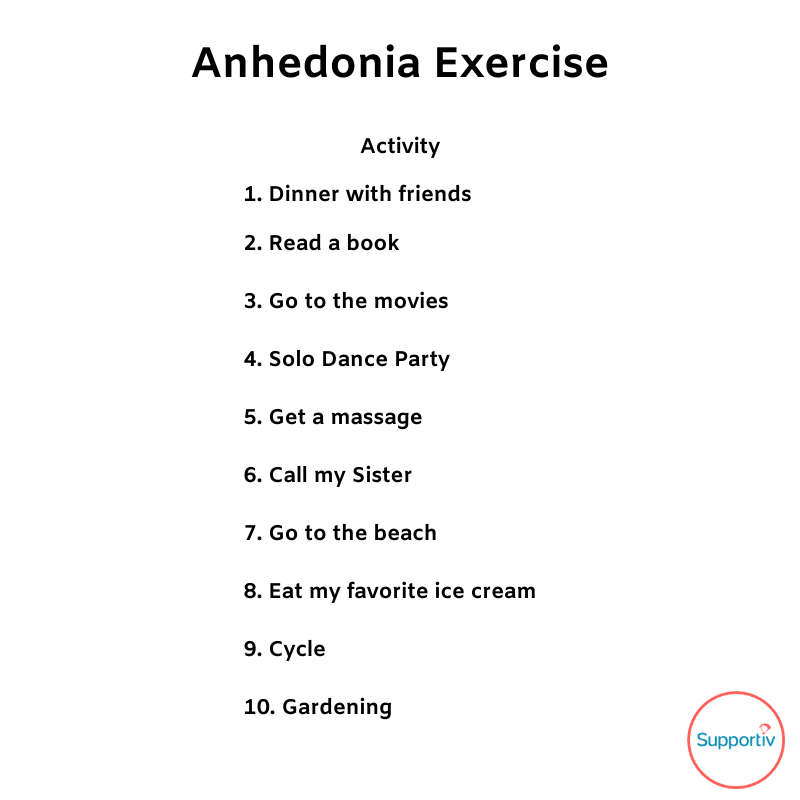
So, on your piece of paper, write down 10 things that you have enjoyed doing in the past. Things that brought you pleasure, happiness, joy – all the warm fuzzies. If you’re struggling in self-isolation due to coronavirus, this list should consist of things you enjoy which can be done indoors.
You can list these in any order. Let’s not be lame and write boring things.
Think about stuff you actually did that made you laugh, that you have great memories of! No matter how little you can feel right now, you have definitely felt good at some point in life — even inside the house.
The reason for this is to identify the things that once made you feel alive, but which you now probably can’t imagine yourself doing (since they now give you little enjoyment, or since you’re stuck in the house).
You can check out my personal list below.
Step 2
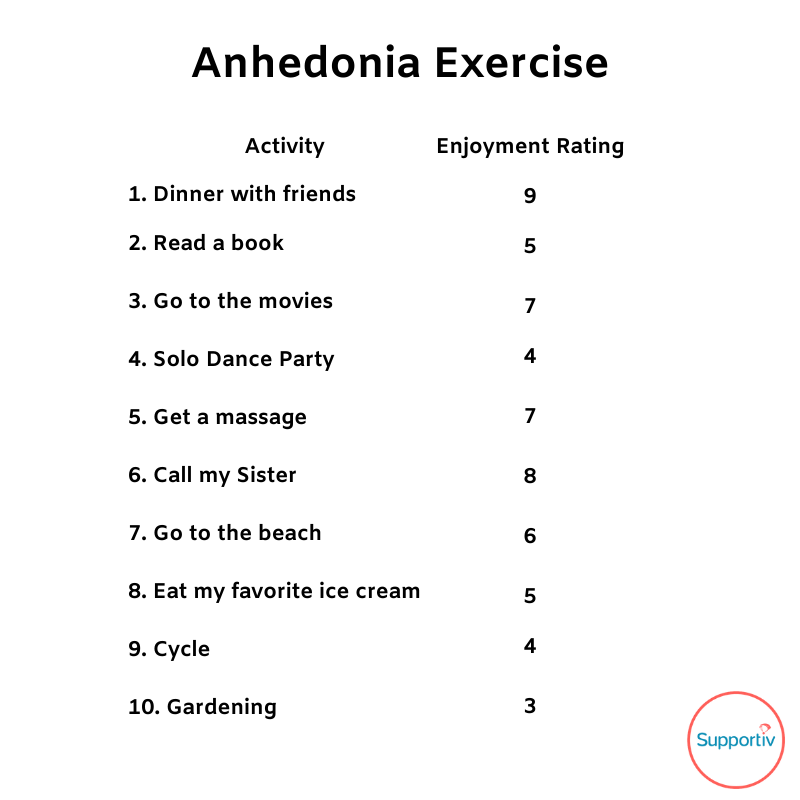
Once you’ve got your list ready, think about how much excitement, happiness and pleasure each of these activities bring you and rate each one. On a scale of 1 to 10 (with 1 being “it completely sucks” and 10 being “this rocks my world”), write the level of enjoyment each activity brings you — as if they were all completely effortless. This is how I rated my activities:
Step 3
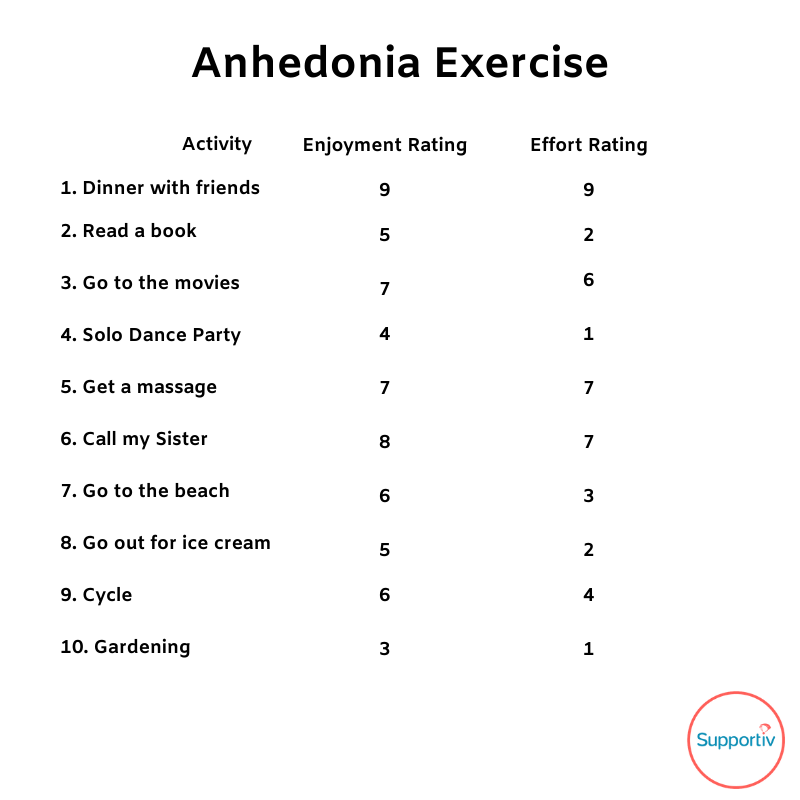
Next, think about how difficult the activity is for you to do – like how much effort, time, planning goes into actually doing it. So again, from 1 to 10 (with 1 being pretty easy and 10 being “Hell NO”), rate each activity on your list.
See my list below. In contrast to how much pleasure these activities (used to) bring you, you can also see how difficult they are to do.
Step 4
Now comes the fun part – okay, maybe more introspection than fun. Last step! In this part of the exercise, you want to find the tradeoff between your enjoyment and the effort required to do each thing.
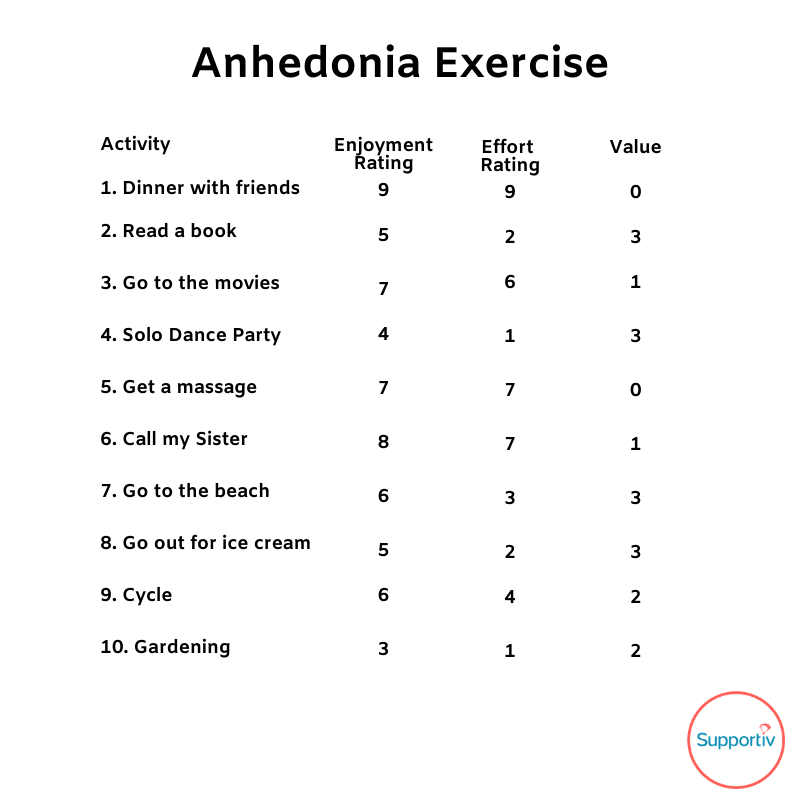
To do this, subtract (minus) the effort rating from the enjoyment rating. For example, on the activity of reading a book, my enjoyment rating is 5 and my effort rating is 2. Therefore, the value of my activity is 3 (5 – 2 = 3). Do this for each of your activities like below.
The Result
After you’ve found the tradeoff “value” for each activity, look at the activities with the highest value number. These will likely be the easiest for you to accomplish, while bringing you the most enjoyment.
Now the key is to act on these activities, even if you have to force yourself. Start planning to do your high value activities as soon as possible, because they have the best chance at bringing you some enjoyment.
Doing the easier and more pleasurable ones first may motivate you to keep going. This way, you can build your brain’s reward systems back up, until you start magically wanting to do things off the list!
But just saying you’re going to get it done doesn’t work! Turn your piece of paper around and write down the dates and times for you to try each thing you used to love. Hold yourself to these dates and try your best to just try doing them – even if you bail after 5 or 10 minutes, you tried!
Moral support available right here! Actually trying this stuff can be the hardest part of healing from anhedonia.
The purpose of this exercise is to kick anhedonia to the curb. So even if you don’t start enjoying things at first go – keep trying and be consistent.
Once you’re sort of enjoying the highest value activities, try to work on those lower value ones too. Don’t be too hard on yourself, and have patience. With some effort, you really can recover your ability to care about things!
If you need some moral support or motivation to tackle your anhedonia, we’re here 24/7 to chat.
The post Don’t Care About Anything? Enjoy Life Again, Through COVID-19 appeared first on Supportiv.
]]>The post After Trauma: Post Traumatic Growth and Liminal Space appeared first on Supportiv.
]]>How Trauma Changes Us
I am a trauma survivor. In October of 2016, I survived an assault, and prior to that, I’d undergone a very substantial amount of trauma during my childhood and teen years that had already left me with a diagnosis of PTSD.
In my life, I have met a lot of other people who have survived trauma, and what always strikes me about these individuals is the resiliency and wisdom that they carry.
I have met people who are extraordinarily happy despite having been through tremendous amounts of trauma; at the same time, I have met people who identify with no substantial hardship, who feel as though life is happening to them, they’re trapped, or they are just generally unhappy.
That said, there is no value judgement on whether or not we’ve experienced trauma. We all have our own path, and you don’t have to go through tragedy to suffer or to grow.
But while trauma is not a virtue, it can be a unique teacher–of very important lessons that all of us need to learn, trauma or not. Many survivors take these lessons from their life circumstances or from piecing themselves back together after threatening or painful experiences.
What Is Post Traumatic Growth?
Post-traumatic growth (or PTG) is a positive form of psychological growth or change that occurs in an individual following trauma. This trauma can be complex, or it can follow an emotional “sentinel event” that forces you to shift your way of living. The theory of post traumatic growth promotes the possibility that after trauma, a person can reconstruct their sense of themselves, others, and the world around them to be more helpful and optimistic than even before the trauma.
We often hear about people who come into peace, develop a new sense of confidence, go through a spiritual awakening, or have a new appreciation for life after experiencing a traumatic event. All of these experiences could be considered post-traumatic growth.
The Five Areas Of Post Traumatic Growth
Developed in the 1990s, the Post Traumatic Growth Inventory was built to measure positive outcomes that can occur for people post-trauma. The inventory contains 21 questions that relate to the following five areas which show most potential for growth after trauma:
- Personal strength and confidence
- Openness to new possibilities
- Relationships with others
- Appreciation of life
- Spiritual change
Not everyone who survives trauma experiences post-traumatic growth, but research has shown that those who have undergone trauma are more likely to experience these types of positive growth, than those who haven’t. Nobody thinks trauma is a good thing; but post-traumatic growth opportunities can be seen as proof of your own resilience after going through such pain.
Another way to look at it: proof of your own strength
As someone who has undergone it myself, the way that I like to view post-traumatic growth is that the growth you experience isn’t something that the trauma gave to you; rather, it’s something that you give to yourself and that trauma simply allowed you to do.
Post-traumatic growth is the process of focusing not on the helpless feeling of trauma, but instead, focusing on what you can do for yourself after the fact. It’s your opportunity for self-directed reclamation.
That said, post-traumatic growth doesn’t develop overnight after a trauma. All forms of growth take time, and this time can be painful. The time between a traumatic event and the realization of post-traumatic growth is called liminal space.
Ok, So What Is Liminal Space?
There is a space between trauma and the eventual feeling of growth from it; that period, from point A to point B, is called the liminal period, also referred to as liminal space.
It’s a chrysalis-like stage; and while it may be corny to say that things have to get worse before they get better, it’s often true.
The word “liminality” refers to a transitional state of being, or a transitional period of time in one’s life. In regard to trauma, this is really the “hard part,” where a survivor must open themselves to realization, recalibration, and rebuilding in order to heal.
When talking about trauma specifically, liminality or liminal space relate to the often uncomfortable stage of time between the period where the trauma takes place and the time before post-traumatic growth is fully-fledged, or has begun at all.
It’s a chrysalis-like stage; and while it may be corny to say that things have to get worse before they get better, it’s often true.
Why is the transitional or liminal period so painful?
The work done in a liminal space is that of accepting a new perspective on the world–and for some, living in a liminal space may feel too hard to bear.
As we discuss the topic of post-traumatic growth, it’s vital to talk about liminal space. It’s so crucial to acknowledge this time because we can’t expect ourselves to heal overnight. Even though it feels like the pain should be over once the traumatic event ends, we have to mourn and rearrange the scraps of our lives before we can start anew.
Recognizing Liminality As Temporary
Depending on what kind of trauma you went through, there is a lot of work to do before you can really process what happened. That could be paperwork, police reports, cleaning out a deceased loved one’s house, moving to a new place, or just scrambling to survive and pay the bills.
When you finally do get a break from all of that, you are tired. You’re exhausted from all of the tangible, physical things that you’ve had to complete, many of which are so heart-wrenching that no one should ever have to do them. You had to do these things, with the crushing weight of trauma on top of you. So when they’re done, you crash, and all of the feelings that you were too busy to process begin to hit.
After trauma, that time of tiredness and mourning characterizes liminality. It’s a strange and tumultuous time, but it’s valuable. And although it is a sensitive and unsure state to be in, it won’t last forever.
Liminal Opportunities For Growth
The liminal space between trauma and post traumatic growth is both uncomfortable and necessary for a new beginning. Liminal periods in life are opportunities to look at where you’ve been and decide how to move forward. It’s your chance to put things in perspective and decide who you’ll be from now on.

You aren’t obligated to be solely positive right now; it’s expected that you feel your feelings, and it’s healthy to do so. But remember that this difficult time is something you can work with. With respect to all of the pain it comes with, liminality does mark a time of opportunity in the purest sense of the term.
Looking Forward While Respecting Your Trauma
Post-traumatic growth adds a whole new dimension to the idea of “growing pains.” It’s not something to force along, and it’s also not about putting on a happy face all of the time. You don’t owe that to anyone, nor will it help you.
Post-traumatic growth, and having a positive outlook in general, doesn’t mean forgetting your trauma, dismissing it, or painting something awful that happened to you in a totally optimistic light.
Growth can coexist with the fact that what happened to you sucked. You don’t even have to believe that it happened for a reason to take something positive from it.
Ultimately, the people who assaulted me are not the ones to thank; I am.
As mentioned earlier, tragedy and pain aren’t required for us to grow and shape our lives more consciously. However, trauma often teaches us that we have only one life to live. In the case of some traumatic events, you do have a brush with death in a very literal sense, but with other forms of trauma, that’s not the case.
Whether your trauma is physical, mental, emotional, or all three, it does typically come with some sense of loss. Whether that’s the loss of your old routines, an important relationship, your innocence, or who you used to be, your loss is valid, and will come with a multitude of feelings and life changes. What you’re experiencing is real and deserves to be recognized–please don’t let anyone make you feel anything less than validated in your pain.
Tip: give yourself credit
As someone who has experienced post-traumatic growth myself, I find it helpful to distinguish myself from my trauma when I talk about these things. Instead of chalking my growth up to what happened to me, I give myself the credit for my growth.
Ultimately, the people who assaulted me are not the ones to thank; I am. Before my trauma, I couldn’t give myself that kind of credit. As many of us are, I was shy to credit myself or proclaim what I liked about myself. But since my trauma, I have learned the value of being able to recognize myself, especially when it comes to personal development and growth.
Post traumatic growth allowed my outlook and personality to change substantially, allowing me to be more generous and kind toward myself. Framing it this way is something that allows me to respect my trauma and use it to be stronger and more resilient at the same time.
Ways To Ease The Pain So You Can Start To Grow
Trauma has a way of making you realize that life is something to be cherished. You will grow as you process trauma, but you might also cry. A lot.
You might mourn silently, or you might spend weeks or months staying stagnant in a cocoon-like state. Maybe that’s what you have to do.
At the very least, you have to experience your emotions, you have to grieve, and you have to rest. Both the pain and the payoff are important, and healing from trauma shouldn’t be a battle between optimism and negativity. It’s ok to feel all of the things that you’re going through right now. These feelings are simple facts of your reality, and you don’t need to change or power through them. But some steps may be necessary so that you can experience the growth trauma may unlock.
Here are some tools that you can use to grow, work through the liminal space, and feel your feelings all at once.
Radical Acceptance
In therapy, we often talk about radical acceptance, and when we talk about radical acceptance, we’re generally referring to learning to accept what we can’t change about ourselves. It doesn’t mean we like what we can’t change; it just means that we won’t vie for control that we don’t have.
Radical acceptance is about focusing on what is in our power, and changing that–rather than wrestling with the inevitable, which only leaves us feeling hopeless. During the liminal period, we don’t always feel powerful, but we are. This is where you start creating your life’s map. This is where you let go of all of the arbitrary restrictions holding you back and decide that you’re going to live your life to the fullest, whatever that means for you.
I was a mess when I was living in the liminal space. From the outside looking in, I’m not sure that the people around me thought that I was going to be okay. I reflect on who I was during that time in my life and see that I was a determined person who was rapidly growing despite how I appeared to those around me. Those around me hadn’t experienced what I did, and I had to remind myself that I knew my own perspective best.
Be gentle with yourself, and understand that growth, like healing, is not linear.
Inner Child Work
Inner child work can be incredibly important post-trauma, because it’s all about how you treat yourself. It helps to imagine your inner child, as a template to be gentle with yourself the way that you would be with a child. After trauma, we are like children, in that we’re just learning to live in a world that feels very new. To do work with your inner child, you can imagine how you’d treat a little cousin, or even yourself as a child, in this situation.
Give yourself the same compassion that you would give to a little kid who is hurting. How would you help them feel as safe as possible right now? Inner child work is something that you can do in therapy, or at least start on in therapy, and it’s also something that you can do the bulk of yourself.
Peer Support
Sometimes, there’s no better form of support than from people who have been there themselves. You can find people online (anonymously, like here at Supportiv) or in your area that have been through similar forms of trauma to talk to. You can also come to supportive friends or family members. Tell them what you’re struggling with and where you’d ultimately like to be. Let them be there for you, and thank the people around you that make an effort to understand.
Therapy
One of the first things that I did after I started to move out of the liminal space was ask my doctor for a referral to see a therapist. I didn’t necessarily know what my goals were in therapy, but having been through trauma previously, I knew that therapy was something that could help me. It did. I had an excellent trauma-informed therapist, which is exactly what I recommend looking for if you are healing from trauma.
Now Is The Time To Think About What You Want (and deserve)
Your actions and the ability to change your life are in your hands, so take this time to think about what you truly need to feel whole. Think about who you want to be.
My post-traumatic growth looked like this–I gained:
- the ability to stand up for myself,
- a heightened sense of humility that allowed me to apologize with ease, and
- the realization that I could make a difference in the world.
I always believed that every single person had power, but before my trauma, I couldn’t seem to extend that to myself. After trauma, I realized I deserved more; I became confident and started believing in myself.
Trauma made me realize I could’ve lost it all by dismissing my own needs–and that motivated me to learn to put myself first.
Your post-traumatic growth may not look like mine. It’s different for everyone. But ultimately, growing through trauma means asking yourself, “What am I going to do for myself now? How can I be the best person that I can be, for my own sake?”
Post-traumatic growth not only creates an opportunity for positive change, but it shows you that you can change, period. Our lives are meant to be spent evolving, and trauma can clarify how unbounded your growth capacity really is.
You get to keep growing for the rest of your life if you choose to do so. The pain of trauma is a loss, but it also spurs a beginning. What will you do with it?
The post After Trauma: Post Traumatic Growth and Liminal Space appeared first on Supportiv.
]]>The post Does My Insurance Cover Mental Health? Help For You Or A Friend appeared first on Supportiv.
]]>Are you looking for a peer who understands your situation because they’ve been there too? A psychologist? A psychiatrist? What’s the difference? And how do you know if your insurance will cover it? Use the jump-list of topics, or browse to find simplified answers to your questions, below.
Using Insurance To Get Mental Healthcare
- Mental healthcare and insurance: an overview
- Mini-glossary of insurance terms
- How to determine your mental health coverage
- Finding a covered mental health provider
- Figuring out what you want from a provider
- Questions to ask your potential provider
- How billing works for in-network mental health care
- How to get reimbursed for out-of-network mental healthcare (the dreaded superbill…)
- Getting mental healthcare on behalf of your dependent
- Medicaid/Medicare coverage for mental health
- How to ensure you get quality care
No-Insurance Alternatives For Getting Help
- Overview
- Self-help books and guides
- Online interventions
- Free clinics and low-cost providers
- University training clinics
- Employee assistance programs
- Research studies
- Community support groups
Clear your head in a chat before digging in?
Using Insurance To Get Mental Healthcare
Mental health care is hard to come by in the United States. Good mental health care is even rarer. Unfortunately, there is currently a shortage of MH professionals across the board. Many U.S. counties have few or no professionals available, and many of the professionals that are available have full caseloads.
Those who do find access to mental health care often find themselves jumping through insurance hurdles to start and continue their care. Many are surprised with denied claims and large bills. Because of the abundance of insurance options out there, and the variation in coverage among them, it’s a messy system. Here, we’ll help you navigate it.
Mini-glossary of insurance terms
Here is a short glossary of terms that may be useful in understanding your health care coverage.
Allowed amount — the maximum amount that an insurer will pay for a given service
Brand name — medications that are sold under a specific name and are patented, and usually cost more
Claim — a request for your insurance to cover some or all of the cost of the service accessed
Coinsurance — the percent of the total cost that you are responsible for paying, usually after you’ve met your deductible
Copayment — a fixed amount that you pay each time you access a particular service
Deductible — if you access any care, you’ll be responsible for paying 100% of the allowed amount for the service until you’ve reached the deductible amount, at which point your insurance begins to pay
Generic — medications that have the same exact ingredients as their brand name counterparts, but usually cost less
In network — providers within your insurance plan’s network, which will usually cost less for you
Out of network — some plans allow providers outside of your insurance plan’s network, which are partially covered, but will usually cost more for you
Preauthorization — for some care options and medications, your insurance needs to issue an approval before you can access the service
Premium — you or your employer will pay this amount for your insurance regardless of what services you use
Referral — a request by your primary care provider on your behalf for a specialist service, which is sometimes needed to access certain types of care
Bonus: What’s the difference between a psychiatrist and a psychologist?
There is a great full article on the differences, here. In short, remember that both can diagnose mental health conditions, and both can provide treatment; however, psychiatrists can prescribe medications and often don’t have much time to talk, while psychologists offer counseling and other behavioral interventions, as well as psychological testing.
If you’re just looking for someone to listen, 24/7, anonymous peer support chats might be a good choice in the moment.
How to know if your insurance covers mental health
Traditional mental health care rests in the hands of psychologists, therapists, and psychiatrists. Typically, this type of care will require insurance to be affordable. Below, we answer common questions about accessing and affording mental health care. First, you probably want to know what kind of care will be covered for you.
If you have an insurance plan, look on your insurer’s website to find a coverage sheet. There, you should be able to find information about in- and out-of-network coverage, copays, deductibles, and more.
Unfortunately, interpreting this information can be difficult. On the back of your insurance card, you should see phone numbers for different kinds of care. Reach out to the number associated with MH care (or general care) and ask them to walk you through their specific coverage.
A good rule of thumb is that if you’re covered for medical care, you can use that coverage to see a Psychiatrist – who is a type of specialist MD. If your plan offers separate coverage for counseling and mental health, therapy visits may be covered as well.
For those who know they don’t have good mental health coverage, you may want to skip to our section on getting help without mental health insurance.
Specific questions you might want to ask:
- Which mental health services does my plan cover?
- Does my plan cover both psychiatrist and psychologist/therapist visits?
- How much is my deductible for in-network mental health care?
- How much of my deductible have I already met?
- How much is the copayment for in-network mental health care?
- Is there a limit on how much I have to pay out-of-pocket per year?
- Is there a limit on how many sessions are covered per year?
- Do I need preauthorization or a referral to access mental health care?
- Is [specific provider] covered by my plan?
When you do eventually select a provider, double check with their office (not just the insurance company) to make sure you’re covered. You don’t want a surprise bill for a service you think is covered, but really isn’t. A provider should be able to clearly tell you what kind of coverage you’ll have for their help.
Coverage not so great? Talk to peers who have been there.
Finding a covered provider
Check Psychology Today’s find a therapist tool to see providers in your area. You can also select the dropdown box that says “therapist” to change your search to psychiatrists, treatment centers, and support groups. After submitting your search, you can select the “insurance” button to narrow the results by your plan.
Not every provider will be on the Psychology Today website. Also try the American Psychological Association’s search tool.
Many health insurance plans also include a doctor search tool in the patient portal. This may simplify the process of finding a clinician who actually accepts your coverage.
Figuring out what you want from a provider
So you found a few mental health providers near you who might be a good fit. After narrowing down a few good candidates, you’ll want to check in with yourself about important traits in a provider. This person will be your partner and advocate in healing, and you might want to ask yourself the following:
- How accessible do I need them to be? Do they invite clients to text or call during crises? Do I want someone with flexible scheduling, or a fixed weekly time slot?
- Do I have transportation to their office? Do they offer video visits or telehealth?
- Will they submit to insurance for me, or do I have to prepare and/or submit a superbill?
- Does the provider’s gender or sexual identity matter to me?
- Do I have a unique situation I need the provider to have experience with?
- What do I want from therapy? Do I prefer when someone listens quietly, or when someone takes a more active role in helping?
Questions to ask your potential provider
No two providers are alike. Here’s a list of questions you can ask your potential provider to help determine if they’ll be a good fit for you.
- What is your treatment orientation?
- Cognitive behavioral, psychodynamic, eclectic, etc
- What are your areas of expertise?
- What is your approach to therapy?
- How would we decide on treatment goals?
- What does a typical session look like?
- What kind of homework would I do after sessions, if any?
- Do you have experience with [my specific situation]?
- Specific problems or disorders, race/cultural issues, LGBT issues, etc.
- Are you more directive or reflective?
- Do you tend to see patients short-term or long-term?
- How often do you usually see patients?
- Do you accept [insurance plan]?
- Do you think we are a good fit?
How billing works for in-network care
If your insurance covers therapy or psychiatry, you’ll be eligible for in-network care. For in-network care, you’ll directly pay your provider the copay (or the full allowed amount until you meet your deductible) at each session. Your provider will then bill your insurance for the rest of their payment.
You shouldn’t have to do anything for the billing process, but it’s a good idea to keep an eye out for denied coverage or other issues with your insurance’s payment.
How to get reimbursed for out-of-network mental healthcare (the dreaded superbill…)
If you are seeing an out-of-network provider, and you have out-of-network benefits, you’ll likely need to submit superbills for your sessions. In this situation, you pay your provider directly and in full, and then after submitting a superbill, you’ll get reimbursed by your insurance. Sometimes the provider can submit the superbills for you, but you’ll likely need to do it yourself. A full guide to getting reimbursed can be found here, or see a checklist for creating your own super bill, below.
Creating your own therapy super bill
To create a superbill, search for a template or make your own. If you’re making your own, you’ll need the following information:
- Identifying information: Your name, date of birth, address, phone number, and any other information the insurer requires.
- Practice information: The name of the practice where you receive services, the office address, and any other identifying information the insurer routinely requests (e.g. EIN, NPI, and/or license number of the therapist).
- Referrer identification: If a medical provider referred you to your therapist, include the referring provider’s information and address, as well as their National Provider Identification (NPI) number. If you don’t know this number, ask the provider who referred you.
- ICD code: Your ICD code identifies your mental health diagnosis. If you don’t know your ICD code, ask your therapist.
- Date of service: The month, day, and year of your visit.
- CPT code: Your CPT code identifies which treatment procedures you have received. If you don’t know your CPT code, ask your therapist.
- Description of service: The name of the service associated with the CPT code.
- Cost of service: What you paid your therapist for this visit.
- Place of service code: The type of location where you received services.
Again, a complete guide for filing a super bill can be found here.
Care on behalf of your dependent
What happens when you’re trying to get care for someone else, who is on your insurance plan? Talk to your insurance provider and your potential mental health care provider to make sure your child or spouse is actually covered under your plan.
The hard part comes in picking a therapist or psychiatrist on behalf of someone else. We don’t always fully understand our child’s or partner’s needs, even if we have their best interests at heart.
If you’re trying to help your partner, try to make it an open dialog and guide them, rather than take the lead. They may just need a push to explore options on their own.
Alternatively, to decide on the right kind of therapist for your child, ask the potential provider these questions:
- What kind of child-oriented training and experience do you have?
- How will we communicate about my child’s progress?
- How long should I expect my child to be in therapy with you?
- What are your thoughts on medication? (if applicable)
- What type of therapy do you use most?
- Play therapy, CBT, family therapy, etc.
Before taking your dependent to a therapist, make sure they understand what is going on. Talk with them beforehand to see if you can identify goals together. Ask them what they want out of therapy.
And if they don’t end up liking the therapist, listen to them. A substantial predictor of therapy success is the quality of the relationship between therapist and patient. If your child does not feel comfortable around their therapist, they likely will not benefit much from the sessions. Consider trying a few providers until your child finds a natural fit.
Frustrated in the search? Venting helps.
How to ensure you get quality mental health care
To make sure you’ll receive quality care from your provider, vet them thoroughly before beginning sessions. Ask them questions to determine if they have the right background and skillset to help you. See if they’ve worked with other patients who have similar experiences and concerns. Ask yourself if you felt comfortable and heard during your initial introduction to the provider.
If you’re already in therapy, and it isn’t going well, be honest with your therapist about your concerns. It can be uncomfortable to assert yourself, especially to a trained professional, but it is sometimes necessary in mental health care.
If your provider is making you feel uncomfortable, is using techniques that don’t work for you, or isn’t listening to you, tell them. See if you can explore solutions together to strengthen your patient-therapist relationship. Or, if you have a feeling it’s just not a good fit, find another provider.
For therapy to be beneficial, it’s essential for the patient and therapist to have a good relationship. Telling your therapist that it’s not working out can be particularly difficult, but they will understand. They, just like you, want you to receive the best care possible.
Medicaid/Medicare
If you’d like insurance, but find it difficult to find a plan that works with your income, try applying for Medicaid or Medicare. Medicaid can help you pay for therapy if you have a low income, and Medicare can help if you are older or have a disability.
No-Insurance Alternatives
So far we’ve mainly discussed the process for accessing mental health care through insurance. Luckily, if you’re one of the five million-plus Americans who have recently lost employment-linked health coverage, there are still mental health options out there for quality care–no insurance required.
Self-help books and guides
Research comparing individuals that were assigned a self-help book with individuals receiving standard care has shown that self-help guides can be successful for mental health care.
Just be sure to choose one that is highly-rated, and ideally one with an evidence-based background, to make sure you’re getting a quality guide. Some of the books most highly rated by mental health care professionals are listed here and here.
Also, remember that using a self help guide doesn’t mean you’re admitting defeat; you’re taking charge of your own wellbeing and happiness. Take self help books with a grain of salt, and use them as they fit you. There should be no feelings of pressure involved; you’re doing this for yourself!
Sharing plans with peers = Instant accountability. Just sayin’!
Online interventions
Nonprofit CIMHS has produced a free online therapy tool for depression, and Stony Brook’s Lab for Scalable Mental Health has produced free web-based interventions for children and teens. Smartphone apps that cover a range of mental health issues can be found here, many of which are free.
Free clinics and low-cost providers
Try these provider lookup tools to find free clinics and low-cost mental health providers near you:
- SAMHSA tool
- Medicine Assistance tool
- HRSA tool
- Open Path Collective tool
University training clinics
The providers in university training clinics are graduate students studying psychology, who are supervised by advanced psychological professionals.
Training clinics usually have sliding-scale fees, so that no patient is paying more than they can afford to pay. These sessions tend to be much more affordable than traditional providers, especially if you don’t have insurance.
To find a university training clinic, search for universities near you and see if they have a graduate psychology program.
Employee assistance programs
EAPs are employer-provider services for staff within a company or organization. Many states require employers to provide these services.
For instance, California State Employees’ EAP program is “offered at no charge to the employee and provides a valuable resource for support and information during difficult times, as well as consultation on day-to-day concerns.”
While limited in terms of care options, EAPs work independently from insurance and are usually free. If you need short-term care, check your employer’s EAP program to see what kind of services are available for you.
Many EAP programs provide a certain number of free counseling sessions per year, along with other resources to help mental health indirectly, such as financial planning advice and “consultation on day-to-day concerns.”
Research studies
Before interventions make their way to community providers, they have to be tested in a research setting. Many folks think of research trials as only medicine-related, but you can also join trials for free non-pharmaceutical treatments.
If you meet qualifying criteria, you can participate in research studies investigating novel therapies and treatment approaches. These will be free or even offer payment to incentivize participation! You can search for open studies on the NIH Clinical Trials website, or you can see if any research labs are recruiting by visiting college and university websites. To find these studies, search the clinical psychology faculty listing on the site, find the faculty’s lab page, and check there for any openings.
Online Peer Support Chats
If you’d like to chat with people who know what you’re going through, support groups are the way to go. Ideally, you want a support group where there’s no fear of judgment, and where you don’t have to jump through hoops to join.
One example is Supportiv, which provides on-demand, low-cost, and highly accessible mental health support for all mental health concerns. Supportiv has been featured by Men’s Health, Oprah Magazine, and as a winner in the 2019 South By Southwest Pitch competition.
The first 24 hours are free for anyone, and it’s a good place to go if you need to talk, but aren’t yet sure about using your insurance for clinical care.
We hope this guide has helped you find options for your mental health care. Best of luck to you on your mental health journey.
The post Does My Insurance Cover Mental Health? Help For You Or A Friend appeared first on Supportiv.
]]>The post I Hate Myself: Overcome Feeling Broken And Low Self Esteem appeared first on Supportiv.
]]>If you’re thinking “I hate myself,” but aren’t sure why, it’s time for a reality check. Below, we explore why it’s easy to hate ourselves in the first place, and offer some options for cultivating self esteem and respect.
Need some instant relief? Chat with people who know how it feels, here.
Read on, or jump around using the Table of Contents below.
- Low Self Esteem and Depression
- Identify Reasons For Your Feelings
- What Have You Given Up While Seeking Acceptance?
- Win-Win Self-Esteem Boost: Work
- Build Self Esteem With Friends
- “I Hate Myself” vs. “I Hate Where I Am Now”
Low Self Esteem and Depression
When the reality of having depression kicks in, and anxiety about our self-worth may appear as well. We might blame ourselves for the depression, which makes us feel hopeless and even more depressed.
Depression can cause us to lose sight of ourselves — at least the parts of ourselves that are bright, shiny, and healthy. When we feel broken, we lose our self-esteem. And accordingly, we may hate ourselves for feelings we have little control over.
In the midst of depression, it becomes progressively easier to forget about your positive qualities, and to accept the labels society puts on your symptoms: useless, damaged, lazy…
When you’ve been in the depression pit for a while, you tend to forget you have resources and options to heal and come out on the other side.
You’re never irreparably damaged, since healing from self-hatred and depression is a process, not a destination. Start the process, below.
How Depression Steals Your Self Esteem
Low self esteem and depression go hand-in-hand, because depression makes it easier to think about your inadequacies.
Depression’s cognitive biases make you focus only on the negative feedback you receive, causing you to become more depressed. Depression shifts your focus from growth to disappointment, and when this shift continues for many years, it starts to become something you actually believe in. Even if it is not at all the truth.
Depression is a liar.
Self esteem is the sense of value we assign to ourselves. Having high self esteem feels like we are worthy of love and belonging.
On the other hand, when we feel depressed, we question our place in the world and in our own lives, and we feel broken or unworthy. We start to feel different and isolated. And we feel like we don’t deserve to take up space.
But remember that very true saying? “Depression is a liar.”
You cannot let yourself listen to a liar
Depression makes us believe the worst about ourselves, and the deepest self-hatred arises when we stop believing we’re worthy of love and belonging. In this headspace, we spiral further into depressed symptoms and thought patterns — soon, our depressed selves feel like all we are and will ever be. So we have to consciously challenge the messages our depression sends us about our worth.
This is when the deepest self-hatred comes out — when we stop believing that we are unconditionally worthy.
We can’t forget there’s another way to be, and we can’t give up until we no longer hate ourselves.

Identify Reasons For Your Feelings…
Low self-esteem (and maybe even depression) can often stem from deep-seated habits and beliefs, like those learned in childhood.
If you’ve never completely been yourself around others, you’ve never seen evidence that your genuine self is lovable and worthy.
In order for children to adjust to the world, they must feel the love of a caregiver — a mother, father, nanny, or even extended family member. Studies have shown that without the trust and love of a reliable caregiver, children’s bodies may react to fear as if they are in danger of dying.
Other than food and physical security, a child has a tremendous need for love and emotional security. This need is arguably just as important to a child’s health and wellbeing as physical needs, but far less frequently fulfilled.
Humans have a primal need to feel worthy and safe, in order to function. This is why, in childhood, we tend to do whatever it takes to feel accepted and loved. When we don’t get adequate acceptance from our caregivers, we learn to seek it from anyone we meet.
In order to keep functioning, we tend to stick with this approach to our self-worth, into adulthood. Whether we see it or not, most of us seek approval and shape ourselves to make that approval more likely.
Over time, since we’ve been shaping ourselves away from authenticity, we never get to form a deep knowledge that people accept us. If you’ve never completely been yourself around others, you’ve never seen evidence that your genuine self is lovable and worthy.
If our self worth wasn’t established in childhood, we internalize a connection between our peers’ or superiors’ positive reactions and our worth. This cycle kills our self-esteem.
What Have You Given Up While Seeking Acceptance?
What parts of yourself have been clouded by low self esteem and a yearning for acceptance? What authentic traits has self-directed negativity chased away?
These may be painful questions. Answering requires you to acknowledge and grieve the time were out of touch with your authentic self.
It also may force you to struggle through the disheartening process of rebuilding your identity. Yes, it might be disheartening — if you’re already depressed, many do-able things feel hopeless. That includes trying to rebuild your self-esteem.
That doesn’t mean it’s not worth trying.
The things low self esteem steals…
- things you like (foods, activities, places)
- people you genuinely enjoy being around
- with both depression and low self-esteem, many of us seek out friends who specifically ease negative feelings, often without regard for authentic connection
- opinions on news, events, anything around you
- conversational presence
- you may find it least threatening to just go with what everyone else is saying, or to stay quiet in a group
These are the parts of yourself to welcome back, in order to heal.
Win-Win Self-Esteem Boost: Work
Although there will always be a learning curve at work, your professional successes will surely nurture your self esteem. And when you have healthy self esteem, you can make mistakes and feel like it’s not the end of the world.
When you have low self esteem you tend to take every situation personally. Try to shift your focus and internalize only your successes, giving less thought to the ambiguous or negative events.
A person who makes a mistake at work can decide to see it as an opportunity to grow. And professional accomplishments boost your self esteem in an indirect, safe way – your work doesn’t directly reflect who you are, so it’s slightly lower stakes than, say, social situations.
From the small confidence you develop, taking pride in your work, build your self-esteem. Aim to call out just one piece of evidence for your self worth, daily.
Build Self Esteem With Friends
More than your professional life, your social life directly impacts your self esteem. Depression makes it difficult to connect with friends, or to get out in the first place.
You may not even enjoy doing the things you used to with loved ones, which leaves you feeling more broken. And since you know yourself best, your self-hatred feels universal to everyone in your life.
You might hate yourself, but what does that say about the people that love you?
Do try to believe that you’re worthy of your friends’ love. They do see you. They love you and probably wish you could feel more comfortable proudly flying your flag.
Positive Interactions Build Evidence Of Your Worth
Self-esteem comes from an evidence-building feedback loop – incidentally the same type of loop that can bring you out of depression.
You have to take a small step, even if it feels scary or useless – build small bits of evidence that it’s safe to be your authentic self, that you’re worthy of self-love instead of self-hatred.
Tiny interactions can be those small steps. Even if it’s not a whole conversation (which feels vulnerable when you hate yourself), connect in a tiny way, like by sending Snapchats, or joining an understanding anonymous chat.
There are few better self esteem reality checks, than chatting with folks who have felt this way too. Chat now, here.
When you open up to the people you trust, and they are there to support you emotionally, you begin to feel connected again. Real friendships are about being present to someone else’s pain and struggle — by opening up about your self hatred to a trusted friend, you deepen your connection while practicing authenticity.
Only you can heal you, but having someone hold you while you do that… that is a great gift.

“I Hate Myself” vs. “I Hate Where I Am Now”
The former ends your narrative; the latter inspires change.
It helps to remember that as Mama Cax says, “How you talk to yourself affects how you feel.”
Trust that you are on a self discovery journey and will continue to be. You are growing and evolving into a healthier self-awareness. And the result will be worth it.
If you don’t have someone to listen unconditionally and accept your authentic self, try reaching out at Supportiv – in an anonymous, low-stakes, no-judgment setting.
The post I Hate Myself: Overcome Feeling Broken And Low Self Esteem appeared first on Supportiv.
]]>The post Raised By Narcissists: Signs, Effects, And Tips For Recovery appeared first on Supportiv.
]]>Institutional racism is like having not one narcissistic parent, not two, but living with millions willing to scapegoat or harm you because they’re threatened by your very existence. Institutional racism means living under a government and policing system that makes unfair or impossible demands, and exacts unfair, cruel punishments. It’s living not in a house, but in a country, where rules apply to you and not others, because of an ego-driven prejudice.
Was I Really Raised By A Narcissist?
Most people shy away from even asking this question: it feels shameful not to praise the people who, in name, helped you get to adulthood. But in reality, our parents are human, and it’s ok to acknowledge their flaws — as, in the case of narcissistic parents, they have no issue acknowledging ours.
An alarming number of adults struggle to escape an unhealthy childhood’s effects. Reddit’s r/RaisedByNarcissists is growing by over 10,000 users per month, with an already gigantic user base of 403,000 members. And the subreddit for people in later stages of recovery, r/LifeAfterNarcissism, ranks at almost 17,000 members, as of May 2019. So, if you think you might’ve been raised by narcissists, you really might be right.
Even if it wasn’t both parents, even if they never physically hurt you, even if they charmed your friends and impressed outsiders: good acts don’t outweigh the bad, and a lack of overtly bad behavior doesn’t mean there’s no negativity or covert narcissism at play.
Signs of an “Nparent”
Common behaviors of narcissistic parents, that impact children into adulthood, can include:
- Not really listening, failing to engage with things you say
- Dismissing your feelings because they don’t feel them
- Shaming you for bringing up needs they don’t have
- Convincing themselves (through blaming and shaming) that you don’t deserve their help
- Requiring constant obedience and deference
- Maintaining transactional relationships (e.g. you have to compliment them if you want to get a ride home from school, you have to praise their cooking or they refuse to cook)
- Gaslighting you to believe you deserve their mistreatment
Most of these traits relate to a narcissistic parent’s inability to empathize, and need to maintain their own emotional needs over others’.

Above all, narcissistic parents prioritize feeling good about themselves, which they most easily achieve by demanding love and putting others down. And oh, how easy it is, to manipulate and find fault in a child, who doesn’t yet know how the world works.
How To Tell If You’ve Been Impacted
In childhood, parents are our main sources of knowledge about the world. So what happens when they teach us wrong?
Nparents, like all parents, teach their children explicitly, but even more by example. They show us how to give and receive love, how to feel about ourselves. By extension, Nparents’ high demands, low tolerance for mistakes, and numerous unspoken needs teach children to prioritize others and expect disapproval, from birth.

Abuse and Being Raised By Narcissists
All narcissistic abuse falls into these categories, though not all of these categories are always narcissistic abuse. While emotional, psychological, and financial abuse are not sure signs of being raised by narcissists, they often come with the territory.
The following list, from Tumblr user furiousgoldfish, has been circulating the internet, especially in the context of Ireland, France, and the UK: countries, which have passed laws against all kinds of abuse, not just physical.
If you’ve experienced any of the above, there are people here for you through the healing process. In the context of being raised by narcissists, any of the above can be even harder – because while being abused, you’re also expected to cater to the abusive parent’s narcissism.
Non-Abuse Signs You Were Raised By A Narcissist
People who grow up with narcissistic caregivers often pick up two types of behaviors, in differing ratios:
- habits that helped deflect/minimize parents’ negative behaviors, or
- semi-narcissistic habits subconsciously picked up from parents (also known as FLEAS)
We pick up undesirable behaviors not only by exposure, but also by developing defense mechanisms in early life.
Defensive Habits
When we learn to expect negative reactions to ourselves, we easily absorb and develop defensive habits. Some examples are:
Prioritizing control: over your space, your food, your schedule, or even other people. The degrees of this prioritization can range from mildly rigid to demanding and self-centered.
Withholding personal information: fear that people will take honest expressions of your self badly. Fear that people will use personal information to belittle or punish you.
People pleasing, or going with the flow – all the time: you might tell yourself this helps those around you. However, by holding back your real opinions, you’re hiding your authentic self from those you care about. This habit also reinforces the subconscious notion that people won’t like who you are.
There are, however, tools where you can practice being yourself in a non-judgmental place. It might take time, but you can learn to let your authentic self out more easily.
When raised by a narcissist, you don’t get to complete normal experiences of independence, autonomy, and acceptance. This comes out in adulthood — when you finally do have control over your own life, you cling to it.
The Urge To ‘Complete’ Childhood
When you’re raised by narcissists, you often don’t get to be a child. At the very least, you don’t get to move unimpeded through that crucial phase in life.
Because your brain wasn’t allowed to develop normally through experience, you might find yourself seeking or drawn to crucial childhood experiences you missed. This can create adult habits that make you feel ‘different’ or make it hard to connect with peers:
- Re-watching favorite childhood movies
- Holding on to stuffed animals or comfort objects (which may have provided more ‘protection’ than your actual parents)
- Gravitating toward ‘fun’ foods
- Resisting commitments
- Trouble keeping a healthy bedtime/sleep schedule
People from healthy families got to do these things or have these obsessions in the safe space of childhood; they got to satisfy these needs before becoming adults.
However, when raised by narcissists, it’s like you never got to satisfy these fundamental drives of childhood. So, your brain freezes in playing out and replaying satisfying habits.
To an extent, prioritizing these drives as an adult gives you a chance to re-do childhood without feeling ashamed for owning your needs. You’re just catching up, and you should allow yourself these habits as part of the ‘re-parenting’ process.
FLEAS
“If you sleep with dogs, you’ll get fleas.”
Fleas: Automatic behaviors and coping mechanisms we pick up from our Nparents. These automatic coping mechanisms, perpetuated into adulthood, usually help us rationalize mistakes and avoid pain. Examples:
- When someone asks you to do something, and you forget, you tell yourself that it didn’t matter so much, anyway.
- When someone corrects you, you get extra defensive and have trouble accepting their point.
- While talking with friends, you tend to accidentally talk too much about yourself. You feel weird about it but don’t know how to stop it.
- If someone annoys you, you briefly get overly angry, but then apologize.
These aren’t overtly narcissistic behaviors; they’re usually low-stakes, and nobody is getting irreversibly hurt. But they do reflect some tendencies you probably absorbed by being around Nparents. You may have picked up some behaviors from your narcissistic parents, but you are different – you acknowledge others’ feelings, and rationalize your missteps instead of dismissing them completely.
If You’ve Picked Up FLEAS
Don’t panic! You grew up in an unhealthy environment, where a deeply flawed individual (or two) was your main role model. Instead of blaming yourself for learning to act as you were taught, focus on the fact that you’re here. That you possess empathy and some level of self-reflection your parents didn’t.
Even if you really think you’ve become a narcissist, you can change in ways your parents haven’t. Continue focusing on slow improvement, and check out some resources on consciously changing.
Trouble With Boundaries
For most people, even if they weren’t taught boundaries, their bodies give natural warning signals when others take liberties: they feel anger, annoyance, etc.
But when you’re raised by narcissists, boundaries are constantly transgressed, you “get used to it,” in a sense. If you live in that, and you get angry at every inappropriate thing your parent does… how can you cope? You can’t, so you learn to tune it out.
So, when you’re outside the narcissistic family, you’re already numbed to others’ overstepping. And that’s compounded by the fact that most of the time, nobody in the outside world is going to be quite as cruel or dominating as your narcissistic parent. Narcissist parents make most common boundary transgressions look mild in comparison! So please don’t fault yourself for not noticing. Not noticing means your brain knew how to protect itself during the worst of the gaslighting, manipulation, and abuse.
Tips For How To Recover
The problem with Nparents is that they refuse to think enough about their behavior to improve themselves through life. You are not doomed to mirror their behaviors, nor to repeat their mistakes.
Everyone has issues, weird relationship patterns ingrained in them, etc. But maintain a healthy (not self-critical), lifelong drive toward self-improvement, and you have a way out of the narcissistic abuse cycle.
Go ‘No Contact’
Many children of narcissists consider going ‘NC,’ or “no contact” the first step to healing. Your Nparents may represent and perpetuate all the unhealthy patterns you’ve learned, and being around them can reinforce bad habits and negative self-talk.
This 48 year old, male Reddit user’s experience with going NC is pretty representative of the newfound freedom many NC children experience – whether young or old; male, female, or nonbinary:

That said, many children of narcissists have reasons to maintain contact with toxic family members — and NC isn’t the only way to heal from narcissism’s lasting effects.
Wherever you decide to draw the line with communication, make sure it’s YOUR line, and your boundaries remain in place, whether you inform your narcissistic parent of your boundaries or not.
For example, if you decide your sanity drops after an hour on the phone, draw your line there. You don’t necessarily have to tell Nmom about your ‘limit,’ but do honor the decision you made for yourself, and remember you’re not obliged to serve an Nparent’s emotional needs.
Embrace your anger
Anger often arises from your body as a warning of unfair treatment. When you’re raised by narcissists, it’s often easier to ignore injustices and mistreatment than to assert your needs. So you might’ve gotten in a habit of stuffing strong emotions down and ignoring internal signs that something’s up.
“When you’re raised by narcissists, it’s often easier to ignore injustices and mistreatment than to assert your needs.”
To embrace your anger, you have to first start noticing it. When you start to feel hot, sweaty, dizzy, or even just like you REALLY don’t want to be in your current situation, take stock of what’s going on. Is this anger? Is there a reason you’re feeling this way?
If you sense someone has disrespected you or violated your personal boundaries, it’s OK to be angry! Feeling the anger helps deal with it. You just have to deal with it productively.
Just Do It
When you call out your narcissistic parent, or try to set a new boundary, expect resistance and even retaliation. A narcissist often responds poorly to the boundary-setter, retaliating or throwing even more insults, in an attempt to squash disobedience. They maintain the moral high ground at any cost, which often leads to name-calling and expressions of utter disappointment: “You’ve changed,” or, “I didn’t raise you to be like this.”
If you receive a poor reaction to asserting your emotional human rights, you know two things:
- Your parent definitely adopts a narcissistic parenting style, and
- You have successfully started to demand justice!
The habit of ignoring mistreatment makes it harder to break undesirable habits related to your narcissistic upbringing. By extension, if you can learn to insist on respectful treatment (even if it means expressing anger sometimes), you’ll feel more comfortable; and this removes the need for defense mechanisms, so you’ll more easily shed your ‘fleas.’

The Journey Ahead
If you were raised by a narcissist, you’ll probably recognize lasting, adverse traits and habits in yourself. It feels disheartening to notice unproductive habits from childhood, to realize how much of a journey lies ahead.
But not everyone notices their own shortcomings, and even fewer actively try to better themselves.
If you’re here, you’re both reflecting on yourself and looking for ways to improve. If you feel bad for the tendencies you may have picked up, you’re exercising empathy your parents didn’t. You’re already ahead of the narcissism curve.
To get confirmation you’re not a narcissist, in a safe space with others who understand, try talking in an anonymous support group tailored to your struggle.
The post Raised By Narcissists: Signs, Effects, And Tips For Recovery appeared first on Supportiv.
]]>The post Steps To Take When You’re Depressed and Can’t Find A Job appeared first on Supportiv.
]]>Whether unemployment is causing your depression, or depression is an obstacle in your job search, it’s hard to get the right momentum to successfully find a job.
And now that the COVID Crisis has hit, you may be depressed, anxious, coping with unprecedented uncertainty, and recently unemployed with no idea how to support yourself.
It feels overwhelming, but you’re not powerless. In this article, we’ll break down steps you can take to find a job — from getting into the right routine, to interview prep, to continuing in the face of rejection.
How Do I Job Search When I’m Depressed and Unemployed?
Unemployment and depression go hand in hand with each other. In a study published by the CDC, around 20% of the unemployed young adults sampled suffered from some form of depression.
And it’s easy to see why this occurs. Trying to find a job while depressed feels extra draining, and can magnify your current symptoms like sadness, apathy, feelings of worthlessness, and mental fatigue.
With all your free time, you may start to question your worth, your interests, or your purpose. Unemployment might even send you into an existential crisis. And in turn, being depressed can make it harder to find motivation to look for jobs.
Set Yourself Up For Success: Take Care of Yourself
Finding motivation can be one of the hardest parts of the job search. Yes, you need a job, but fear of failure, lack of self esteem, and depression itself all suck away your will to get out there. Luckily, you can take a few self-care measures to set yourself up for success.
Avoid Anxiety: Get Prepared
Spend time preparing for each stage of the job process. If you’re prepared, you’ll feel less depressed and anxious about finding a job and more confident in your prospects! You’ll also free up some space in your brain, which always helps.
Prepare your documents: If you haven’t already, go over your resume and update it. Don’t be afraid to show it to a friend and ask them their thoughts on it as well. The same goes for a cover letter.
While not all jobs require one, it’s always good to have a basic cover letter template on hand that you can adjust for every job you apply for. Both documents provide a brief snapshot of your skill-set, as well as of how you present yourself, so it’s important to continually refine them as you try to find a job.
Interview questions: Even if you haven’t reached this stage of the job process yet, it’s important to make a list of some common questions that most interviewers ask. Make a list of these questions and write out your answers to them. Focus on authenticity and self-awareness in your responses.
Keep in mind, interview questions can still be hard to plan for. Every interviewer is different and may ask something you don’t expect, and that’s okay! Planning for the most common questions is still helpful, and it will help you feel more confident. Finding a job while depressed requires as many confidence-padding techniques as possible.
Questions for your interviewer: After most interviews, you’ll get an opportunity to ask your interviewer questions. Don’t squander this opportunity, as it’s a great way to get an idea of how things run at the workplace. This is a chance to learn if this job really is a fit for you.
Write down a list of basic questions you want to ask after every interview, and base some of them on what’s important to you.
While ‘beggars can’t be choosers’ still holds true in the job search, knowing your worth — and what you need to be happy and productive — shows confidence and forethought that employers appreciate. Interviews are a two way conversation, and asking questions shows your genuine interest in the position.
Start A Do-Able Routine
Creating and maintaining a routine adds some stability to your life, which will show in the job search process. A solid routine also gives you something to focus your time and energy on during the boredom of unemployment, and makes you feel better about who you are. Win, win, win!
Plan out a basic idea of how you want each day to go. Think of when to wake up, where you’ll look for jobs, how you’ll approach applications, and what skills can use some improvement (like public speaking or organizational skills).
Don’t be afraid to start slowly, with something like one or two applications or a few tasks a week until you feel comfortable. If you push too hard, you’ll burn out before you’ve found a job, and you’ll get stuck even further in your unemployment depression.
The basic idea is to start a routine you can stick with, and over time it will take next to no effort at all. Then, you can expand the number and intensity of things you focus on.
You can and should tailor your routine to how you function best and what makes you feel comfortable. So this requires a little introspection.
Do you get cranky if you skip breakfast? Do you think better when you have downtime in the morning? What time of the day do you feel most motivated? Take your list of daily to-dos, and fit them to your ideal structure.
Potential steps to include on your daily to-do list:
- Save jobs from job sites while drinking morning coffee.
- Complete 2 applications, and individualize resume and cover letter for each one.
- Spend 1 hour tying up loose ends from yesterday’s applications.
- Stretch for 5 minutes between emails.
- Take a walk to get some snacks.
- Follow up on applications completed two weeks ago, either by email or by phone.
- Rehearse practice interview questions and responses. (This can also help you get a better idea of who you are, boosting your self confidence!)
- Research part time and volunteer options as backup plans.
- Talk to a friend or understanding peer about all you’ve accomplished today, so you don’t fall victim to imposter syndrome.
Stay Motivated Through Rejection
Getting motivation to start job searching is hard, and it’s just as hard to stay motivated. Some days just feel hopeless.
Perhaps you’ve had a string of rejections or there’s a lack of open positions in your area. That’s completely normal, and there are a few things to keep in mind to keep your spirits up.
Focus On Improvement
When you’re depressed and can’t find a job, something may fall through, and you think, “Was it something I did wrong?”
Nobody is perfect, but we’re blessed with the opportunity to grow from our mistakes — adopting a “growth mindset” will help you embrace and improve from errors.
Do you think you have trouble speaking during interviews? What about job-specific skills you could have more experience with? Make a note of where you think you might have weaknesses and do your best to remedy them.
Take classes at a local community college, online classes, or practice with friends and ask them what some of your weaknesses are. In time, you’ll shore up these weaknesses and become a stronger candidate overall.
Make Productive Backup Plans
When you’re depressed and not finding success in your job search, you’ll want to make plans that maximize the value of your downtime. Perhaps you’re not finding the full time job you want — that doesn’t mean you have sit at home and wait for an employer’s call.
Use the downtime to get extra experience, build resume-boosting skills, or just to support yourself — so you don’t experience financial anxiety on top of everything else.
Part Time vs. Volunteer Positions
Assess what your own needs are at the moment and what resources are available to you. Do you need money right now? Are you willing to volunteer? What about further education?
Finding a part time job or a volunteer position can be helpful in your job search. Part time jobs can help mainly with finances and may help you get experience; volunteer positions can be fantastic experience-builders and gateways to paid positions later down the road.
In addition, each of these options can help take your mind away from your negative feelings and give you something else to put time and energy into. We all have a need for ‘occupational wellness,’ or a feeling of “personal satisfaction and enrichment derived from one’s work.” Fulfilling this need will help you avoid an unemployment-related existential crisis.
Remember: It’s Not Your Fault
Everyone goes through bouts of unemployment in life.
There are a million and one factors that go into finding and keeping a job. You can be the perfect candidate on paper, but maybe you don’t have that much chemistry with the team. Or maybe you wake up one day ready to find a job, but there’s a drought of openings in your area.
These things happen, and it’s not always your fault. The most you can do is not take it too hard, and remember to try your best for the next time. There is always going to be a next time, and if you give up, you miss out on that chance!
Job searching can be a game of chance and numbers, where you have to keep trying to find success. As Michael Caine’s character in Interstellar said, “it only has to work once.”
A healthy support network can help keep you motivated and help you sort out your priorities. We encourage you to take advantage of the support available right here, right now.
If you want to talk with other people struggling to find a job while depressed, visit Supportiv‘s instant, anonymous chat. Hit Chat Now, enter your main thoughts, and you’ll get connected with others who get it.
The post Steps To Take When You’re Depressed and Can’t Find A Job appeared first on Supportiv.
]]>The post After the Loss of a Pet, Put Grief and Healing First appeared first on Supportiv.
]]>Those mourning non-human loved ones haven’t been as validated by society in their grief.
Our pets are just as worthy of our pain and mourning as the humans in our lives. In fact, in many cases, losing our dog or cat (or horse, rabbit, snake, etc!) means losing the deepest relationship in our lives.
Trying to ignore this grief dishonors your relationship with your pet, and makes the healing process take longer. So read on for confirmation on why this grieving process is so important, and tips for how to start healing.
You Shouldn’t Have To Explain Your Grief In Losing A Pet
In an article for Scientific American, renowned emotional wellbeing expert and psychologist Guy Winch sums up why our society has to take pet loss more seriously:
“Losing a beloved pet is often an emotionally devastating experience. Yet as a society, we do not recognize how painful pet loss can be and how much it can impair our emotional and physical health. Symptoms of acute grief after the loss of a pet can last from one to two months, with symptoms of grief persisting up to a full year (on average).”
“Although grief over the loss of a cherished pet may be as intense and even as lengthy as when a significant person in our life dies, our process of mourning is quite different. Many of the societal mechanisms of social and community support are absent when a pet dies.”
Losing a pet during the pandemic is proving to be an even more anxiety-inducing experience. In lockdown, we are relying on our pets more than ever — they replace the human connection we’re missing, and they show us some of the purest love we may ever know.
Pets Keep Us Accountable
In addition to what we get from our relationships with our pets, we have to remember that their loss can also mean losing a regulating force in our lives.
Pets help us regulate both our emotions and our routines, providing a key support in lessening anxiety and depression. They keep us exercising with walks, they force us to put away leftover food and pick up the trash, and they make us feel needed and important. With a pet relying on us, we have a reason to live, no matter how difficult we find life to be.
They give us strength to get out of bed on the bad days, and now with them gone, we may feel doubly demotivated to keep chugging along.
Pets Are Our Biggest Supporters
A huge reason we may fear losing our pets, is that our pets are there for us when it seems nobody else is–these can be our most reliable relationships!
Our family and friends have their own lives, their own issues; but our dogs and cats are available to us 24/7. Rather than ever feeling like a burden to our pets, we feel needed and wanted by them–and we’re able to feel very secure in that, because they are also reliant on us.
So what happens when we lose the relationship we may be most secure in, and trust most?
How Can We Cope With Losing Our Pet?
1. Accept difficult feelings as normal and expected.
This was a big loss. No matter how deep and unique your grief is, it can help just to know you’re justified in feeling how you do.
Before trying to heal, make sure you’ve accepted the grief you’re feeling–it’s all a part of the process, and you’re not weak or overly sentimental in your pain. Below, find some firsthand accounts of the strong emotions folks tend to go through when a pet crosses the rainbow bridge…
“It was tragic losing my emotional support animal during COVID-19. I am left with a 10K vet bill and a broken heart. Carly helped me through panic attacks. Since her passing, there are some days I can barely get out of bed. They say time heals all wounds. I hope that is true for me losing my best friend.” (via)
“I knew it would be rough when she died, but I had no idea… I was a total wreck. I cried for days. I couldn’t get any work done. And worst of all, I was too embarrassed about it to tell anyone. I spent days at work crying in private and muttering ‘allergies’ whenever someone glanced at my puffy eyes.” (via)
“I got laid off because of quarantine but my husband is an essential worker. I’m home alone and just seeing my cat’s favorite spots all over the house. It’s bringing me so much sadness and pain. I know he got to live such a long life, but he’s been there through me growing up, becoming an adult, college, marriage, everything. I can’t wrap my brain around him not being with me for more life experiences.” (via)
“Sometimes it feels like I’ll wake up and he’ll be there again, it’s all a bad dream and he’s fine. But I know that won’t happen. I just really miss him more than anything and life feels wrong without him.” (via)
2. Share your grief. Let it out.
The most important part of the healing process is to share our grief. Letting the intense feelings out of our heads, into a safe conversation, allows us to process it better. It also helps us remember we’re not alone, even though we lost our best friend.
It’s almost impossible to heal from this type of monumental loss, without a social safety net. That can be friends, family, or even strangers who understand the depth of love we can have for pets.
When we feel shame about our reactions to pet loss, we deprive ourselves of the necessary social support to help us both recover and feel less alone.
If you’re afraid of being judged for your emotions, remind yourself that even experts acknowledge pet loss can be just as difficult as (or more than) the loss of a human loved one. Don’t let yourself be gaslighted into believing you’re overreacting.
3. Focus on rebuilding your identity without your beloved companion.
According to the American Veterinary Medical Association, pets often become a large part of our self-identity. Their positivity reflects back on us, increasing our self esteem, and others may even come to view us in relation to our pets.
Special effort should be made to reflect on how your identity will fundamentally change after the loss of a pet. Some tips on clarifying your own identity can be found here.
4. Take time to memorialize your pet in a way that will bring you joy.
Feeling the sadness and pain is a crucial part of healing and grieving your pet. However, as you come through the grieving process, you want to work toward remembering your pet as they were in life, rather than after their death.
Try to shift your thoughts from: “I’ll never see his fluffy paws again,” to “He had the biggest, fluffiest paws. They always made me so happy.” Try to remember and hold on to the feeling of being with your pet, and all the joy they brought to your life when they were here.
You can encourage yourself to think of the good times by creating a photo board with all your good memories. Or even get creative and put a reminder of your pet (like their old food bowl) in a place that would have made them happy–that way you think of how happy they would’ve been, every time you see it.
The post After the Loss of a Pet, Put Grief and Healing First appeared first on Supportiv.
]]>The post Dating Someone With Depression: Everyone Can Win appeared first on Supportiv.
]]>- Everyone experiences the symptoms of depression differently, so identifying where your partner struggles will help your relationship.
- You are still an equal priority. You can help your partner, and improve your relationship, but if you don’t care for your own emotional needs in the same way, there’s no point.
All relationships face obstacles, some more than others. Dating someone with depression is no exception, and can even be more challenging. However, those with depression often have incredible capacities for empathy, understanding, and emotional insight, which enrich relationships.

Learn how others get through similar struggles, and make the most of your amazing partner, despite their depression.
Be Aware of the Challenges
For those who have depression, the stigma surrounding their symptoms can dissuade them from dating in the first place. If you’ve found your ‘person,’ but they experience depression… it’s lucky you found them at all!
Because your partner’s emotions may work differently than yours, it’s important to educate yourself. We’re glad you’re here.
Arguing With A Partner Who Is Depressed
Depression takes arguments to a whole new level. For many with depression, sarcastic comments feel more threatening, and conflicts feel more like personal attacks. While you didn’t mean to hurt their feelings, rejection sensitivity is a key component of depression.
Will you work with me, to make us work better?
Even a small argument can seem catastrophic to someone with depression. Depression’s unhelpful cognitive biases can cause your partner’s brain to internalize and amplify a single event’s emotional turmoil.
They may give up easily, believing your issues are unfixable, while you see an argument as a small bump on the road.
This might be because their depression causes helplessness and skepticism, or even because they’ve begun to believe the stigma about depression — that there’s something fundamentally wrong with them, and they can’t be ‘fixed.’
Here, your communication skills will shine: remind them that the two of you are together for a reason. There’s obviously a reason you want to be around your partner, and you don’t believe they’re permanently broken.
Even if you can’t help in the same way a doctor or therapist can, you want to be their rock, their safe space. After reassuring them, you can come back to the issue at hand: Will you work with me, to make us work better?
They’re Pushing You Away?
Your partner may not always feel depressed, and can often be warm, affectionate, and happy. However, bouts of depression can cause them to isolate themselves from you. They may not want to see you or talk to you, or may seem withdrawn. This can last a couple hours, to a few weeks, and feels hard not to take personally.
Understand that it is not a reflection on you. In fact, fear of losing you, who may be the one happy thing in their life, can cause the distance in the first place
Showing love and affection may be difficult when they feel that everything but you sucks. Going on dates becomes challenging when they can’t get out of bed. There are good days and bad days, but it doesn’t mean they love you any less.
The Shame of Depression
Learning about your partner’s struggle with depression can improve your communication with your partner, and by extension, your relationship.
For instance, their constant fatigue and poor self image may make them feel unlovable or unwanted, which can lead them to create distance. They may even be reluctant to share that they’re depressed with you in the first place, so you might feel pushed away without an explanation.
If your partner’s depression is causing relationship problems, they’re probably aware of it, though the shame of having depression might keep them from talking.
Creating emotions ranging from isolation to guilt, your partner’s symptoms can come to affect you as well — without some strategic effort. Tips and strategies to maintain your emotional wellbeing are laid out below.

Reminders For Your Own Mental Health
The hard truth is there is no 5 step plan to fix depression or your relationship. Depression is pervasive, inescapable in the short term, and affects everyone differently. You’re bound to encounter conflict related to it. However, your personal mindset impacts both your relationship and your ability to support your partner.
You are Not Their Therapist
Showing your love and support for your partner is really important, but will never equal therapy or dedicated mental wellness support. Don’t put pressure on yourself to fix your partner’s depression, because it’s genuinely not your job. You are not responsible for their struggles, and feeling like you are puts unreasonable pressure on your relationship. Just do your best to support them, as any devoted partner would.
You Need Self-Care, Too
#You may realize that constant high emotions drain you. Taking care of your own mental health is key. Often, partners will put the needs of their significant other who is depressed above their own. This can deplete your mental resources and even tax you physically. Take a step back and make sure you have the support you need as well.
Empathize and Communicate
Empathy and open communication are essential in all relationships — but an extra effort is required when dealing with depression. Your partner’s depression requires you to develop a new emotional language with your partner.
Be open with how you feel, and understand that they may struggle to put their emotions into words. Validate what they say, even if you may not personally understand what they’re feeling.
In Conclusion…
Navigating a relationship with a partner who is depressed is daunting. Depression can highlight the flaws in relationships and make them even more challenging to overcome. However, many of the skills needed, such as empathy, can improve any relationship.
When you find yourself at your wits’ end, searching for your own support system, try Supportiv.
People going through the same things are here to listen to your frustrations, and to help remind you that your own emotional wellness is always important.
Just hit Chat Now, enter your thoughts, and get connected immediately, any time of day or night.
The post Dating Someone With Depression: Everyone Can Win appeared first on Supportiv.
]]>The post Need Someone To Talk To? Stop Feeling Isolated appeared first on Supportiv.
]]>Some of us literally have no one to vent to, but feeling alone isn’t defined by how many people are physically surrounding you. You can feel isolated at a party, at work, or even out with friends.
Sometimes it feels like you don’t have anyone you can talk to without judgement, and that just compounds your feelings of loneliness and inadequacy. When everyone else seems to have an outlet, you desperately need to find yours.
Why You Can’t Stay Lonely Forever
When you’re lonely for a long time, the need to talk to someone eventually becomes pressing, even desperate – and for good reason. You may be surprised to find that prolonged loneliness has profound physical implications.
If you really need to get something off your chest right now, you can take a shortcut: an online peer support chat.
Studies show that individuals who are more isolated tend to have more active white blood cells. This causes chronic inflammation, your body’s defense to an attack. Those who are lonely are also more likely to be depressed – it’s a chicken/egg scenario, but this may also relate directly to inflammation.
This might be part of why it feels so hopeless to be alone. Loneliness has ancient origins, imbedded deep in our genetics. Those who were left shunned from the pack were often unable to survive on their own. Even today, we crave social interaction and belonging for this reason – feeling connected helps your health, and may even help you live longer in modern times.
Is Anyone Else This Isolated?
In a society that idolizes popularity, talking about feeling alone feels like outing yourself. When you scroll through your feed and see everyone out with friends and posting about their gatherings, you start to feel like the only one who needs a listening ear. In reality, many people feel lonely and are searching for someone to talk to (you can find someone to talk to right now, at Supportiv).
Social Comparison
Some individuals are afraid to admit they’re in need, in part because of social media. They fear being judged as weird or unlikeable by their peers. There’s a deep-seated societal belief, that if you don’t have friends, there must be something wrong with you. This adds to the cycle of self-consciousness that might be keeping you from sharing in the first place.
Sometimes we need someone to talk to just because we’re scared to be open with those actually in our lives. You may not feel comfortable talking to friends about what’s on your mind for many reasons. Perhaps you’ve been hurt in the past when you shared your problems. Maybe your friends don’t understand the specific struggles you experience.
Noticing why you’re hesitant to open up may help you figure out a better way to reach out for someone to talk to.
How To Start Opening Up
The first struggle is finding someone to talk to. Once you’ve made a connection, it still may feel strange talking about depression and loneliness with someone you know.
While no friend will have all the answers, they’re likely to at least validate your feelings. If you’re still feeling apprehensive, start small by expressing your feelings broadly: you’ve had a rough day, or you’re scared for the future. When you feel more comfortable, you can bring in more details and talk about the more difficult feelings, too.
If you want to jump straight to the meat, or really need to get something off your chest right now, you can take a shortcut: an online peer support chat, where anonymity takes away your apprehension, and technology helps you find someone who will get it.
Feeling less lonely begins with reaching out, in any small way you can. We believe you’ll be able to let it out soon.
The post Need Someone To Talk To? Stop Feeling Isolated appeared first on Supportiv.
]]>The post Zoning Out Too Much? There’s A Name For That appeared first on Supportiv.
]]>I don’t mind zoning out when I’m watching Netflix or reading a book, but I always freak out when I’ve been driving for a little bit and can’t remember the last couple of miles.
Half the time, I can’t point out exactly where my mind wandered to, and the other times, I’ve daydreamed this whole alternate version of myself, in a perfect world I’ve made up.
What Happens When You Zone Out
‘Zoning out’ or ‘spacing out’ are terms used to describe dissociation.
Dissociation’s definition: “a mental process that causes a lack of connection in a person’s thoughts, memory and sense of identity.”
Experts, like Stephen Porges, have theorized that dissociation, or zoning out, is one step past our fight-or-flight response. When your mind feels overwhelmed, whether you recognize it or not, your body may bypass fight or flight, going directly to the ‘freeze’ reaction.
Why don’t we hear about dissociation very often? Dr. Emma Cernis et al begin their paper on dissociation with a suggestion: “Despite its long history, dissociation remains under-recognised clinically, partly due to difficulties identifying dissociative symptoms.”
Why People Zone Out
In this mode — zoned out, dissociated, or frozen — your body essentially “plays dead,” to varying degrees. It thinks survival depends on shutting down and expending as little energy as possible.
Studies have shown that “every area of the brain has a decrease in activation during dissociation.” When you’re zoning out, it becomes harder to move or speak, your emotions can become numbed, and your body’s resources actually start to conserve themselves to prepare for any shock that might come.
As intense as the physical process sounds, dissociation does not look the same from person to person. It can look like mild zoning out, or a totally frozen state. And everyone’s brain works differently, creating different symptoms and triggers.
A person can tune out in a variety of different situations, like ones that involve “highly focused attention, or repetitive, low stimulation experiences, or even strong and emotionally evocative events.”
For instance, young people may use dissociation as coping mechanism when feeling threatened. However, dissociation is often so low-key, that you wouldn’t even notice you spaced out.
What Does Dissociation Feel Like?
Everyday examples of dissociation can range from zoning out, to daydreaming, to your mind going completely blank, to having an out of body experience.
You can feel disconnected from your surroundings, get a sense that the world around you doesn’t feel real, or even feel like you’re observing yourself from the outside looking in. From other people’s perspectives, you might have glazed eyes, or look like you’re staring off into space.
One article describes dissociation like a computer that reaches overload for input and then has to shut down for a bit to reboot itself. While the ‘computer’, your brain, is rebooting, you can feel like you’re in a fog.
This is what happens when we’ve been walking for a bit when we suddenly realize we have not noticed a thing we’ve walked past, or when we mindlessly eat our way through all of the food in front of us.
One person described a more intense dissociative experience in a swimming pool, where they could no longer feel the water around them.
They saw that people were talking around them, but they couldn’t understand what anyone was saying; they were focused on how they didn’t feel wet.
Then, they went on to explain how it felt: “Physically, I feel floaty. My skin tingles and I feel outside myself—like someone observing myself observing what I’m in front of. I don’t feel solid, but as if I’m above or next to what is happening. I’ve been told that my face goes blank and I don’t blink very often, and I sometimes get a distant look in my eye.”
Who Experiences This?
Dissociation can happen to anyone, regardless of age, race, ethnicity, or socioeconomic background. Dissociation feels and looks different to each person, but even on the most extreme end of it, almost half of all adults in the United States “experience at least one depersonalization/derealization episode in their lives.”
Mental Health America lists mild dissociation as extremely common — “like daydreaming or getting ‘lost’ in a book.”
They mention that almost one-third of people say they have felt like they were watching themselves in a movie while zoning out, and 4% actually say they feel that way as much as one third of the time.
These dissociative experiences happen the most during one’s youth and then start to decline after people turn 20.
This makes sense because when you’re young, it’s harder to get out of situations that might make you anxious or stressed, and dissociation is a physiological response to helplessness.

Occasionally daydreaming or spacing out is completely normal, but when the dissociation starts interfering with everyday life, you might want to consider reaching out for help.
What To Do When You’re Zoning Out Too Much
Sometimes, zoning out is healthy and can give you a chance to chill for a little bit. It gives your mind time to relax and digest info you’ve taken in.
There are things you can try, however, if dissociation starts to disable you.
Grounding techniques are used a lot to anchor you back into reality. Examples of these techniques would be to focus on your tactile and sensory input like:
- Focus on the sensation of holding an ice cube, or
- Smell peppermint oil
- Do physical activity like going for a run or even just lifting something heavy in your room
- Try structured mental activity like sudoku, crosswords, or counting down from 100 in intervals of 3
- Just take note of the world around you, counting all the green things you can see, which can bring you back down to Earth.
For a couple more suggestions, techniques as simple as listening to your favorite song, snapping a hair tie on your wrist, or writing down your to-do list can also help bring you back to reality.
There will also always be people at Supportiv who understand what zoning out feels like.
Talking to others going through the same things can help you accept what’s going on, so it’s easier to tackle. Sharing with peers can also give you ideas – ask how they cope, or how they come back to the here-and-now when zoning out too much.
There are people out there going through the exact same struggle as you, so why not start developing your support community? Click “Chat Now,” and you’ll get connected to people who get it, instantly.
The post Zoning Out Too Much? There’s A Name For That appeared first on Supportiv.
]]>