The post How To Deal With Anxiety During The COVID-19 Crisis appeared first on Supportiv.
]]>
If you have been feeling increased anxiety about COVID-19, otherwise known as Coronavirus, you are not alone. Dawn Brown, director of the National Alliance on Mental Illness (NAMI) HelpLine, reports the line has seen “an uptick” in calls related to COVID-19.
Additionally, Axios data estimate that 29% of adults have experienced a decline in emotional wellbeing!

It is not selfish to take some time out to check in with yourself and your mental well-being during this time. In fact, it is vital to stay grounded and balanced, especially if you have others relying on your help.
We have compiled some ideas for how to address your coronavirus anxiety through simple measures and small steps, which we hope will help over time. Find tips below.

Keeping Calm While Self-Isolating
Self-isolating may sound like a Netflix-binge-filled breeze, but it comes with its own challenges, especially for those already prone to anxiety and depression.
Stay At Home, But Stay Connected
Those with previous experience with anxiety and depression probably already know the importance of having a support network, made up of family, friends, and health care professionals. You may also be more prone to self-isolating out of fear and sadness.
It is important to not let your physical distance from loved ones prevent all communication. Take some time to reach out to those who can lend an ear and listen to your worries. For this, you want to call the type of friend who shame and vulnerability expert Dr. Brené Brown refers to as a “move-a-body friend”: someone who will not shame you or tell you you are overreacting, but who will be there to listen without judgement and offer practical help if they can.
Don’t be afraid to be honest about your anxiety, but also do not feel pressured to tell everyone about it either. It can be just as healing to simply ask someone else about their day or talk about a new series you’re watching or video game you’ve discovered.
There are also plenty of ways to spend time “together” while staying physically apart, like playing that new game together, starting a virtual book club, or starting a digital hangout (Google and Zoom offer great tools for this, but Facebook and Instagram Live can also offer creative ways to stay in touch!). There’s also Supportiv, of course, if you’d prefer to socialize with strangers.

Set Limits For How Much News You Consume
Many experts, including Krystal Lewis, clinical psychologist at the National Institute of Mental Health, agree that we should set limits for media consumption during the pandemic.
Lewis explains, “Mass media coverage of a topic can have long standing and far-reaching effects. It is common for children and adults with health anxiety and generalized anxiety to be triggered by world events and news.”
While it is important to stay informed, getting overloaded on media — especially conflicting news from many different sources — will likely provide more stress than it does clarity.
To combat this, Catherine Belling, Ph.D., an Associate Professor of Medical Education at Northwestern University, recommends choosing one trusted source to rely on for your coronavirus news, for example your local health department.
Allow yourself to check this source for updates once or twice a day, but try to focus on other things the rest of the time as to not overload yourself. Helpful resources like this NPR comic can also help if you need to explain the coronavirus situation to children.
Help Someone Else
When you are feeling more calm, pay it forward by helping others in whatever way you can. Some ideas:
- Help deliver groceries to older people/immunocompromised people in your building or neighborhood
- Reach out to other friends who may be suffering
- Support a small business that might be struggling by buying a voucher for later use
- Contribute to an artist’s Patreon or other funding efforts to help them through the next month of cancelled gigs and reduced freelance income
- Read a story to kids via FB live
Create A New Routine
If you are not used to working from home, it might feel completely bizarre and uncomfortable — plus very tempting to simply lie in bed all day! You can stay productive and keep your mind occupied by maintaining a routine, even at home.
A work from home routine can look like:
- Setting an alarm for the morning,
- Taking a shower and getting dressed as if you’re going to work,
- Creating a dedicated workspace at your desk,
- Having regular meal breaks, and
- Starting and ending your work day at the times you normally would.
Making time for regular exercise is also great!
One tip is to avoid working in bed, as this may confuse your brain when it comes time to go to sleep, and thus lead to increased insomnia and anxiety. Let bed remain a safe, relaxing zone, rather than one you associate with work!
Stay In The Present
It is always easier said than done to “stay in the present,” but it is one of the most important tools anyone has in their arsenal for battling anxiety. Anxiety almost always deals with disappointment over past events or worry about future events.
We are in uncertain times, and things are changing every day, so it is only natural that we feel concern about what will happen tomorrow, in one week, or one month from now. Coronavirus anxiety is real.
Spiritual teacher and author of The Power of Now, Eckhart Tolle, explains that we can balance staying in the present with “productive planning” for the future by giving ourselves conscious, “focused” periods for planning, with a time limit. This is different from dwelling in “toxic,” anxious thoughts about future events that we cannot control.
Mindfulness practices like meditation and journaling are also a great help for staying grounded and overcoming anxiety.
Go To Nature
If you can safely avoid crowds and maintain distance from others while outside, going on a long walk can help us clear our minds and reduce anxiety.
This study on the Japanese practice of “forest bathing” showed evidence that time in nature can reduce stress and improve immune function. Another study on nature therapy from 2011 revealed similar results for participants, including decreased heart rates and cortisol levels.
Explore A New Hobby
You might decide to fill your free time in front of the TV, but why not use this time at home to explore a new hobby? Test a new recipe, download a language app, or try your hand at knitting or sewing. You can also check out online courses — there are tons of sites like Udemy offering hundreds of thousands of different topics, where you can either participate in set class times or study at your own pace!
Reach Out To Mental Health Providers
Mental health providers like therapists are a hugely important part of your network, and due to quarantining efforts, you may not be able to easily see them in person.

Still, there are other ways to get the mental health care you need. Ask your therapist if they would consider online video sessions, or phone sessions.
Supportiv also provides peer support groups online. It’s not therapy, but it’s a great middle ground between screaming into the void and seeing your therapist. For the time being, all front line care workers dealing with COVID-19 can use Supportiv’s emotional support for free.
The self-care application Shine has also put together a great treasure trove of resources specifically for dealing with Coronavirus anxiety.
Know That Your Grief Is Valid
If events in Asia and Europe are any indication, it is likely that more and more events will be cancelled as this pandemic unfolds. That might mean the birthday dinner you were looking forward to must be postponed, your favorite musician has cancelled the tour, or you possible have to cancel gigs, events and vacations you’ve been planning for months.
It is completely understandable to be disappointed, and you are allowed to grieve these losses, even if they seem small or unsubstantial in comparison to the loss of a life.
When you have given yourself time to grieve, you may want to further ground yourself by taking time to write down a list of what you are grateful for. This can help root you back in reality, and let you see that there is still good in the world. We will also move forward and get through this.
What If You Can’t Self-Isolate?
For many people, complete self-isolation is not an option. This may be because you are someone else’s primary caretaker, a front-line health care worker, or someone else who is not in the position to work from home. Not self-isolating can be just as anxiety-inducing if you are concerned about catching or spreading COVID-19.
For people not able to self-isolate, we would still recommend many of the above grounding techniques, like meditating, journaling, taking time for walks in nature, and reaching out to trusted friends for emotional support. Here are a few additional ideas.
Stress Inoculation Exercises
If you are nervous about a certain scenario, like going to the grocery store, try a stress inoculation technique at home. This involves imaging the various outcomes and being aware of how they make you feel. Ground yourself with mediation and breathing techniques to stay calm. This is a kind of “at home practice” that can help prepare you for the real situation.
Make A List
Make a list of what is worrying you. Anxiety around finances is a particular concern for many as businesses temporarily close and events are cancelled. Writing down everything everything you are worried about helps to get it out of your head and into a controllable, visual form on paper.
After you make your list, write down some possible outcomes and solutions. Try to take a practical, solution-oriented approach rather than letting your worries spin out of control in your mind. This comes back to what Eckhart Tolle refers to as “focused planning.”
Ask For Help
If you have made a list of your concerns, brainstorm if there is someone you can trust and go to for help. We are often fearful of showing our vulnerabilities or admitting we need help, especially when it comes to financial worries. But you will probably be surprised to see at how much your loved ones are willing to help you if they can.

So don’t be afraid to reach out and be honest about what you need — whether it’s a small loan to help cover next month’s rent after your work hours were reduced, or assistance caring for your children while you work, or someone with a car who can help you do errands while avoiding public transport.
In Conclusion
Remember that life will return to normal. We may have to adjust to a new normal in the meantime, but that does not mean life is over. You will get to see your favorite band again. You will get to clink glasses with your friends. You will get to take that much-needed vacation.
It should at least be a comfort to know that everyone is dealing with this at the same time. You are not alone in the struggle, so reach out to each other. Everything is better when we work together.
The National Alliance on Mental Health has also compiled an incredibly thorough document with resources for people in various situations due to the Coronavirus pandemic.
If you need immediate crisis support right now, find help for your specific situation:
Crisis Text Line – reach out for support via text messaging. Send a text to 741-741
National Domestic Violence Hotline — 1800 799-SAFE (7233) or text TELLNOW to 85944. A 24-hour hotline for any type of domestic abuse, including dating abuse and cyberstalking. You may be isolated with your abuser, and we encourage you to seek help here.
National Parent Helpline — 1-855-427-2736. Call for support, ideas, and further resources when in a parenting kids home during lockdown.
And if you’ve already reached out for help, you’re welcome to just come let off steam with us at Supportiv.
The post How To Deal With Anxiety During The COVID-19 Crisis appeared first on Supportiv.
]]>The post Anxiety and Insomnia: Breaking The Cycle appeared first on Supportiv.
]]>It’s true. In a study of 10,000 adults, “people with insomnia were 20 times more likely to develop panic disorder,” a type of anxiety disorder, and according to Harvard MD, Lawrence J. Epstein: “Not only does sleep affect mood, but mood and mental states can also affect sleep. Anxiety increases agitation and arousal, which make it hard to sleep.
“Stress also affects sleep by making the body aroused, awake, and alert. People who are under constant stress or who have abnormally exaggerated responses to stress tend to have sleep problems.”
Prefer to talk about your struggle instead of reading? Click Chat Now.
A Sleepless and Anxious Society
According to a study released by the CDC, one out of every three adults in the United States gets an inadequate amount of sleep.
Lack of sleep is often normalized or even encouraged in our society, but it shouldn’t be. Sleeping too little can lead to a multitude of serious physical consequences such as the increased risk of heart disease and stroke, high blood pressure, and trouble staying focused at work or school.
Lack of sleep can also cause trouble with completing daily tasks like driving, which puts us at a higher likelihood of getting injured – or injuring someone else.
Our culture makes us feel like we need to be working all of the time, even if it means running ourselves dry and putting ourselves at risk for physical and mental health challenges. This is harmful to all of us, but it can be particularly damaging to those who already struggle with mental health, anxiety and insomnia.

Understanding Your Own Anxiety and Insomnia Cycle
Forty million adults in the United States have an anxiety disorder, and anywhere from fifty to seventy million people have a sleep disorder. These are serious problems, and the research is there to show that anxiety and insomnia are connected.
Insomnia can manifest as trouble falling asleep, but it can also present as trouble staying asleep or getting back to sleep. If you’re diagnosed with an anxiety disorder such as PTSD, Generalized Anxiety Disorder, or Panic Disorder, or if you suspect that you may live with an anxiety disorder, you’ve likely noticed that the condition impacts your sleep.
The good news is that you aren’t permanently stuck in the anxiety insomnia cycle. In honor of World Sleep Day, we’re going to talk about how to break the cyclic nature of sleep and anxiety so that you can maintain a better quality of life.
Start by getting a good view of your situation.
The AADA states that lack of sleep can actually cause anxiety. And we also know that anxiety itself can interfere with sleep. This brings up an important question for those who struggle with both insomnia and anxiety: Which struggle came first?
It’s not exactly fun to think about these things, but pinpointing when your trouble sleeping began can help you figure out how to fix it.
- When did my anxiety start?
- When did my sleep issues start?
- What if I get anxious about sleep?
- What if it’s just always been this way?
When did my anxiety start?
Think back to when your anxiety started. Maybe you’ve had it for your entire life. Or perhaps it started in your teenage years. Did your anxiety come before or after your struggles with sleep?
Many of us experienced anxiety as children, but had no name for the experience. Here are some symptoms of anxiety as often felt by children:
- restlessness
- excessive sweating
- unexplained tiredness
- avoidance of running and playing
- trouble concentrating
- feeling unable to yawn or take a big breath
- irritability
- intense fear of natural disasters
- shaking
- muscle clenching
- biting nails or lips, or pulling out hair
- trouble sleeping
When did my sleep issues start?
Once you’re able to gauge roughly when your anxiety began, think of when you first started to struggle with sleep.
If trouble sleeping came first for you, do you have ideas why that is? Was it during a high-stress time in your life, or was it random? Let’s say that you started to struggle with sleep after a traumatic event occurred in your life. You may have started having nightmares or flashbacks or nightmares that prevent you from sleeping.
If that’s the case, you may want to look into Post Traumatic Stress Disorder or PTSD (CPTSD is also a thing). If you need help with PTSD or GAD, that treatment might also be the key to better sleep because it would mean that you’re tackling the root problem underneath your sleep issues. Band-aid treatments like sleep medicine can only go so far if there’s an active cause of your sleep and anxiety issues.
I just get anxious ABOUT sleep!
Let’s think about why anxiety happens in the first place. Anxiety occurs when a threat is perceived. Stress responses are necessary for human survival because they help us in the face of genuine threats.
When it comes to anxiety issues, however, we experience stress responses when they’re not needed or helpful. Depending on how a person’s anxiety manifests, they might throw themselves into work or social activities during the day. The daytime provides us with opportunities to distract us from anxious thoughts.
When we’re in bed, though, those distractions are no longer present. We’re also more prone to think about tomorrow and all its uncertainty, looming on the other side of our dreams. This is why some people are more affected by their anxiety at night.
Others have anxiety that’s triggered specifically by nighttime hours or by sleeping itself. If someone experiences nightmares or sleep paralysis, they might be afraid to go to sleep because they want to avoid these things. Alternatively, it makes sense to worry about getting enough sleep, period, as inadequate sleep makes tasks the next day much harder.
Individuals might also have phobias that prevent them from falling asleep, such as a fear of home invasion or fear of a fire starting while they’re not awake.
Research shows that an inadequate night of sleep can increase your levels of anxiety by 30%, so sleep anxiety can be a truly vicious cycle for some; you stay up because you’re anxious, and you’re more anxious due to the lack of sleep.
If you’re ever tempted to stay up studying or working on a project, try to remember that statistic and get some shuteye.
It’s always been this way. I don’t know when either issue started.
Alternatively, you may have struggled with sleep, anxiety, or sleep anxiety for your entire life without any marked changes taking place. That doesn’t mean that there’s no hope; there absolutely are ways to treat sleep or anxiety issues as stand-alone items, and we will go over them, too.
Anxiety doesn’t always come from a large event, and it’s okay if yours doesn’t. Some people have emotional struggles like anxiety and lead otherwise happy lives. It doesn’t mean that you’re ungrateful, broken, or that you’re not trying enough.
Your experience is valid no matter what you find in this reflection. Thinking back will simply help you to identify relevant information or rule out possibilities that might hinder you from finding the root cause.
What can I do to feel better?
Jump to where you want to start. Click one of the following:
Improve your anxiety (to help your sleep).
Improve your sleep (to help your anxiety).
Rule Out Other Conditions
Mental health conditions aren’t the only diagnoses that can affect your sleep, and health conditions that aren’t psychological can sometimes contribute to, or mirror, anxiety symptoms.
Physical Conditions
Here are some examples of physical health problems that can impact both sleep and your mental state:
- Thyroid conditions
- GI issues
- Lupus
- POTS
- Endometriosis
- Diabetes
- Chronic pain
If you experience the symptoms of any of the above health conditions, or if they run in your family, it’s worth considering getting tested for that condition. Comorbid or co-occurring health conditions are common to both anxiety and sleep issues. So if you’re working to get to the bottom of your troubles with sleep and are struggling to understand the cause, it’s worth looking at other potential factors.
Note, too, that hormones have an impact on sleep and psychological health; if you experience PMS, for example, or if you are going through hormonal changes due to menopause, your sleep might be affected.
Below, you’ll find a list of anxiety conditions that can cause sleep issues, their other symptoms, and ways to improve the anxiety symptoms that block your sleep.
When Trauma Affects Sleep
PTSD is a disorder that develops after a traumatic event. The symptoms of PTSD include but aren’t limited to flashbacks and intrusive or disturbing memories affiliated with the traumatic event, nightmares, hypervigilance, and severe nervousness.
Studies show that up to 91% of those living with PTSD experience issues falling asleep or staying asleep throughout the night. This could be due to the nightmares that many trauma survivors with PTSD face, or it could be due to other symptoms like hypervigilance.
Though PTSD is often affiliated with those who have been in the military, it can stem from trauma from many different sources, with some of the frequent contributors being trauma affiliated with sexual assault, physical violence, and car accidents. With treatment, symptoms of PTSD can improve tremendously.
Types of Anxiety Conditions That Can Affect Sleep
Here are some of the anxiety conditions discussed in this article that can affect sleep and your life overall. All anxiety issues are challenging and can impact a person’s ability to engage in daily life activities – due to sleep disturbances or not. But addressing the root of your anxiety may help you avoid insomnia.
Generalized Anxiety Disorder
Generalized anxiety disorder, or GAD, is categorized by seemingly uncontrollable and excessive worry that surrounds a variety of topics. It can severely affect a person’s ability to function and can cause challenges in all areas of a person’s life.
An individual living with GAD might have feelings of impending doom or danger, tension, and being on edge, irritable, or hypervigilant. They may also experience intrusive thoughts, trouble focusing, and GI symptoms.
This all comes on top of the pervasive worrying they undergo as a result of their condition. This worry and feeling out of control may seriously interfere with sleep.
Social Anxiety Disorder
Social Anxiety Disorder, or SAD, which is also referred to as social phobia, is categorized by distress and worry surrounding social situations. A person with social anxiety might fear embarrassment or judgment that leads to ruminating over or limiting interactions with others. And both of these symptoms can encourage insomnia.
Obsessive-Compulsive Disorder
Obsessive-compulsive disorder or OCD is categorized by obsessive thoughts and compulsive behaviors. A person with OCD might latch onto a topic thought-wise and feel as though they’re unable to let go of it; the obsession could be anything from a relationship, to germs, to feeling like a fraud in the workplace. These uncontrollable ruminations lead a person with OCD to perform compulsive behaviors or rituals. These behaviors usually help a person feel more in control of their out-of-control fears.
The intrusive thoughts and rituals affiliated with OCD can take over an individual’s life. Some people experience a form of OCD that is sometimes referred to as “Pure O” where they experience obsessions and intrusive thoughts but don’t experience the compulsions typically affiliated with OCD. While it is now diagnosed outside of the umbrella of traditional anxiety disorders, OCD can cause extreme anxiety and sleep loss.
Panic Disorder
Panic disorder is characterized by recurring panic attacks that often happen without notice. During a panic attack, one might experience shortness of breath or trouble breathing, loss of touch with reality, rapid or irregular heartbeat, nausea, sweating, shaking, overheating or getting the chills, lightheadedness, chest pain, fear of death, and severe nervousness with or without cause. People with other anxiety disorders like GAD or SAD may also experience panic attacks.
Phobias
A phobia is a fear of something specific. Someone with a phobia might go to great lengths to avoid what they’re afraid of, and while it doesn’t always impede someone’s ability to function, certain phobias absolutely can. Since a person can have a phobia related to almost anything, there’s an infinite number of phobias that one might experience. Some common phobias are related to medical or dental settings, heights, animals, pregnancy, bugs, vomiting, and more.
See a psychiatrist or your general physician for a diagnosis of any of these conditions. Anxiety disorders sometimes overlap and can be co-occurring with other conditions, so pinpointing where your symptoms are coming from can help you treat them in the most effective way.
Understand and Improve Anxiety To Help Insomnia
If it turns out that you’re in the cycle of poor sleep and anxiety, you’re not alone. Try the following anxiety-reducing techniques in order to sleep better.
Try Talk Therapy
CBT or Cognitive Behavioral Therapy is documented as the most effective form of therapy for anxiety disorders at this time (though it doesn’t always help).
CBT can be useful for those looking to combat sleep issues. Many people find that a combination of medication, talk therapy, and self-care is the way to go. Improving your quality of life when it comes to both sleep and anxiety can be a multi-step process.
Challenge Perfectionism
Especially for those of us with a diagnosable anxiety disorder or those of us who tend toward perfectionism, we might feel a constant need to progress in life and worry that we aren’t doing enough. This is actually counterintuitive to our struggle, though!
Perfectionism can lead to burnout and an increased risk of depression – neither of which help your productivity. One of the reasons that talk therapy can have such a positive impact on anxiety is that, using neuroplasticity, we can change our thought patterns. With the help of someone else, we can develop self-compassion that allows us to succeed, thrive, and lead a happy, healthy life.
Find Support
A support system is essential for everyone, and building community is a big factor in anxiety treatment. You can find support in a variety of places: friends, support groups, a therapist, or even an anonymous online community.
Anxiety can often make you feel like you’re alone; it can be debilitating and isolating, and it can make you feel like no one gets it. Even if you know others with anxiety, it might feel like no one else struggles to the extent that you do. You might feel like the world around you is functioning so much better than you are, and wonder why you can’t operate the way that everyone else seems to be able to.
But the truth is that anxiety is a very common condition, which we just aren’t so open about. So if you’re battling an anxiety disorder, you’re not on your own. Anxiety disorders are highly treatable, and people who are going through the same thing or who have made it through what you’re going through are abundant (for example, there are a lot of these kinds of people, here).
Choose Self Care
Here are some self-care choices to get better sleep and manage anxiety:
- Maintaining a work-life balance
- Prioritizing stress management
- Meditation
- Positive self-talk and affirmations
- Making rest and relaxation time a priority
- Challenging unhelpful thinking styles
It’s known that a night of poor sleep can raise anxiety levels substantially, and that insomnia is correlated with mental health struggles. So it’s no surprise that the opposite is true; deep sleep is shown to improve anxiety.
Understand and Improve Sleep To Help Anxiety
Whether you have anxiety or not, we can all benefit from fine-tuning our sleep hygiene. Sleep hygiene refers to routine behaviors that help people get a better night’s sleep and form healthy sleep patterns.
The brain is programmed to only be able to sleep well in certain situations. So give your brain the sleeping conditions that it needs. Here are some key sleep hygiene practices to integrate into your life:
- Make sure that the area you sleep in is dark and noise-free
- Try to go to bed and wake up at roughly the same time daily
- Keep your sleeping area at a comfortable temperature
- Avoid caffeine after 2 pm
- Stay away from screens before bed including your phone, TV, and computer
- Reserve your bed for sleep and sex only
- Have a bedtime routine; this can be anything from drinking a caffeine-free tea at night to meditating. It’s all about what works for you. Even implementing a skin-care regimen or setting aside time to read can be part of your routine. Pick something that you can stick to on a nightly basis because when you do, completing these tasks will start to signal to your brain that it’s time to go to bed.
Staying Connected To Your Thoughts and Needs
If you suffer from sleep anxiety, it can be particularly helpful to be mindful of your thoughts at night. Are you thinking about work before bed? Are you often up all night trying to finish a project or task?
It’s great to be productive, but we all need downtime. If you’re a student, an important part of sleep hygiene would be setting study times during your day or evening and sticking to them.
The same goes for working professionals that have work to do at home. You can only function well within your body’s limits, and studies show that people benefit both at work and school from getting a good night’s rest. Time to stop twiddling your thumbs and actually start prioritizing sleep!
Respecting Your Limits
When you’re up at night stressing over what you need to get done, remind yourself, “there is nothing that I can do about that right now.” Or try a more blanket statement of: “Now is the time for sleep only.” When you find the statement that that works for you, make it your before-bed mantra for when you’re feeling anxious.
The same is useful for those who ruminate about social interactions or other events that took place during the day. Consciously give yourself permission not to think about those things at night.
Often, things really do look better in the morning; you can’t do anything about it right now anyway; and the chances are, that overthinking before bed will not benefit you.
In Conclusion
Beating anxiety and insomnia is possible. This World Sleep Day, implement some of the sleep hygiene and self-care tips in this article and see if they help you.
Share the importance of sleep with those around you, and be gentle with yourself. It can be hard to prioritize relaxation in a culture that’s always telling us to work more, work harder, and work faster. But it is vital that we shift this idea and start prioritizing sleep and balance in our lives.
The post Anxiety and Insomnia: Breaking The Cycle appeared first on Supportiv.
]]>The post Choosing Music to Calm Anxiety appeared first on Supportiv.
]]>Evidence even shows that a jam out session can be extremely cathartic, and that just listening to certain songs can reduce anxiety.
This series of songs, Weightless by Marconi Union has been shown to reduce anxiety by 65%, and to help your body relax 35% more than normal – just by listening!
Try putting it on for a few minutes and see how you feel. If it’s not relaxing, read on for tips to find the most calming music for you!
Other than listening to this song on infinite loop, here are some tips on choosing the best music to calm anxiety:
Pick Songs to Get Comfortable
Start with songs you are familiar and comfortable with.
Regardless of the message or nostalgia, use music you enjoy. As cheesy as this sounds, finding music that speaks to you can help you to start feeling better. Whether it’s Hannah Montana or Frank Sinatra, trust your judgment and listen to music that resonates.
Leverage Good Memories
We generally already have certain emotions attached to specific songs in our head. We associate music with feelings of happiness, sadness, etc. from our reservoir of memories, and it can be powerful to utilize these emotions.
List songs that take you back to a happy time, or put you in a good place. You can find similar pieces to expand the playlist, later on.
Remember to also beware of negative emotions that could be triggered by each song. When you’re panicking, it’s crucial to find music to calm anxiety, not rev it up!
Prepare Your Playlists
Have different playlists with different tempos, volumes, and genres so you can choose which one you need at any given time. Sometimes, we need to get pumped up with something upbeat and fast, but other times we need something slower and calmer to set the mood – but making the perfect setlist isn’t always an option.
When anxiety hits, decisions only make things worse, so make sure to have a good set of tailored playlists on hand – for good times and bad!
Instrumentals: Failproof Anxiety Jams
Consider adding songs without lyrics. Instrumental music can be quite calming, with no words to focus on or bad memories to bring up. Just laying back and basking in the vibrations may help bring you out of anxiety, down to earth.
In parting, be prepared to have your music with you when you need it. Whether it’s carrying around your headphones or an external speaker, make sure you’re prepared to broadcast your special playlist for when you need to be lifted.
The post Choosing Music to Calm Anxiety appeared first on Supportiv.
]]>The post How To Manage Financial Anxiety appeared first on Supportiv.
]]>Talk to Friends and Family
We all have that one friend who seems to have an unlimited budget. Going along with their hangout plans and food choices means economy toilet paper and dollar store steak the rest of the month!
Remember that if you get along with your friend on a fundamental level, the actual setting of your hangout shouldn’t matter.
Sometimes it’s embarrassing to talk about money, but setting spending boundaries can be really helpful. Be transparent with your loved ones about what you can contribute or afford without suffering in other parts of your life.
They shouldn’t want you to feel stressed over whether you’ll get drinks tonight, or eat lunch today, and if they shame you for your situation… that’s a good way to tell they don’t have your best interests at heart, so no shame anyway.
Check in With Yourself
Research on mindfulness has shown it can strongly reduce anxious feelings, and financial anxiety is no different. Checking in to see how you are feeling and what exactly triggered those anxious feelings can help. Was it seeing the total for those plane tickets home? Or checking your bank statement? Are you feeling guilty, sad, or ashamed? Make it a point to consistently practice these mindfulness techniques of checking on your body, on how you are feeling, and why you are feeling that way. Downloading an app like Headspace, meditating daily, or just taking a quiet moment to hear your own thoughts can help bring you peace despite the tight wallet.
In addition to mindfulness, continue taking care of yourself! Self-care is incredibly important, so make sure you still take time to partake in those habits that keep you going.
You Don’t Have to Go Broke to Have a Good Time
Everyone has struggled with finances at some point, and you are not alone in your struggle. Remember that at the end of the day, taking care of yourself is of the utmost importance. Seek help when you need it, be mindful of both your spending and yourself, and enjoy the freedom of living within your means!
The post How To Manage Financial Anxiety appeared first on Supportiv.
]]>The post Loneliness and Social Anxiety: The Connection Is Not A Curse appeared first on Supportiv.
]]>Feeling connected involves meeting people, figuring out which you relate to best, maintaining the relationship, and letting yourself be vulnerable. All of which become especially difficult when you experience social anxiety.
So is social anxiety contributing to your loneliness? Maybe. But you might be able to feel less lonely while combatting your social anxiety.
What Is Social Anxiety?
Social anxiety is a set of feelings and safety behaviors caused by a fear of social interactions, which is totally different than introversion.
We may not always feel socially anxious, but when we do, it’s hard to reach out to those around us.
Social anxiety can mean feeling scared to go to social gatherings, or worrying that peers think you’re annoying, no matter what you say.
Whether you have social anxiety or not, it’s easy for the brain to jump to the worst possible scenario, where everyone dislikes or judges you. And that can contribute to feelings of loneliness.
Do Social Anxiety, Loneliness, and Isolation Have To Go Together?
While social anxiety doesn’t have to make you lonely, it often does.
Social anxiety can make it hard to attend social gatherings, reach out to peers, or maintain relationships. All of which in turn can make us feel more lonely. Social media can also skew our perspective of loneliness by making us feel like we’re connecting, when it’s only on a superficial level.
This disconnect between our intentions and abilities, created by social anxiety, can heighten our sense of isolation, and make us feel defective and guilty – making it even harder to reach out to others. Over time, social anxiety can suck us into a pit of isolation.
Small Tricks To Combat Social Anxiety
A lot of us with social anxiety feel like we should wait until we’re NOT anxious to reach out. But if we think that way, we’ll never come out of the fear and isolation.
Other people are a big part of healing, and in baby steps, the understanding ones will help you build evidence that socializing doesn’t have to be scary.
Social anxiety doesn’t just come from nowhere, so it’s not quick or easy to get rid of it. You’ll be fighting longstanding patterns, and maybe some conditioning from your past. And to fight this conditioning, you’ll probably have to build up a bank of evidence that people are safe.
Reaching out despite your fear helps you see that people are safe, while helping you feel at least slightly less lonely.
You can reach out right now, 24/7 and completely anonymously here at Supportiv. Or if chatting in a judgement-free space still feels like too much, here are a few small, easy strategies to make connecting easier — despite social anxiety.
Imagine the worst case scenario.
Imagine you’re going out to meet a friend. Or even just answering the phone.
By thinking of the worst possible chain of events, you can dig into what you’re actually afraid of. Then, try making arguments against this anxiety-reasoning.
As you practice this more and more, you may find that your brain stops jumping to the “what if?” mindset. You may be able to notice and counteract an unhelpful thinking style.
Recognize your safety behaviors.
When we start to feel anxious, it’s easier to isolate ourselves by resorting to safety behaviors. These could be looking at your phone, avoiding commitments, or physically stepping away from a group.
Try and avoid these behaviors to push yourself, even if it’s uncomfortable at first!
Reverse the roles.
Social anxiety can make us feel like everyone hates us. We may feel awkward asking people to hang out.
But try imagining how you’ve felt when a friend asked you to hang out. You were probably glad to hear that someone wanted to spend time with you.
Chances are people you ask will feel the same way.
Realize You’re Imperfect
It may be hard to accept, but not every social interaction will be perfect. And most people are not loved or even liked – only tolerated, so that’s all you have to aim for.
You may say “thanks you too” when a waiter says “enjoy your meal.” You may be a bit (or very) awkward on a first date.
By realizing you are not expected to be perfect, you place less pressure on yourself, and thus less weight, on every social interaction.
If you want some practice chatting in a group format, please don’t hesitate to join a group of peers in a chat room here.
The post Loneliness and Social Anxiety: The Connection Is Not A Curse appeared first on Supportiv.
]]>The post 13 High School Struggles and How To Handle Them appeared first on Supportiv.
]]>Mountains of Homework
If you’re headed into high school for the first time, homework can feel overwhelming. And if you are returning… it only gets harder as you progress!
Different teachers give different types of assignments and use different systems. It’s totally normal to feel lost at first.
Avoid falling behind by staying organized, in a way that works for you. Try keeping an agenda or To-Do List. Or try putting everything into your Google Calendar.
If those dont work, experiment until you find a system that actually fits how you operate.
Anxiety-Inducing Crushes
You have a crush on a classmate and you can’t focus in class. You’re obsessed with who they’re talking to, what they’re doing, and what they’re thinking. Not to mention – how you can get them to notice you.
Getting a crush is normal. But remember to be honest with yourself and others! They may not return your feelings, they might be taken, or they may be completely out of reach. You might not even be ready for a relationship. And that’s okay.
Be respectful of their boundaries and gentle with your own heart. Enjoy the feeling, but dont put too much pressure on it.
Boyfriend/Girlfriend Relationships
Dating in high school is rough. You need to juggle time with your friends, your significant other, and schoolwork. And make sure you respect your parents boundaries and rules for your dates.
Sometimes your parents may not even approve of them, and if neither of you drive it can be hard to see each other outside of school!
The key to a healthy relationship is open communication and honesty. That means with everyone involved – with your BF/GF, with your parents, mutual friends, and even yourself!
You shouldn’t feel afraid to tell your significant other you need to spend time with other friends or doing work.
And you should not have to worry that your BF or GF will drop you for listening to your parents or friends. A good fit will understand, and pushing against your loved ones needs can be a red flag.
Thinking about College
As you enter high school, you may start thinking about college, or your future career. You might feel pressure from parents or peers.
It is okay not to know or have it all planned out. Most people change paths a few times throughout high school, college, and even after that!
Take classes that fulfill your interests and speak with a counselor to set reasonable goals.
Exam Stress
High school throws a big curveball with exams. The tests given in high school are designed to challenge you, sometimes more than the ones in college. You may receive a bad grade for the first time.
Don’t be discouraged. Getting a bad grade doesn’t mean you aren’t smart, and its important to challenge thoughts like that.
Make sure to reach out to peers or teachers if you need help. Your school may even offer a tutoring program led by other students!
School Dances
High school dances can be filled with chaos and anxiety. You may worry about asking someone to the dance, or not being asked yourself.
Putting yourself out there is hard. Don’t fret if you face rejection, and consider going with a group of friends! You will make memories with the people who matter, even if they aren’t the one person you were pining for.
Sports: Trying Out and Time Management
Your high school may offer competitive sports or other athletic activities to help you make friends and build your interests. Team practices and games can suck up a lot of your time, but are definitely fun as well.
Consider trying out for the team and remember to manage your time wisely. If you don’t get in the first time it’s okay! Many people try again and get in the next year, anyway.
In the meantime, you will get to build some other interests!
Clubs and Extracurriculars
As you become more independent you start to develop your own interests and hobbies.
Join 2-3 clubs that fit your interests and then stick with the ones that you really like! Don’t overwhelm yourself with club activities, and try to have fun exploring new things.
New Campus, New Schedule
Whether you’re a freshman or a senior, a new schedule is disorienting. Finding your way around campus can be confusing and frustrating.
If you really want to avoid the chaos, spend some time with a map of your classes and buildings before the first day of school. You could even try going and walking through your schedule in person.
If you still get lost, try asking peers or a teacher if they can point you in the right direction.
Friend Drama
Although not a new thing in high school, drama with your friends can feel even more hurtful now. Rumors can spread and it’s easy for things to get out of hand.
Try to be upfront with your friends about how you feel. There may have been a miscommunication that snowballed into a huge fight. Listen to their side of the story, and also realize that no friendship is without arguments.
Worst case scenario, you may find that your current friends fail to treat you how you deserve. If that is the case, try branching out to people who seem like they share similar ideals for how to treat friends.
Battling Bullies
Every school has bullies. They may tease you for anything they get their hands on, at no fault of your own. Step one is to try ignoring them until they get bored. But that does not always stop things.
Reach out to an adult if you feel unsafe and need help. There is no shame in knowing when others are crossing your boundaries.
Remember to Rest
As you get busier, you may find yourself sacrificing sleep and feeling more drained.
Prioritize yourself! Sleep affects memory, appetite, and mood. Don’t hesitate to take a break, whether it means taking a nap or doing an emotional staycation come the weekend.
Feeling Alone/Fitting In
You may feel like you don’t belong to this or that group. Cliques can make you feel even more isolated from your peers.
This is totally normal and happens for a number of reasons. You may be more mature for your age, or perhaps you just haven’t met others in the school who click with you.
Keep an open mind and stay positive. We guarantee, you do belong somewhere. It is just a matter of finding that place.
And speaking of finding a place to feel understood: if you want to vent some of these struggles, reach out to your understanding peers at Supportiv to feel validated and heard. Its 24/7 and troll-free.
The post 13 High School Struggles and How To Handle Them appeared first on Supportiv.
]]>The post Social Anxiety: Resist Hiding By The Appetizers! appeared first on Supportiv.
]]>It feels better to be alone, to avoid seeing loved ones, or to bite your nails non-stop.
There Are Ways To Overcome Social Anxiety
For those who suffer from major social anxiety, avoiding social situations or relying on defense mechanisms can keep the discomfort hanging around.
People who experience social anxiety tend to engage in “safety behaviors.” These are actions or habits which serve little purpose other than calming down anxiety in the moment – and which can actually increase your social anxiety in the long run.
For instance, if you’re at that holiday gathering and feel anxious, your flight response might tell you to hover in the least crowded part of the room. It might feel imperative to keep a snack in hand at all times, or to scroll through your phone.
You’re probably already somewhat aware of what your safety behaviors are, and know that these tendencies help you handle tense situations.
Unfortunately, safety behaviors usually involve some cost (like appearing aloof, or causing you to overeat), which creates good motivation to treat your social anxiety at its root!
Just Do It: How To Stop Perfectionism
For most people, perfectionism isn’t about being perfect; it’s about never being good enough.
To take the pressure off any conversation, look at it more like a puzzle and less like a performance.
To someone with social anxiety, a holiday party becomes more than just a party. It becomes an all-or-nothing opportunity to be judged. So unless we give some kind of outstanding performance, we feel we will be seen as a failure.
A good start to overcome this perfectionism would be to lower the bar a bit. In other words, it’s okay to have an awkward silence during a meal at the dinner table. It’s okay not to respond with delight at everything someone else says.
Before going into a social situation, remind yourself: if you make a mistake, sirens aren’t going to go off, and you are probably the only one who would call it a ‘mistake,’ anyway.
Being human means having endearing quirks, and we’re never able to accurately judge our own quirks – why stress yourself out trying?
Start Conversations Without Pressure
Sometimes the worst part about talking to friends is that you don’t know how to get to the meaningful, personal part of the conversation. A trick is to embrace small talk as a funnel into better conversation.
Pick a talking piece such as a new jacket your friend bought, or the favorite scarf you’re wearing. Your small talk can start around the clothing so you can transition naturally – into conversations about favorite clothing stores, then grocery stores, then cooking habits, favorite foods, childhood memories.
Remember that any point of conversation is a funnel to something else. To take the pressure off any conversation, look at it more like a puzzle and less like a performance.
Help The Host
Offering to help the host at a party or group hangout is another way to manage anxiety.
Become a helping hand with a purpose, and you’ll see some of the pressure go away. You’ll have an excuse not to make small talk while you’re occupied, and after, you’ll feel a self-esteem boost – you made someone else’s life easier!
It’s OK To Say ‘No’
If your friends and family want you to be there for every event they’re going to, that’s an honor. But it’s ok to say no.
This doesn’t mean you should avoid everyone, which will only exacerbate the anxiety, but you don’t need to go to every holiday party or family event, either.
It’s better to pick the events that mean the most to you and politely decline the rest. This way, you give yourself necessary time to regroup and rest with your thoughts. It’s ok to decline get-togethers that will really cause you more stress than joy.
Battle Through and Seek Support!
When battling social anxiety, it’s important to focus on external events instead of being in your head all the time.
If you’ll need to use coping mechanisms to get through an event, be smart about which you choose (think helpful over self-destructive).
And if it’s really hard to cope with your anxiety, be honest around those who care about you. Communication is everything, and keeping stress bottled up can make things worse in the long run.
So find someone you can confide in and let them know that you are in need of support. It will help.
Written by: Alyssa Foster and Christina Beck
The post Social Anxiety: Resist Hiding By The Appetizers! appeared first on Supportiv.
]]>The post Work Anxiety: How To Deal Without Therapy appeared first on Supportiv.
]]>You don’t have to have an anxiety disorder to feel overwhelmed at work. So how can you manage work stress and prevent it from coming back? In short: identify the causes, and then try some tailored solutions.
Coworkers Causing Anxiety?
More often than not, coworkers are a bigger cause of stress than work, itself. That part of work won’t change, but you can strategize your interactions to deal with the most difficult people.
When interpersonal issues arise, keep perspective. Anxiety inevitably causes cognitive distortions – by nature, it makes us see things as more important than they are. So first, take a second to realistically assess the level of passive aggression or conflict you’re dealing with. You probably aren’t imagining it, but it will help to ‘pick your battles.’
Where that’s not practical, call attention to the issue without putting your coworker on the defensive. Open ended statements diffuse the pressure, like “Here’s what I’ve been thinking. . . What are you thinking?” Increasing opportunities for communication in a nonthreatening way keeps tension at bay, and makes the other person feel heard – this prevents future conflict and helps everyone avoid anxious assumptions.
If issues persist, try strategies targeted toward handling specific types of difficult coworkers, like the toxic manager, drama queen, or office gossip.
Work Tasks Causing Anxiety?
When tasks build up and make you anxious, unplug with a few seconds of deep breathing or discreet desk exercises.
Have a few more minutes? Take a quick run up and down the office stairwell, or a walk around the block. You’ll literally clear out the excess neurotransmitters that are making you feel crummy.
Paralyzed by anxiety and can’t get up? If you are procrastinating, set a small goal and reward for yourself.
If you can talk about anxiety-inducing issues at work, go for it – first, get some feedback from trusted coworkers if that’s possible, then present your boss with concerns, as well as some concrete solutions to your problem.
And if you’re stressed about something you can’t share at work, seek support from friends or counselors, and remember your community of supportive peers are available around the clock.
The post Work Anxiety: How To Deal Without Therapy appeared first on Supportiv.
]]>The post Reverse Helplessness and Anxiety appeared first on Supportiv.
]]>According to the National Health Interview Survey, 6.1% of individuals feel hopeless and 5.1% report feeling helpless at any given time. That makes more than 1 in 20 Americans! You are definitely not alone in feeling this way, and we’ll show you what steps you can take to combat these feelings, below.
The Definition of Helplessness
Helplessness is more commonly referred to as learned helplessness, because it’s an emotion we pick up through repeated stressful experiences. While struggling with depression and anxiety, we may become conditioned to think that the bad things around us will continue to happen, no matter how hard we try to change them.
Although we could try to make a difference, in the end, why bother? Especially if our past efforts failed or hurt us even more.
Why Do I Feel This Way?
First of all, know that helplessness is a natural response. In 1975, psychologist Joe Siegelman conducted an experiment: college students had to perform a series of tests while a loud, distracting noise blared in the background. They were given the option to press a button and stop the noise, though the noise always came back eventually.
While some students dilligently hit the button every time the noise came on, all of them quite trying to stop if over time. It began to feel pointless; even though they had some control over the bad environment, it wasn’t enough for their effort to feel worth it.
As we can see, learned helplessness can occur even on a small scale, even when you do have some control over your life. So it’s no surprise as to why anxiety and depression cause overwhelming feelings of helplessness. There’s also the biological basis of helplessness, explained below.
The Biological Basis of Helplessness
Learned helplessness also has roots within our biology, specifically in our brain. Serotonin is a chemical in our brain that controls many things, including well-being and emotion. When we experience learned helplessness, serotonin levels spike in an attempt to handle the situation, and then subsequently drop once we start to feel as if we don’t have the control we need.
Activity also spikes in our amygdala, which is the part of the brain that responds to fear. This is a response both the stress of a situation and to the fear that our efforts will be in vain no matter how hard we try.
To Reverse Helplessness, Change Your Perspective: Attributional Styles
Attributional styles are the way we perceive the situations we’re in. One theory behind learned helplessness is that it’s related to the attributional styles, or types of perspectives, we usually take. The types of attributional styles that can cause helplessness are divided into three categories:
Personal:
This is the whether we attribute a negative situation to internal causes versus external causes. It’s the difference between viewing something as our fault (internal), vs. viewing ourself as a victim of an unlucky circumstance (external). An external perspective can stave off helplessness.
Permanent:
This is how we see a situation as permanent, vs. temporary. For example, it’s the difference between “things will always be bad” compared to “things are only bad for now.” The temporary perspective on bad events helps keep strong emotions and overwhelm in-check.
Pervasive:
This is how view a situation as global or local. In other words, it’s the difference between “things will be bad everywhere” versus “things are bad here, but there are better places.”
Even though our outlook can seem set in stone, attributional styles are easily managed with self-reflection, peer support, or even cognitive-behavioral treatment that teaches us to reassess our thoughts.
How Else Can I Combat Helplessness?
Managing helplessness by changing your whole perspective can be difficult. Thankfully, there are also smaller steps you can take to help.
Run Simple Errands:
Helplessness, like depression, can be a vicious cycle. Errands like shopping for groceries or going out for coffee can help break the cycle by giving you a sense of control and autonomy, even if it’s over something small. A small victory is a victory nonetheless!
Plan an Event:
Helplessness makes us feel like we can’t get anything done. But we can fix this by scheduling an event with friends or helping another friend plan an event. Something as simple as this can help you feel more accomplished and in control of your life.
Set Goals, Plan For The Future:
When you feel like you’re lost in a pit of quicksand, try imagining how things can change in the next few years. Set some goals for yourself that you want to accomplish within a year or two, and map out some potential steps you can take towards that goal. Planning what you can in advance gives you more time to prepare for any missteps along the way, and it gives you a greater sense of control in your own life in general. It can also help by letting you separate yourself from your current feelings of helplessness by recognizing that your life still has potential to change for the better.
Exercise:
It’s on every list, but getting active is one of the simplest ways we can help our brain chemistry. Exercise helps regulate the chemicals in our brain that can affect our mood, and research suggests that it doesn’t need to be a long or exhaustive session. Even a few minutes of activity can help lift feelings of helplessness.
Build a Support Network:
If you constantly feel yourself spiraling, ask a close friend to remind you when you’re sinking into learned helplessness. This may be tough love, but sometimes a wake up call can be just what you need to pull you out of the pit of helplessness. Reaching out is especially helpful if you’re naturally pessimistic, or if you feel yourself falling into some of the more negative attributional styles.
Recognize The Pattern:
One of the strongest tools available to us is our ability to reflect on what’s going on. When you feel helpless, reflect and try to identify what happened. Were you rushed for time? About to turn in a big project? By recognizing when this happens, you can better understand why you feel helpless and be more prepared if it happens again.
What If I Still Feel Stuck?
Remember that relearning any skill set takes time. Do your best to continue practicing, and don’t hesitate to reach out to Supportiv to express your struggles and feelings. Your peers can help you work through the hardest times and celebrate your successes.
Written by: Angie Won and Anthony Toves, MS
The post Reverse Helplessness and Anxiety appeared first on Supportiv.
]]>The post How to React to a Panic Attack appeared first on Supportiv.
]]>
Panic attacks are physical and mental: racing heart, excessive sweating, shortness of breath, feeling like you’re about to die, can’t focus, or have no control. And lucky you… They can happen wherever and whenever…!
With one in ten adults experiencing this hellish feeling, it’s a common struggle to face. Whether your panic is stemming from work stress, relationships, or even PTSD or GAD, we’ve compiled a list of strategies based on your unique experience of anxiety attacks.
Techniques By Symptom
You can’t control your own mind during a panic attack – which makes the symptoms even scarier. Regaining control involves taking advantage of what your brain is doing in the moment.
During an anxiety attack, our senses take over, and the brain stops thinking about what is relevant, in favor of what feels or seems relevant. So you need to jump in where your brain is automatically focusing – on the senses!
Because uncontrollable hyper-awareness drives a panic attack, the goal is to strategically distract yourself with anything that you’ll automatically process in a calming way.
Chest Pain, Muscle Tightness, Short Breath: Feels like a Heart Attack!
The scariest part of an anxiety attack is often the feeling of physical danger and unrest that underlies the whole thing. You might sweat a lot one time, or feel like you’re having a heart attack another. To tone down the feeling of danger, you can try a couple techniques:
- Safely notice sensations: put your right hand over your heart, on your neck, or even on your left side/ribcage. Focus on the temperature of your hand, how it changes, how the pressure feels.
- Discreetly comfort yourself: place your right hand on your left ribcage, and your left hand on your right upper arm. Remember this body is just your container, and that you are in control of this container! This exercise can also feel like a comforting hug, and doesn’t look strange to do out in public (it’s like crossing your arms).
Intrusive Memories
- Visualize a safe space: Think of being somewhere that doesn’t remind you of the bad stuff, and that actively makes you happy. It could be laying out on the beach, or strolling around your cabin in the woods. Try to focus on the exact details and picture as much of it as you can. This is your happy place!

Racing Thoughts
- Distract yourself and restore control: when you’ve lost all mental control to a panic attack, check in with your surroundings. A common one is the 5-4-3-2-1 technique, in which you look around and point out 5 things you can see, 4 things you can touch, 3 things you can hear, 2 things you can smell, and 1 thing you can taste.
- Preoccupy your mind until your body can calm down: try tasks requiring intense concentration, like long division problems or counting numbers out of order.

- Focus on something, anything: Whether it’s repeating a mantra or assessing everything about a focus object, get your mind stuck on something to help come out of a panic attack.
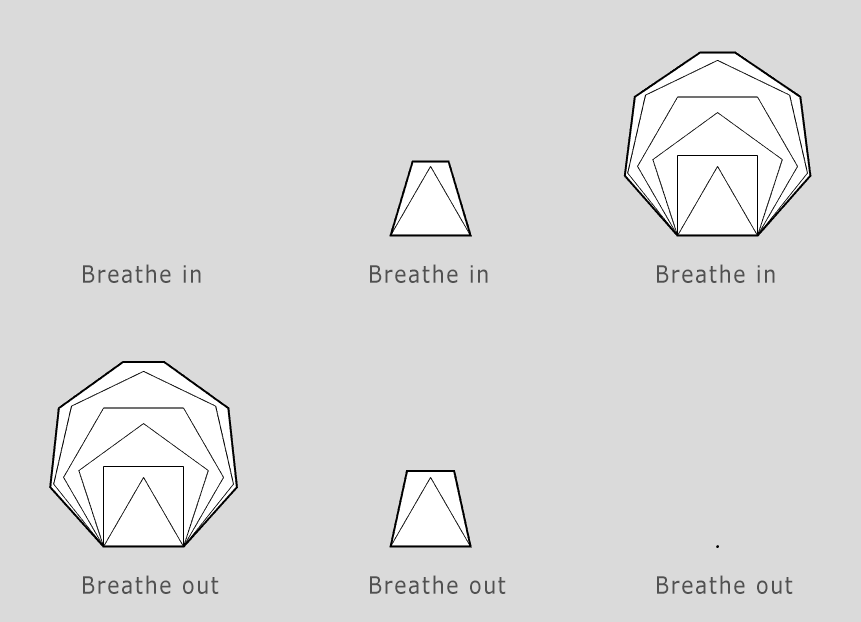
- Breathe, with help: Any guided breathing exercise on the internet will do, but here’s an easy one. Gently breathe in through your nose and out through your mouth, in time with the picture below. If the picture is too much, just close your eyes and count to four for each inhale and exhale.
- Talk to someone: Remember, panic attacks last only 15 minutes on average – even if it’s 15 minutes of torture, you will come out the other side! Call a friend when you feel it coming on, so they can remind you what’s happening and provide reassurance.
And if you can’t access a friend quickly enough, you can always turn to your online, anonymous support network.
The post How to React to a Panic Attack appeared first on Supportiv.
]]>