The post Existential Crisis, Anxiety, or Dread? Inner Tools To Find Relief appeared first on Supportiv.
]]>We are all becoming more aware of the coldness, cruelty and dysfunction in this world, leading us to question our habits and values, whether we have any power to change things (we do), and whether it’s possible to create good inside such a callously-constructed system.
When everything seems absurd, pointless, and you don’t feel like it’ll ever change? That’s certainly fuel for an existential crisis.
What Is An Existential Crisis?
An existential crisis happens when life’s uncertainty or absurdity become too much to bear. The weight of it all sends you into an abyss formed and perpetuated by feelings like helplessness, apathy for the world around you, a loss of enjoyment in things you used to like, sleep problems, and more.
An existential crisis can show itself as any of the following:
- existential dread: the dread of trudging through a meaningless existence
- existential anxiety: the panic or anxiety of needing to find meaning in a meaningless-seeming world
- existential depression: the depression that comes with the belief that nothing you do matters
Or, it can look like your own brand of crippling despair…
“Existential frustration is in itself neither pathological nor pathogenic. A man’s concern, even his despair, over the worthwhileness of life is an existential distress but by no means a mental disease.” – Viktor Frankl
Every now and then, we’re going about our lives until suddenly, an intrusive thought hits us like a truck: “What is the meaning of my life?” “Do I have a purpose?” “What’s the point of all this?”
It’s natural for thoughts like this to wander in and out, but often, these thoughts seep deeper into our minds and overwhelm us with despair and other negative feelings.
It feels like you could have an existential crisis every single day lately. When everything seems absurd, pointless, nonsensical, and you don’t feel like it’ll ever change? That’s certainly fuel for dark emotions.
You’re not alone in feeling this way, but the goal is for you to feel better.
For immediate relief, you can talk to an understanding peer about your struggle (anonymous and judgement-free).
And for the longer-term, we’ll show you steps to overcome an existential crisis, below.
Why Does It Happen?
An existential crisis seldom appears on its own. It can usually be traced back to something, such as an unhelpful thinking style, a life-changing event, or trauma.
These crises occur, in theory, when we face vague aspects of existence like finality, infinity, or mortality.
It can come in the form of questions like:
- “What is my purpose?”
- “Where is my place in this vast world?”
- “If I’m just going to die, why does anything I do matter?”
- Or, like this redditor put it: “Why do we live?”
Especially in today’s social and political climate, existential anxiety can arise from outside the self, too, spurred by senseless or confusing trends and events.
Depression, Anxiety, and Other Mental Health Struggles
Existential crises can accompany mental health struggles like depression, anxiety, bipolar disorder, and obsessive compulsive disorder, among others. However, the question of what causes what is still up for debate.
“Talking about our feelings gives them validity and helps prevent them from consuming us.”
If someone is overwhelmed by an existential crisis, it makes sense to assume that those very thoughts cause depressive symptoms like apathy, loss of pleasure, prolonged periods of sadness, and more.
But on the other hand, if someone already has major depression or something similar, that can lead to feelings of disconnect with the world. And that disconnect can trigger questions like “What is the meaning of my existence?” and “Do I matter?”
All we know for sure is that existential crises have links to mental health, but whether they are a symptom or a cause is still being researched.
Life Events
Traumatic life events like living through a natural disaster, a medical emergency, or the death of a loved one are potential causes for existential crises. This also applies to other life-changing events like losing a job or a disastrous break up.
When we’re faced with such events, it’s natural to take a step back and ponder things such as our life’s purpose or our own mortality. It becomes easy to fall into an existential crisis
How Can I Deal With An Existential Crisis?
Existential crises are not something wrong with you.
In modern life, it’s easy to feel a lack of drive. Many of us feel like our efforts are pointless, like there’s no motivating factor worthy of our energy.
In his book, Man’s Search For Meaning, Holocaust survivor Viktor Frankl suggests that existential frustration can often be solved by making some change in life that provides a person a fuller sense of meaning and purpose.
Luckily, we all have inner tools to help us overcome existential crises in this way.
Zapfee’s Inner Tools In An Existential Crisis
Around 1933, philosopher Philip Zapfee proposed that existential dread is something we’re all bound to experience at some point. He suggested that while existential crises are pretty much inevitable, but he also gave us hope.
He theorized that each of us has specific, internal tools that can help combat these overwhelming feelings.
Anchoring:
This is our ability to fixate on specific concepts to help stave off feelings of dread and unease. We can anchor ourselves to things like specific goals, values, or relationships. This allows us to find meaning in the governing principles of our lives.
Anchoring, as the term suggests, keeps us grounded and driven in the face of an existential crisis.
Isolation:
It sounds bad just to write it like that! But this is our ability to separate ourselves from our dreadful thoughts. We have the ability to take a step back from disheartening situations and reflect on what we’re going through.
Distraction:
Distractions can help by diverting our time and attention to other things instead of remaining focused on negative existential thoughts.
Sublimation:
Similar to distraction, sublimation is another way to refocus our energy. Instead of focusing on our thoughts, we can turn our attention to things that bring us joy or give us meaning.
Sublimation can be as simple as devoting your energy to the positive things in life, or creating a positive outlet for your emotions like arts and literature.
Additional Methods
Those tools were proposed a long time ago, so let’s also look at the issue from a more modern perspective. Below are some more tools you may find within yourself, to help in an existential crisis.
Reflecting:
Spend some time thinking about why you feel this way. Reflection is a powerful tool that lets us assess a situation and assess what our options are to handle it.
Reflection can help evaluate and understand your feelings, and from there you may find ways to manage your emotions and find meaning in life.
Setting Goals:
Setting goals is one of the best ways to give us a sense of purpose and autonomy. Try to think about something you’ve always wanted to do.
Have you ever wanted to try your hand at making a difficult but delicious dish? Or how about talking to a stranger?
Map out a game plan for reaching your goals. This can directly help combat that feeling of having no purpose – no matter how small, you’re creating one for yourself!
Finding Hobbies:
As Zapfee alluded to, distractions are a great way to take our mind off of negative thoughts.
Pour your time and energy into something you’re passionate about. If you don’t have a prominent hobby, reflect and think about anything you’ve ever wanted to try but never had the chance.
There are lots of YouTube videos on random hobbies you might never have thought of. Take some time to explore and land on something that feels right for you.
Talking to Someone:
Dealing with these thoughts on your own is hard, so take some time and voice your concerns to a trusted friend or family member.
Talking about our feelings gives them validity and helps prevent them from consuming us. And others can even lend a helping hand to help you through an existential crisis!
In Conclusion
Dealing with an existential crisis isn’t easy, but hopefully you’re now equipped to handle it better than before.
If you ever feel like your thoughts are weighing too heavily on you, don’t be afraid to start a chat at Supportiv! Hit the coral Chat Now button, type a thought, and you’ll get to talk in less than a minute.
We’re always here to talk 24/7 and can provide a listening ear – whatever is on your mind.
The post Existential Crisis, Anxiety, or Dread? Inner Tools To Find Relief appeared first on Supportiv.
]]>The post Resentment In COVID Pods: 8 Steps To Resolve And Prevent It appeared first on Supportiv.
]]>People are more on-edge than usual, and emotions are running high, making it even more difficult to get along. On top of that, we’ve fallen into de-facto “pandemic pods,” leading us to over-rely on a select few people. Unfortunately, over-reliance can often lead to resentment.
So, what do you do when you start to resent the people around you?
First, it’s important to understand the signs of resentment and what to do if you find yourself experiencing resentment. Next, it’s crucial to start understanding the patterns that led you to resentment or over-reliance.
Then, you can start to break free and establish healthier patterns within your COVID pod. Round-the-clock exposure to each other does not have to breed resentment.
Signs of resentment
Sometimes, people act on resentment without fully understanding that they are, in fact, experiencing resentment. That’s common, but resentment left alone may lead to burnt bridges.
Here are some signs that you may resent someone around you:
- Getting frustrated or thinking: “Not again…”
- Feeling like one person is taking you away from other friends, family members, or endeavors
- Anger or hostility toward the person (or people!)
- Feeling irate over minor flaws in someone that you wouldn’t usually notice; or getting annoyed by small things that wouldn’t usually bother you
You may ruminate on the situation or situations that made you resent the person. If you resent someone, you may have a codependent dynamic, or they may have crossed your boundaries. Perhaps, you struggle to set boundaries in the first place, and that’s what led to the resentment.
Understanding of codependency, interdependency, and self-reliance is crucial to navigating over-reliance and the resentment it can cause.
What is codependency?
Codependency is an unhealthy reliance on or over-enmeshment with another person. Often, it pairs with enablement of some kind. Enablement doesn’t always occur in conjunction with the way that we think of the term classically; enablement or enabling behavior doesn’t always surround substance use disorder or similar concerns. It can also include letting someone rely on you for approval, emotion, self-esteem, identity, or decisions. If you feel like someone’s over-reliant on you to the extent that it drains you (or vice versa), you’re likely experiencing codependency.
What if I might be codependent?
If you’re the one who’s relying on someone else past the point that it’s healthy, you might experience anxiety about getting your needs met by the person you rely on, or you might experience a low mood when the person’s unable to provide.
A healthy relationship has give and take, sometimes a great deal of it, but all people involved are able to maintain their sense of identity and self-reliance. Codependency robs you of those things to a degree, which is why it is unhealthy.
You want to feel good about yourself and know that you can self-regulate your feelings, choices, actions, and confidence. That’s why it’s important to be able to recognize and work through codependency.
What Is Self-Reliance?
No one can rely on themselves all the time, but self-reliance is when you have the capability to rely on yourself to get your needs met and utilize that capability. It is a fundamental and crucial skill for anyone to develop to avoid codependency and to be able to develop healthy interdependent (not codependent) relationships.
If you are self-reliant, and no one is there to respond or people are busy, you can get yourself through. You can take it upon yourself to find someone who can talk, whether it’s a volunteer, another friend, a chatroom, or a mental health professional.
The bottom line when it comes to self-reliance is that you don’t have a constant expectancy of a specific person to meet your needs and know that you can meet your own or reach out to another person on your own if that person isn’t there.
The Balance Between Self Reliance And Codependency
It is a highly nuanced topic because social support is a crucial part of our emotional and physical well-being, but over-relying on one individual or being codependent toward friends, family members, or partners can grow extremely unhealthy both for you and the other person. It can lead to resentment, over-enmeshment, or lack of belief in your ability to help yourself, and no one wants to feel helpless.
Self-reliance is not isolation or keeping things to yourself in a way that’s unhealthy; it is confidence, the ability to establish your own sense of self, and the ability to determine your own emotions or actions. If your relationship with your pandemic pod balances self-reliance and interdependence, your relationships will allow you to:
- Determine your own emotions (instead of relying on the other person as your primary source of happiness or validation)
- Do what’s best for you and make your own decisions
- Feel comfortable spending time apart, without fear, or antsy indecision
- Set and keep healthy boundaries
- Maintain a strong sense of self
To visualize codependency or over-enmeshment, imagine two people glued together, both feeling each other’s feelings, unable to meet their own needs. On the other hand, interdependence or self-reliance looks like two people understanding and supporting one another as individual beings–without fusing into one.
8 Steps To Resolve Resentment In Close Quarters
During COVID, resentment within the pod is likely just due to forced over-reliance. We can’t go out much, so we have to ask a smaller group of people to help us meet our pandemic-amplified needs.
1. Cool Off
One of the best ways to resolve resentment, particularly if it is related to being a little bit too interconnected, is to spend some time apart. Now, this might be hard in the time of the coronavirus, but with some creativity, it is possible.
2. Consider The Specifics
Think of when, how, and where you tend to clash with the person that you resent. Do you resent not having enough alone time? Do you resent an expectancy for you to do more than you can for this person?
3. Set Boundaries
This is an excellent opportunity for boundary setting, compromise, and communication. For example, if a COVID pod member expects you to take complete responsibility for a chore or favor, you might realize there’s an unequal give and take. Even if you’ve been accepting it for months, you still have a right to set a boundary.
When you decide you’ve had enough, you can say something like: “I am so sorry, I’m not able to do that this week. I’m struggling with my mental health and need some time to focus on it. Can we make a deal where we take turns completing this chore every other week?”
Within COVID pods, you can also set similar boundaries for those who lean on you emotionally. In many relationships, one person relies on the other disproportionately, which can easily breed resentment. It can feel especially unfair when this happens outside of crisis situations, due to a relationship pattern that may have been established over time.
4. Avoid Pouring From An Empty Cup
Supporting people in your life is excellent, and many of us are incredibly empathetic people who love being there for others, but the truth is that sometimes, you won’t have the bandwidth. It’s like the saying, “you can’t pour from an empty cup.”
As hard as it is to set boundaries at times, especially when you are someone’s go-to person, there are ways to navigate this situation while making sure that your friend gets what they need. That way, you can be sure that they’re okay even when you are struggling too much or are otherwise unable to be there.
5. Make Room For Pre-Emptive Alone Time
If your resentment is due to the fact that you need more alone time in general and isn’t necessarily that someone’s asking you for something, make that alone time a priority. Take a walk or retreat to your own space, even if it is just your desk or your room.
Do something for yourself that is unique to you; something that feels like “you time.” This doesn’t need to be grandiose. Small pieces of joy can go a long way. For example, you can put your earbuds in and listen to a podcast you like. It’s free, and you can drown out the world around you. That time is yours.
6. Don’t Neglect Your Needs In Helping Others
There are always cases where people have someone that’s dependent on them, whether that’s a child or someone else in their life. In that case, it’s best to let yourself feel your feelings, stick to your responsibilities, but still take that time for yourself. Being a guardian or caregiver doesn’t mean that you can’t take time for you.
7. Let It Out
Sometimes, to deal with resentment (or even the painful emotions that come along with recognizing codependency), the best thing to do is to let it out.
Crying is a very healthy thing to do. It helps you to avoid internalizing or bottling up your feelings, both of which actually have negative health consequences. Some healthy ways of emotional release that might help you let what you’re feeling out are crying, asking a friend if you can call or FaceTime them, journaling, blogging, and going for a brisk walk outside.
All of us are going through a difficult time right now, and if world events, resentment, or being around the same people all of the time is getting to you, have compassion for yourself, and allow yourself to express and acknowledge your feelings. Experiencing a high level of stress is fully understandable, and you certainly aren’t alone.
8. Find Outside Support
Finding outside support is a great way to cope, whether you’re struggling with codependency or you just want to talk to someone new. If you find that you vent to the same person daily, it might be helpful to diversify who you vent to. Don’t go to the same family member or friend every time. This way, you avoid over-reliance and get to hear new opinions, if applicable.
To ask someone for help, you can simply say, “do you have time for me to vent right now?” Another thing you can do to get outside support is to use services like Supportiv where you can talk to someone 24 hours a day every day – whenever you need it. That way, you’re talking to someone objective, and while it’s not a replacement for therapy or counseling, it can be extremely helpful to talk to someone outside of your situation.
If you find that you need a higher level of support or frequent support, it’s a good idea to look for a counselor or therapist. Many counselors and therapists have switched to remote sessions or are offering them as an option as a result of COVID-19. To find a counselor, check with your insurance company, ask for a referral, or search the internet. Whether you seek peer support, support from volunteers, help from a counselor, or all three, take pride in yourself for getting through this difficult time.
The post Resentment In COVID Pods: 8 Steps To Resolve And Prevent It appeared first on Supportiv.
]]>The post Don’t Care About Anything? Enjoy Life Again, Through COVID-19 appeared first on Supportiv.
]]>A surprising number of us feel this way — especially now that we’re stuck in our houses 24/7 due to COVID-19, unsure of what the future looks like! The uncertainty gives everything else a sort of pointless edge.
Whether your experience is depression-related or coronavirus-related, there’s a name for it: anhedonia. And the exercise below can help you beat it right away.
It’s worth taking a look at what anhedonia is, how it happens to you, and a foolproof way to help you enjoy things you used to love again!
If you feel like you aren’t enjoying life anymore, and want to talk to someone about it, there are people here for you. You can chat anonymously on Supportiv, 24/7, with people who know how anhedonia feels.
What is Anhedonia?
Anhedonia is an inability or reduced ability to feel pleasure, enjoyment, and engagement with life. It can also include reduced motivation to do things. You may feel like you don’t care about anything anymore since nothing feels good or brings you fulfillment.
With anhedonia, your interest in things you used to love doing diminishes. That feeling of “wanting” or “liking” things is decreased, and you may not even know why.
Anhedonia is known to especially affect those who experience major depression, PTSD, or other mood struggles. However, even if you don’t have any mental health diagnoses, you may still experience anhedonia. Anyone can find themselves stuck saying: “I don’t care about anything anymore.”
There are various factors that may have set off your anhedonia, such as:
- Depression
- Complex trauma
- Substance addiction
- Abuse
- A major illness or disability
- Loss of a loved one
- Grief
- Social isolation due to COVID-19 and shelter-in-place
You may feel a general sense of not caring about anything, or your anhedonia might be a more specific sub-type:
Social Anhedonia
Social anhedonia is the withdrawal or isolation/exclusion from social activities. This brings about a disinterest or lack of pleasure in doing things of a social nature, like hanging out with friends, attending a party or event, avoiding malls and other public places. Social anhedonia may possibly related to isolation and loneliness, because you don’t care about anything that has to do with socializing. As humans, we are sustained by social interactions – there is a need for being in the presence of others and communicating with them. This is vital for our physical and mental well-being.
Physical Anhedonia
Our ability to receive comfort from touch or be intimate is greatly diminished because of physical anhedonia. If you are a person who enjoys physical activities such as playing sports, exercising, or even sex, developing physical anhedonia can be extremely detrimental to your mental well-being. Causes of physical anhedonia can be trauma, physical disabilities, or sexual dysfunction.
Another factor of physical anhedonia can be attributed to your other senses – eating, smelling, hearing and seeing. You may experience a lack of enjoyment and pleasure from eating your favorite foods, inhaling nostalgic scents, listening to music, or watching movies. Your feeling of “I don’t care about anything” can even cause you to neglect your body.
How Anhedonia Occurs – The Neuroscience Behind It
Scientists and researchers believe that anhedonia occurs as a result of a few factors combined: dysfunction in our brains’ reward systems, environmental factors, and vulnerable genes.
In simpler words, a broken reward system in our brains can’t make us feel pleasure (reward) from doing and feeling things. Environmental factors (such as trauma or grief) may give us a negative feeling about doing things. And if we also have vulnerable genes, our brain’s reward system is tricked into ignoring pleasurable things.
This creates an abnormal reward system, where we don’t feel much of anything, even if good things are happening – we stop feeling pleasure from doing things we used to love!


Break Through Anhedonia with This Exercise!
Do you need a change of scenery from this “I don’t care about anything” mood? Great, let’s get off our asses and actually try to enjoy the things we love, while kicking anhedonia to the curb!
This exercise is adapted from Dr. Robert Duff’s book, F*** Depression. With a name like that, you know it’s not just ordinary advice from a psychologist! Here’s what you need:
- Pen
- Paper
- Motivation (Urgh!)
Step 1
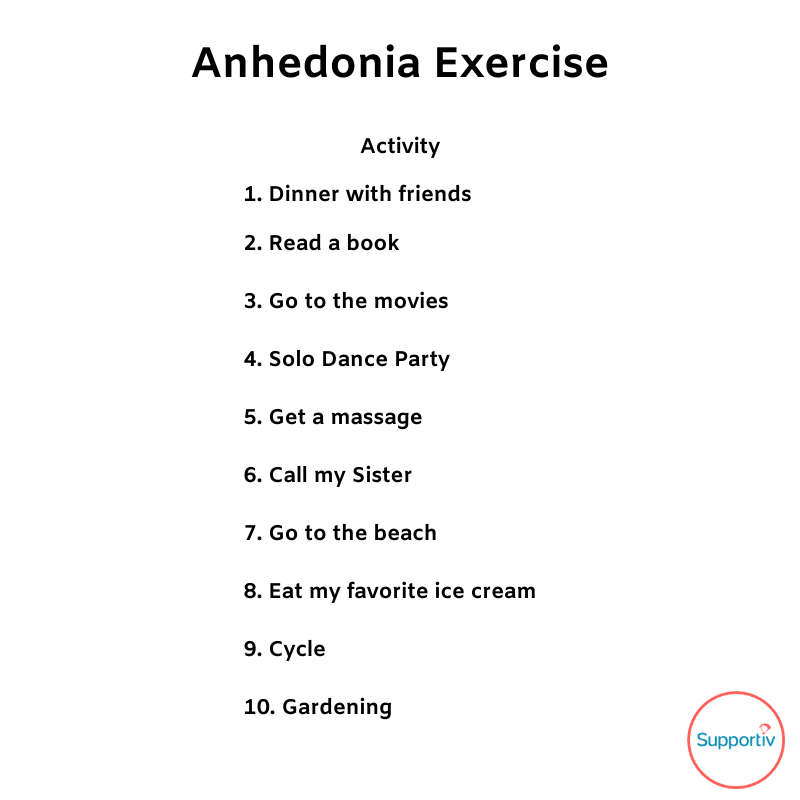
So, on your piece of paper, write down 10 things that you have enjoyed doing in the past. Things that brought you pleasure, happiness, joy – all the warm fuzzies. If you’re struggling in self-isolation due to coronavirus, this list should consist of things you enjoy which can be done indoors.
You can list these in any order. Let’s not be lame and write boring things.
Think about stuff you actually did that made you laugh, that you have great memories of! No matter how little you can feel right now, you have definitely felt good at some point in life — even inside the house.
The reason for this is to identify the things that once made you feel alive, but which you now probably can’t imagine yourself doing (since they now give you little enjoyment, or since you’re stuck in the house).
You can check out my personal list below.
Step 2
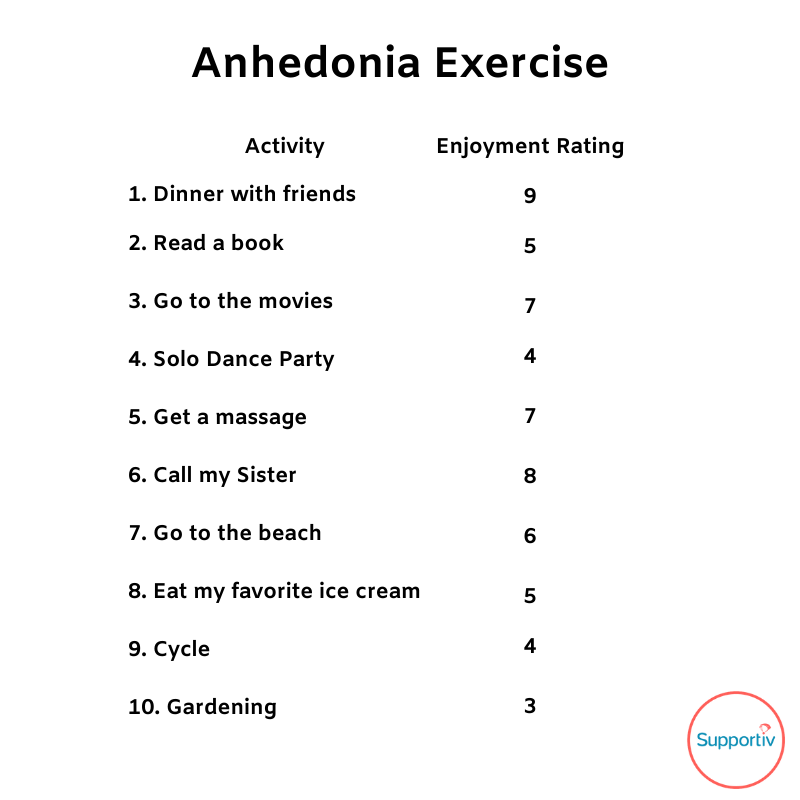
Once you’ve got your list ready, think about how much excitement, happiness and pleasure each of these activities bring you and rate each one. On a scale of 1 to 10 (with 1 being “it completely sucks” and 10 being “this rocks my world”), write the level of enjoyment each activity brings you — as if they were all completely effortless. This is how I rated my activities:
Step 3
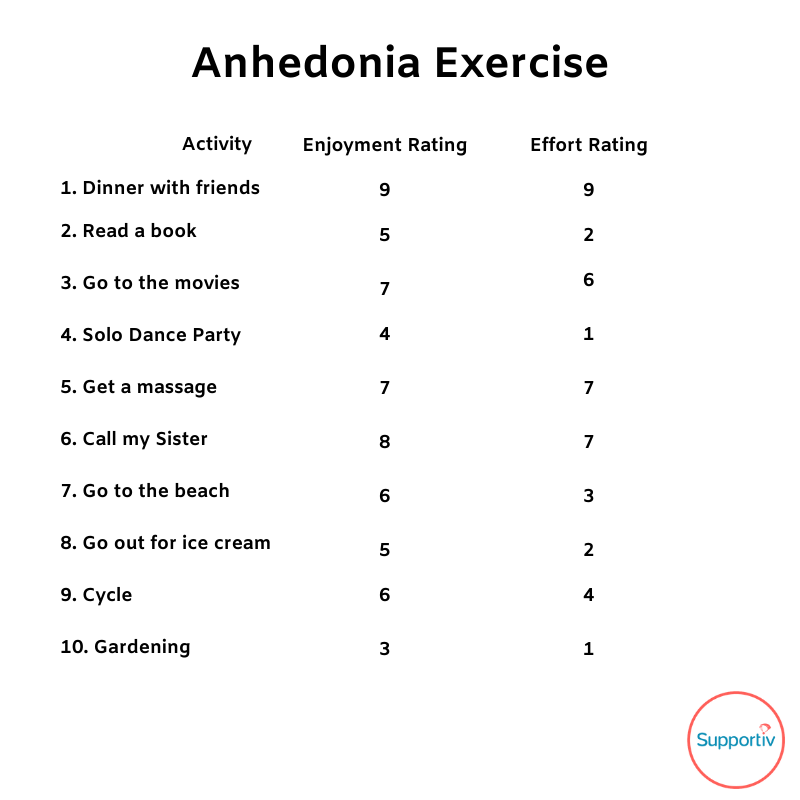
Next, think about how difficult the activity is for you to do – like how much effort, time, planning goes into actually doing it. So again, from 1 to 10 (with 1 being pretty easy and 10 being “Hell NO”), rate each activity on your list.
See my list below. In contrast to how much pleasure these activities (used to) bring you, you can also see how difficult they are to do.
Step 4
Now comes the fun part – okay, maybe more introspection than fun. Last step! In this part of the exercise, you want to find the tradeoff between your enjoyment and the effort required to do each thing.
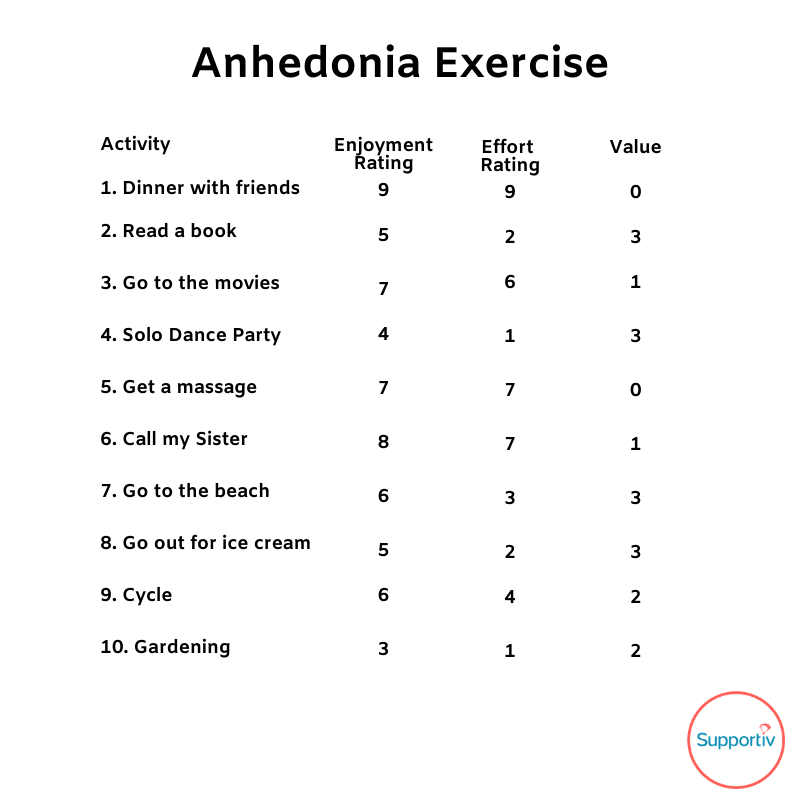
To do this, subtract (minus) the effort rating from the enjoyment rating. For example, on the activity of reading a book, my enjoyment rating is 5 and my effort rating is 2. Therefore, the value of my activity is 3 (5 – 2 = 3). Do this for each of your activities like below.
The Result
After you’ve found the tradeoff “value” for each activity, look at the activities with the highest value number. These will likely be the easiest for you to accomplish, while bringing you the most enjoyment.
Now the key is to act on these activities, even if you have to force yourself. Start planning to do your high value activities as soon as possible, because they have the best chance at bringing you some enjoyment.
Doing the easier and more pleasurable ones first may motivate you to keep going. This way, you can build your brain’s reward systems back up, until you start magically wanting to do things off the list!
But just saying you’re going to get it done doesn’t work! Turn your piece of paper around and write down the dates and times for you to try each thing you used to love. Hold yourself to these dates and try your best to just try doing them – even if you bail after 5 or 10 minutes, you tried!
Moral support available right here! Actually trying this stuff can be the hardest part of healing from anhedonia.
The purpose of this exercise is to kick anhedonia to the curb. So even if you don’t start enjoying things at first go – keep trying and be consistent.
Once you’re sort of enjoying the highest value activities, try to work on those lower value ones too. Don’t be too hard on yourself, and have patience. With some effort, you really can recover your ability to care about things!
If you need some moral support or motivation to tackle your anhedonia, we’re here 24/7 to chat.
The post Don’t Care About Anything? Enjoy Life Again, Through COVID-19 appeared first on Supportiv.
]]>The post Teachers: Start The Year By Honoring Your Struggle In 5 Steps appeared first on Supportiv.
]]>Even if some teachers haven’t been personally accosted with the sentiment, our society has been steeped in the message that “those who can’t do, teach.” This stigma leads teachers to feel undervalued and criticized for their struggles during the pandemic.
If I return to the classroom, how will my family stay safe? (They won’t.)
How do I adapt my curriculum to Zoom? (Through trial and error.)
What keeps a first grader engaged through a remote school day? (Nothing.)
Instead of speaking for teachers, as many decision-makers seem to be doing, Supportiv wanted to get to the roots of the real problems for teachers, and hear about the solutions that seem to be working.
Teachers’ Struggles Must Be Honored
To learn about the struggles of teaching during a pandemic, firsthand, Supportiv interviewed a number of elementary through middle school teachers across the country — anonymously, so that interviewees could speak openly.
One anonymous teacher summarizes the emotional dilemma quite well: “You need your job, and you want to help, but…you don’t get paid well enough to self-isolate from your family, and society doesn’t seem to hold your skills in very high regard.”
“It’s extremely invalidating. It’s like people think you only have to know sixth grade math in order to teach sixth grade math.” There’s a lot more to it, and that’s part of why teachers are struggling right now.
The vast majority of teachers were trained for in-person instruction, plain and simple. So the transition to remote education cuts through uncharted territory, rife with pressure, anxiety, and responsibility for the future of America’s students.
Teachers know how the child’s brain works in a classroom setting — even then, kids are nuanced and unpredictable. So how do kids process information when it’s solely through a screen? How can teachers keep students on their toes and get information across? Figuring that out for your Zoom classroom is like being a sheriff in the Wild West.
How could that not impact you emotionally? How do you feel when your job suddenly becomes entirely different from what you were trained for, and you have little say in what changes take place?
What does this all feel like from a teacher’s perspective?
“Not educated to do this.”
“Imposter syndrome.”
“Unprepared to help those who depend on me.”
“Helpless because I have no power over the choices of the educational system.”
As one teacher interviewed puts it:
“There is nothing I can do right in this situation. Teachers have always been undervalued, but now we’re suddenly responsible for sacrificing our lives and families’ to return the world back to normal in the middle of a pandemic? We care about the kids, and most of us will answer when duty calls — if and when we’re allowed to return to in-person instruction.
“But we aren’t crazy to feel reluctant. We’re being asked to sacrifice our own wellbeing for a job we didn’t sign up for, for a wage that isn’t enough to care for ourselves.”
Another interviewee opines: “This is the opposite of why I chose this job.” Most teachers are in it for the human interaction part. Over Zoom, it’s not the same.
“When my students’ parents talk to me about the state of affairs at my school, they talk as if I’m the one that did it. As if I had a choice about the school’s policy.”
Teachers bear the brunt of criticism toward the educational system, even in pandemic times. If anything goes less-than-optimally, teachers are blamed, rather than the system which constrains them.
“I know I can say no to going back, but then I’m left with no income, a ton of guilt, and the anger of my students’ parents.”
The moral of the story? Let’s have patience with each other — especially with our teachers. Let’s cultivate empathy and understanding. Parents are definitely struggling right now; but teachers are here to help, and they’re having a hard time, too.
4 Ways To Honor Your Struggle Of Pandemic-Teaching
1. Take it one week at a time.
The biggest advice from one of the teachers interviewed by Supportiv: “Take it one week at a time.”
Amy Weinstein, fourth grade teacher in the Bay Area, elaborates based on her Spring 2020 experience:
“At the beginning of shelter-in-place orders, I avoided cabin fever by diving deep into lesson planning. I was excited by the challenge to adapt and complete the year’s curriculum. But since school policy ceaselessly adapted to official messaging as the pandemic unfolded, most of my detailed plans became obsolete.”
Nobody knows what to expect as this school year plays out. We don’t know what will happen politically, economically, or with the virus. So whatever your plans are — plan for them to change. Official guidance or school policy could shift, and if you take your time to thoroughly prepare for the next 6 weeks, you may be crushed when plans change.
Instead of over-planning, teachers should encourage themselves to take breaks and rest, so they can continue rolling with the punches. This upcoming school year will take stamina if nothing else.
2. Know that you may not want to do important stuff after the day ends — even if it’s “just” zoom.
Multiple teachers mentioned the inability to do chores, grocery shop, and exercise on school days during the first round of distance learning. Hobbies, relationships, and sometimes even physical self care can fall to the wayside as teachers are pushed beyond their mental and emotional limits, within their own homes.
Before the pandemic, “85 percent of teachers reported that work-life imbalance was affecting their ability to teach.” Now, that number is up to a whopping 95% according to some sources. If teachers are too stressed to teach, then no one wins.
High expectations about your remote-teaching productivity set you up for pressure and disappointment. So, plan according to the reality. Assume that you won’t have energy to do any more than the bare minimum on school days.
Plan to choose from a set of self-care, relaxation, or mindfulness activities that help you feel recharged. Or just do something fun. Every weeknight, give yourself permission to do these things, or just to rest all evening. Don’t fret: you can use a chunk of the weekend to accomplish your list of higher-energy to-do’s.
3. Create a comfortable and customized teaching space.
Set up your favorite things around you, so that you feel you’re at least getting something out of WFH.
- Computer charger
- Phone charger
- Extra pillows to cushion your “back and bum”
- Water and fun drink or two
- Snack with protein, and something crunchy for jaw stress
- SOMETHING TO FIDGET WITH
- A plain wall for zoom virtual backgrounds, which serve multiple purposes (see below)
4. Shore up your boundaries ahead of time.
Zoom backgrounds, most importantly, help you maintain your boundaries while working from home. You might not care whether your students see into your personal life, but maintaining some distance may aid your peace of mind.
This strategy allows you, as a teacher, to control what parts of your life students see, and removes some of the pressure of remote instruction. It allows your room to remain your room, instead of your (class)room.
Secondly, you can use Zoom backgrounds to shock everyone back to attention, or to set the mood for a particular remote lesson.
While you’re at it, set boundaries for your students within Zoom lessons so you’re not constantly putting out fires. No name changes, no inappropriate backgrounds, no private chats, etc.
5. Have a venting buddy.
When frustration threatens to boil over, identify a friend who welcomes the griping. Airing your grievances as they crop up is known to bolster emotional wellbeing; in the home stretch of 2020, you’ll certainly need that boost.
Shoot off a snarky text, snap your most exasperated reactions, or even visit an online forum to vent.
There’s also always Supportiv, where you’re connected with peers in similar situations, to chat 24/7 and anonymously. You can always find an understanding ear in the moment, and that support can make the difference between resilience and collapse.
The post Teachers: Start The Year By Honoring Your Struggle In 5 Steps appeared first on Supportiv.
]]>The post How To Deal With Anxiety During The COVID-19 Crisis appeared first on Supportiv.
]]>
If you have been feeling increased anxiety about COVID-19, otherwise known as Coronavirus, you are not alone. Dawn Brown, director of the National Alliance on Mental Illness (NAMI) HelpLine, reports the line has seen “an uptick” in calls related to COVID-19.
Additionally, Axios data estimate that 29% of adults have experienced a decline in emotional wellbeing!

It is not selfish to take some time out to check in with yourself and your mental well-being during this time. In fact, it is vital to stay grounded and balanced, especially if you have others relying on your help.
We have compiled some ideas for how to address your coronavirus anxiety through simple measures and small steps, which we hope will help over time. Find tips below.

Keeping Calm While Self-Isolating
Self-isolating may sound like a Netflix-binge-filled breeze, but it comes with its own challenges, especially for those already prone to anxiety and depression.
Stay At Home, But Stay Connected
Those with previous experience with anxiety and depression probably already know the importance of having a support network, made up of family, friends, and health care professionals. You may also be more prone to self-isolating out of fear and sadness.
It is important to not let your physical distance from loved ones prevent all communication. Take some time to reach out to those who can lend an ear and listen to your worries. For this, you want to call the type of friend who shame and vulnerability expert Dr. Brené Brown refers to as a “move-a-body friend”: someone who will not shame you or tell you you are overreacting, but who will be there to listen without judgement and offer practical help if they can.
Don’t be afraid to be honest about your anxiety, but also do not feel pressured to tell everyone about it either. It can be just as healing to simply ask someone else about their day or talk about a new series you’re watching or video game you’ve discovered.
There are also plenty of ways to spend time “together” while staying physically apart, like playing that new game together, starting a virtual book club, or starting a digital hangout (Google and Zoom offer great tools for this, but Facebook and Instagram Live can also offer creative ways to stay in touch!). There’s also Supportiv, of course, if you’d prefer to socialize with strangers.

Set Limits For How Much News You Consume
Many experts, including Krystal Lewis, clinical psychologist at the National Institute of Mental Health, agree that we should set limits for media consumption during the pandemic.
Lewis explains, “Mass media coverage of a topic can have long standing and far-reaching effects. It is common for children and adults with health anxiety and generalized anxiety to be triggered by world events and news.”
While it is important to stay informed, getting overloaded on media — especially conflicting news from many different sources — will likely provide more stress than it does clarity.
To combat this, Catherine Belling, Ph.D., an Associate Professor of Medical Education at Northwestern University, recommends choosing one trusted source to rely on for your coronavirus news, for example your local health department.
Allow yourself to check this source for updates once or twice a day, but try to focus on other things the rest of the time as to not overload yourself. Helpful resources like this NPR comic can also help if you need to explain the coronavirus situation to children.
Help Someone Else
When you are feeling more calm, pay it forward by helping others in whatever way you can. Some ideas:
- Help deliver groceries to older people/immunocompromised people in your building or neighborhood
- Reach out to other friends who may be suffering
- Support a small business that might be struggling by buying a voucher for later use
- Contribute to an artist’s Patreon or other funding efforts to help them through the next month of cancelled gigs and reduced freelance income
- Read a story to kids via FB live
Create A New Routine
If you are not used to working from home, it might feel completely bizarre and uncomfortable — plus very tempting to simply lie in bed all day! You can stay productive and keep your mind occupied by maintaining a routine, even at home.
A work from home routine can look like:
- Setting an alarm for the morning,
- Taking a shower and getting dressed as if you’re going to work,
- Creating a dedicated workspace at your desk,
- Having regular meal breaks, and
- Starting and ending your work day at the times you normally would.
Making time for regular exercise is also great!
One tip is to avoid working in bed, as this may confuse your brain when it comes time to go to sleep, and thus lead to increased insomnia and anxiety. Let bed remain a safe, relaxing zone, rather than one you associate with work!
Stay In The Present
It is always easier said than done to “stay in the present,” but it is one of the most important tools anyone has in their arsenal for battling anxiety. Anxiety almost always deals with disappointment over past events or worry about future events.
We are in uncertain times, and things are changing every day, so it is only natural that we feel concern about what will happen tomorrow, in one week, or one month from now. Coronavirus anxiety is real.
Spiritual teacher and author of The Power of Now, Eckhart Tolle, explains that we can balance staying in the present with “productive planning” for the future by giving ourselves conscious, “focused” periods for planning, with a time limit. This is different from dwelling in “toxic,” anxious thoughts about future events that we cannot control.
Mindfulness practices like meditation and journaling are also a great help for staying grounded and overcoming anxiety.
Go To Nature
If you can safely avoid crowds and maintain distance from others while outside, going on a long walk can help us clear our minds and reduce anxiety.
This study on the Japanese practice of “forest bathing” showed evidence that time in nature can reduce stress and improve immune function. Another study on nature therapy from 2011 revealed similar results for participants, including decreased heart rates and cortisol levels.
Explore A New Hobby
You might decide to fill your free time in front of the TV, but why not use this time at home to explore a new hobby? Test a new recipe, download a language app, or try your hand at knitting or sewing. You can also check out online courses — there are tons of sites like Udemy offering hundreds of thousands of different topics, where you can either participate in set class times or study at your own pace!
Reach Out To Mental Health Providers
Mental health providers like therapists are a hugely important part of your network, and due to quarantining efforts, you may not be able to easily see them in person.

Still, there are other ways to get the mental health care you need. Ask your therapist if they would consider online video sessions, or phone sessions.
Supportiv also provides peer support groups online. It’s not therapy, but it’s a great middle ground between screaming into the void and seeing your therapist. For the time being, all front line care workers dealing with COVID-19 can use Supportiv’s emotional support for free.
The self-care application Shine has also put together a great treasure trove of resources specifically for dealing with Coronavirus anxiety.
Know That Your Grief Is Valid
If events in Asia and Europe are any indication, it is likely that more and more events will be cancelled as this pandemic unfolds. That might mean the birthday dinner you were looking forward to must be postponed, your favorite musician has cancelled the tour, or you possible have to cancel gigs, events and vacations you’ve been planning for months.
It is completely understandable to be disappointed, and you are allowed to grieve these losses, even if they seem small or unsubstantial in comparison to the loss of a life.
When you have given yourself time to grieve, you may want to further ground yourself by taking time to write down a list of what you are grateful for. This can help root you back in reality, and let you see that there is still good in the world. We will also move forward and get through this.
What If You Can’t Self-Isolate?
For many people, complete self-isolation is not an option. This may be because you are someone else’s primary caretaker, a front-line health care worker, or someone else who is not in the position to work from home. Not self-isolating can be just as anxiety-inducing if you are concerned about catching or spreading COVID-19.
For people not able to self-isolate, we would still recommend many of the above grounding techniques, like meditating, journaling, taking time for walks in nature, and reaching out to trusted friends for emotional support. Here are a few additional ideas.
Stress Inoculation Exercises
If you are nervous about a certain scenario, like going to the grocery store, try a stress inoculation technique at home. This involves imaging the various outcomes and being aware of how they make you feel. Ground yourself with mediation and breathing techniques to stay calm. This is a kind of “at home practice” that can help prepare you for the real situation.
Make A List
Make a list of what is worrying you. Anxiety around finances is a particular concern for many as businesses temporarily close and events are cancelled. Writing down everything everything you are worried about helps to get it out of your head and into a controllable, visual form on paper.
After you make your list, write down some possible outcomes and solutions. Try to take a practical, solution-oriented approach rather than letting your worries spin out of control in your mind. This comes back to what Eckhart Tolle refers to as “focused planning.”
Ask For Help
If you have made a list of your concerns, brainstorm if there is someone you can trust and go to for help. We are often fearful of showing our vulnerabilities or admitting we need help, especially when it comes to financial worries. But you will probably be surprised to see at how much your loved ones are willing to help you if they can.

So don’t be afraid to reach out and be honest about what you need — whether it’s a small loan to help cover next month’s rent after your work hours were reduced, or assistance caring for your children while you work, or someone with a car who can help you do errands while avoiding public transport.
In Conclusion
Remember that life will return to normal. We may have to adjust to a new normal in the meantime, but that does not mean life is over. You will get to see your favorite band again. You will get to clink glasses with your friends. You will get to take that much-needed vacation.
It should at least be a comfort to know that everyone is dealing with this at the same time. You are not alone in the struggle, so reach out to each other. Everything is better when we work together.
The National Alliance on Mental Health has also compiled an incredibly thorough document with resources for people in various situations due to the Coronavirus pandemic.
If you need immediate crisis support right now, find help for your specific situation:
Crisis Text Line – reach out for support via text messaging. Send a text to 741-741
National Domestic Violence Hotline — 1800 799-SAFE (7233) or text TELLNOW to 85944. A 24-hour hotline for any type of domestic abuse, including dating abuse and cyberstalking. You may be isolated with your abuser, and we encourage you to seek help here.
National Parent Helpline — 1-855-427-2736. Call for support, ideas, and further resources when in a parenting kids home during lockdown.
And if you’ve already reached out for help, you’re welcome to just come let off steam with us at Supportiv.
The post How To Deal With Anxiety During The COVID-19 Crisis appeared first on Supportiv.
]]>The post 7 Ways To Adapt To COVID-19 Loneliness appeared first on Supportiv.
]]>Easily adapt to coronavirus loneliness with these steps:
1. Make a List
You may feel like you’re lonely because you have no one to reach out to. Or those you regularly chat with in real life suddenly aren’t part of your daily routine, thanks to COVID-19.
Try challenging yourself by making a connection list or map. List names of family, friends, and acquaintances — with your name at the center.
You can draw lines depending on how distant or close you feel to these people. Even if it’s been a while, you’ll have an idea of who you can reconnect with. And we promise you’ll see, you’re not as alone as you may think.
2. Find a Group
During social distancing and shelter-in-place, it can be hard to maintain your in-person support networks and hobby groups. However, online communities exist revolving around all kinds of niche interests.
Online connection will be a vital way to bridge the loneliness gap during COVID-19 isolation. No matter how random your interests are, you can find someone to share them with online.
Take the work out of community-building:
You might worry it’ll take time to re-build an online support system of folks who ‘get it.’ But one already exists, tailored by tech that connects you to other people who think like you. You can find a safe group to talk about your worries, concerns, and struggles online — in less than 2 minutes.
It feels reassuring and connecting to know others are thinking in similar ways.
3. Watch Something Engaging
Sometimes we feel lonely because we feel that we SHOULD be doing something or going out with friends. The silence of being by ourselves can be deafening. Try watching a show or a Ted Talk that speaks to what you’re thinking about lately.
Listening to others who are passionate about your interests can help you feel engaged and eliminate the feeling of solitude.
4. Embrace Your Embarrassing Side
The horror of being all alone can make us forget the benefits to having some space to ourselves. There are so many things you may not be able to do when others are around.
Sing, dance, or do some other embarrassing things that you can’t do while other people are watching! You may find some relief in the ability to be completely relaxed as yourself.
5. Clean Your Room
Constantly going out for social gatherings can lead to chaos at home. There are jackets piled in the corner, no more clean clothes to wear, and your pillowcase definitely needs to be washed.
Use being alone to your advantage — tidy up your personal space and feel good about investing in self improvement. Making order out of chaos can also be really comforting, in itself.
6. Make a Playlist
Sometimes listening to just the right type of music can ease a lot of pain we feel. Songs can speak to us just like friends.
Get in touch with your emotions by playing some songs that fit your mood. Make sure to note which especially fit your lonely vibe; then put those into a personal Loneliness Soundtrack for next time you get extra lonely.
7. Reach Out To Someone Else Who’s Lonely
It’s easy to feel alone in feeling lonely. You probably know that from experience. So try reaching out to others who may also feel isolated.
Maybe a distant aunt, or your grandma for once! You’ll brighten their day, and feel less lonely, yourself.
By reaching out to another lonely person, you can both give and get support. If you can’t think of an old friend to call, try joining an online chat full of peers, right now, here.
You’re never more than 2 minutes from feeling understood and connected.
The post 7 Ways To Adapt To COVID-19 Loneliness appeared first on Supportiv.
]]>The post How COVID-19 Shows Us To Bond With Our Families appeared first on Supportiv.
]]>While we’re isolated from the world at large, we’re indoors and physically closer to the ones we love, remembering the value (and challenges) of bonding with family.
COVID-19 is a pandemic, but also an opportunity.
Doing our part by social distancing involves major disruption to our routines and comfort zones. In the face of overwhelm and uncertainty, most of us are scrambling to make things work, and to find optimism in the situation.
Yes, COVID-19 is devastating, but what can we learn from this experience with our families?
Redefining Family Roles
Family bonding is important in general, but it’s crucial during a crisis.
COVID-19 has put a lot of pressure on family units. Parents have had to homeschool their children while managing work from home. And some parents have been laid off entirely from full time positions, leaving them feeling powerless and overwhelmed.
So much is going wrong, that family becomes a necessary support, being physically there for you. You’re spending time with your kids 24/7 for the first time maybe ever. How can we use this chance to appreciate and come closer to those we love?
How can we make the most of this time, sheltering in place?
During quarantine, we have limitations on what activities we can engage in because many things are unsafe. What can we do to fill the time, together? How can we use this opportunity to bond with our families?
Bonding activities that you used to engage in, such as movie-going and community gatherings, aren’t available. You can’t go on playdates or use playground equipment, either.
It’s time to get creative. For those sheltering in place with family, COVID-19 provides an opportunity for connection, if we allow it. And there are many things you can do as a family that don’t require going to crowded places.
Watch Your News Consumption
There will be times where you need to disassociate from the pandemic and watch Netflix or play games. But it’s important to remember that even in the pandemic, there’s such a thing as too much technology. Even if it is recreational, too much time on a phone or iPad can be detrimental to you or your child’s brain.
Your personal technology use may become even more problematic than your child’s. Of course, you want to know what’s going on in the world and stay educated on the pandemic, but there’s definitely such a thing as too much news. You want to make sure that there’s a balance between remaining aware and spending time in the moment with loved ones, especially your children.
Limit the amount of time that you’re engaging in technology by taking in the essential news and then moving on. This is the time to focus on valuing the relationships within your family.
One way to do that: You can always open up the floor to your kids and let them talk about this pandemic and how it’s making them feel. This is an opportunity to reinforce your role as their safe home base, the comforting caregiver whose safety allows them to deal with life’s uncertainties.
Make The Most Of Minimal Outdoor Time
You don’t necessarily have to make your old favorite activities work during quarantine. Just sitting in the grass can be cathartic and grounding–it’s a way to get in touch with the natural world, to find peace during these overwhelming times.
Even stepping out on the porch and doing something small like playing an identifying game can make mindfulness possible for young kids. Ask your child to identify three things that they can see, touch or hear outside. This feels like a game, and can be an opportunity to connect with each other (while showing your kid how to ground themselves).
Maybe, you’d like to take this a step further and actually teach your kids to practice meditation or another mindful activity, practicing together. Shelter-in-place is nothing if not an opportunity for mindfulness and learning the value of just sitting still.
It’s important to remember that just because we can’t be near others outside, doesn’t mean that we can’t step outside at all. We can still get a bit of fresh air, bond with our families, and model useful skills for our kids, while staying 6 feet from those outside the quarantine pod.
Develop Habits To Continue After COVID-19…
Many of us typically engage in a lifestyle that is fast-paced where we work hard and are constantly busy. Due to this routine, we sometimes neglect ourselves, our passions, or other things that we’d like to do like taking time to have family meals together or teach our kids certain skills.
Many of us are being forced into downtime right now. It’s not what we’re used to. So think about what you’d like to instill in your kids, to use this unpleasant opportunity for good.
Do you want them to know how to balance the checkbook? Do you want them to know how to cook? Do you want to embrace their creative abilities? This is the time to do all of those things.
And once you take the time to do those things during the pandemic, don’t stop integrating them into your life afterward. Keep teaching your kids what you want to teach them, keep spending quality time with loved ones, keep checking in on your loved one’s emotional well-being, and don’t take anything for granted.
Yes, there are a ton of things that we hope to get back to as soon as it’s safe to do so. Those things, like work or social events, are absolutely important, and it’s understandable that we are eager to get back to those things. But there are things that we can learn during this time as well.
Deal With The Emotions Together
This is a complicated time, though we are now reminded of the relationships we value, such as those with our families. Since you have unprecedented time bonding with your kids right now, open communication is a major priority. Be grateful that your family members are close to you if you have that privilege, and connect with those who are distant in any way that you can.
However you’re feeling, it’s okay to share that with your partner, kids, other family members, or friends. There might be people that you aren’t able to see because they have compromised immune systems or simply do not live with you. You can always Facetime with them, text them, or call them, and get some validation about your feelings. This is also a chance to support them in their struggle. For that reason and others, this is a vital time to reach out to those that you care about, openly sharing your experience.
The most important thing to remember during this pandemic is to maintain a support system, even if it is virtual. Having support is vital during this time because stability becomes paramount when the world is chaotic and uncertain.
You can get through this time, and you and your family members will look back on the pandemic as a time when you were pushed closer together and became closer through challenges.
The post How COVID-19 Shows Us To Bond With Our Families appeared first on Supportiv.
]]>The post How To (Not) React When Your Kid Pushes Your Buttons appeared first on Supportiv.
]]>They know how to get our attention, but sometimes that means getting on our nerves. We love our kids, but we can get frustrated and even resentful when they push our buttons.
So, how can you react productively when your kid annoys you? What’s the move when your kid says or does the exact thing you can’t tolerate right now? How do you stop yourself from responding in a way that’s potentially harmful?
Here, we’re going to talk about how to handle our kids’ annoying moods in the best way possible.
The Ideal Way To React
1. Take A Breather
The first thing that you can do to help yourself not react is to take a breather. Step outside and close your eyes to think. Sit on the porch. Ask your spouse, an older child, or someone else in the house if they can take over for a second, so you can go into another room.
Temporarily removing yourself from the situation can’t be emphasized enough. It allows you to feel and process your frustration, while reducing the possibility you’ll scar your kid in a flash of anger.
Even if you’re a single parent and no one else is present, it is often possible to find a way to take a breather. Communication is everything. With kids of most ages, it’s entirely possible to say “mommy needs a minute” or “daddy needs a minute.” Close your eyes and take deep breaths in and out as you think of how you’re going to respond when you re-enter the conversation with your child.
2. Check That You’re Calm Enough
When you do respond to them, the most important thing to do is to make sure that your voice remains calm. Don’t raise your voice or use an aggressive tone.
3. Use Their Need To Illustrate Yours
Ask your child what they need, while indicating that you have needs too. This should be less of a stern reminder than a perspective-setting, potentially mind-blowing moment: “I know you feel like you need ____ right now. We will take care of that! But I want you to know I feel like I need ____. Look, we both have the same kind of feelings! Let’s figure out how we can both feel ok here.”
4. Share A Game Plan
Let them know that you will provide them with what they need right now, and that you will then need some time to get work done, to clean, or to do whatever it is that you need to do.
You can say, “I will answer that question because I know it’s important to you, and after that, I will let you go play with your toys for forty-five minutes while I finish [my work, the dishes, etc.]. I need some quiet time to do my important thing.”
This will show your kids that you’re being attentive to them while also setting a precedent that your needs also need to be attended. It will allow you to focus or have some time to yourself, in a way that your kid can understand.
It can be hard for kids to imagine the needs of others–or even that others have needs and inner worlds just like they do. Your kids won’t know that you’ve got important things to do, unless you tell them.
What To Do When You Can’t Step Aside
Despite best efforts and creativity with supervision, there are times when you can’t step aside or take a breather from your kid’s antics. Maybe you have very young kids, or a child with special needs you can’t possibly leave alone for long enough to calm down.
If you can’t step away, it’s still all about tone of voice–just harder to achieve the right calm in the moment. You can be upset or frustrated without reacting in a way your child perceives as threatening. Keep your frustration about the situation, and about what your child did, rather than about who they are.
“It really frustrates me that you threw a tennis ball at my desk. That makes me feel the way you do when your friend steals your toy. Can you imagine how that feels? Could you have acted in a way that didn’t make me feel bad?”
After acknowledging the situation however you can in the moment, get your space as soon as you can. Even if you can’t take extended time away, don’t underestimate the power of a “bathroom break” during a burst of frustration.
You know your child better than anyone else, so if there’s an activity you know of that will keep them content and occupied for a good period of time, there’s nothing wrong with letting them do that thing while you take a break.
Even if that thing is TV or using electronics, it doesn’t mean that you’re using those things as “a babysitter,” as some would say; you’re allowing them to do something that’s soothing for them while you take a break and stop yourself from reacting in a way that you may regret.
That is entirely healthy and valid both for you and your child.
Dos and Don’ts Of Discipline
Sometimes your kid isn’t just pushing your buttons and frustrating you; sometimes the annoying behavior is causing real, actual problems.
If your child is doing something like breaking household rules, playing rough with a sibling when you told them to stop, or any other behavior you set a boundary for, you might need to put a consequence in place. Here are some do’s and don’ts when it comes to discipline:
DO establish rules, consequences, and boundaries in advance. Your child can’t follow rules that they don’t know about, so if you don’t want them to do something (or if you do want them to do something), let them know in advance, and tell them what the consequences will be if they don’t follow the guidelines you set.
DON’T implement discipline when your anger levels are high. Wait until you cool down before you reinforce consequences.
DO give just as much attention to good behavior. Recognize your children when they do something kind or helpful and compliment them on doing a great job. Sometimes, kids push your buttons to get attention, so make sure that positive things are what you’re attending to the most.
DON’T fail to follow through on the consequences you set. This will teach your kids that if they push you hard enough, they’ll get what they want. Reward positive behaviors instead of button-pushing.
DO pick your battles. Not everything is a big enough deal that you have to react to it. Yes, you might be annoyed or overwhelmed, but you don’t always have to give a reaction at all.
DON’T let your anger or overwhelm build up. Talk it out with a fellow adult when you can and let off some steam.
Overall, if your buttons are getting pushed to the point where you’re mad on a daily basis, it’s probably a sign that something’s not working.
Discipline is said to be most effective when a child feels that it’s fair, so don’t be afraid to incorporate their thoughts, feelings, and input while developing family rules. At the very least, take time to explain the reasoning and logic behind the rules and consequences you set.
Prepping Yourself For Button-Pushing
Figure out why your kids do what they do.
It’s true that sometimes, kids are just kids. But other times there is a bigger issue at hand. If your child interrupts a lot, for example, they may have ADHD or another behavioral health issue.
To get context clues about what your child might be experiencing, ask them questions. You can use any info you get, or behavior you observe, to fill out this mental health symptom checker from the Child Mind Institute.
At times, it feels like your kids are pushing your buttons on purpose when they truly aren’t. In the case that your child does struggle with something like ADHD, there are ways to help them, and it’s important to recognize when there’s a problem, so that it can be treated for everyone’s benefit.
Childhood anxiety is another thing that can manifest as kids “pushing your buttons.” Are your kids annoying you by asking you questions or asking for reassurance constantly? That could be anxiety, and rejecting their attempts to connect might cause more harm to an anxious child than an intentionally annoying one.
Additionally, when a kid has frequent outbursts that are beyond normal childhood tantrums or emotional processing, there is usually an underlying problem.
Whether that underlying issue is something that’s going on for them at school, something affecting them in other areas of life such as a loss within the family, or a diagnosable mental health condition, it is important to talk to your child and get them the appropriate support if needed.
Analyze your own reactions and why they take place.
No one is perfect, and the people who are around us the most are the ones who watch us go through our most difficult times. That includes our kids.
If you look at your own behavior or emotions and see that you react the way that you do out of uncontrollable anger, anxiety, or another emotional struggle, seek help and attempt to build better coping mechanisms.
It can be hard to admit that you might be struggling with something that’s affecting your kids, but it’s important to look the issue in the eyes if you do. Know that mental health struggles don’t mean that you’re a bad person, broken, or crazy.
And remember that kids are capable of understanding mental health struggles (more info on discussing your own mental health with your kids, here). Recognizing these issues and doing something about them is healthy both for you and your children.
If you do react angrily, don’t beat yourself up.
No one is perfect. Even if you intend to keep your cool, there will inevitably be a time when you just can’t take it anymore. All of us break, and you are not a bad parent for reacting when your kids push your buttons.
In fact, an accidental angry outburst gives you an excellent chance to model something else for your child – apologizing! It’s very important that kids learn how to apologize properly, so use this as a learning experience.
You can say, “I am sorry for how I reacted. I’m having a bad day and lost my control for a minute. No one is perfect, and I didn’t mean to get upset with you. Next time, I will try to tell you what’s wrong instead of yelling.”
Kids learn from what you model, and doing this will teach them to say that they’re sorry when they do something they’re not proud of, too.
Find an outlet for yourself: increase your annoyance capacity
Peer support is excellent for parents, and, well, everyone. Have a group of other parents that you can talk to, or at least one other friend that is a parent. If there’s anyone in the world that’ll understand, it’s them.
Sometimes, especially if you are very overwhelmed on a consistent basis, it is also helpful to seek the help of a licensed mental health professional. Don’t be afraid to seek the help of a therapist or counselor. You can also always find topic-specific online peer support here, 24/7 (and totally anonymous).
Either way, connection and community are often what keeps us sane! So, remember, you’re doing the best that you can, and when it feels like life is just too much, you’re not alone.
The post How To (Not) React When Your Kid Pushes Your Buttons appeared first on Supportiv.
]]>The post How To Help Others Without Draining Your Batteries appeared first on Supportiv.
]]>It is objectively hard to dive into our friend’s emotions and absorb what’s wrong like an emotional sponge. For many of us, that kind of emotional stimulation impacts our own mental health. So watching our emotions and prioritizing our own wellbeing always comes first – like putting on your own oxygen mask before helping others.
The following tips should help you build up your resilience and learn how to check in with yourself while helping someone else. In most cases, it is possible to support a friend without draining your emotional batteries.
Support Yourself With Resilience Training Techniques
In a nutshell, resilience training involves learning how to maintain a helpful perspective for yourself in the face of adversity, in order to bounce back more easily. These techniques can be incorporated in therapy, as well as within organizations, and by individuals, themselves.
Without formal resilience training, the following are some ways in which you can build resilience and stay strong through someone else’s struggle.
1. Appreciate The Resilience You Already Have
Recognize the coping skills you already use that make you resilient. At first, this seems like a silly exercise. However, once you really start thinking past the first round of generic adjectives, you start to see where your strengths are.
This can help you identify the skills you already have, which you can use when supporting a friend. Thinking about your existing skills also makes you more confident in your ability to help — while helping you identify areas you can work on.
2. Remember It’s OK To Feel Drained
When you help others, it really can take a toll, and that can cause you to feel like an inadequate friend. Feeling exhausted doesn’t make you a bad friend, but beating yourself up about it can reduce your ability to help.
Be compassionate with yourself when you are drained or sad or tired. That does not mean that you’re a bad friend or that you’re weak. Don’t beat yourself up about your feelings, because it is okay to be feeling them. You’re trying; be kind to yourself the way you want to be kind toward your friend.

3. Don’t Just Cope
Instead of just trying to cope with challenges, how can you take action and actually fix the situation?
Coping does not make the difficulty go away; it just helps you live with the adversity. You can help someone who’s struggling cope, but ensuring your own wellbeing requires action.
Helping may make you feel emotional, overwhelmed, or triggered. Instead of just sucking it up and internalizing these emotions, try to find ways to take charge and improve how you feel.
If you know you’ll be talking to someone who’s struggling, plan on spending 20 minutes to yourself after. Schedule in time for processing and decompressing.
Seek out help of your own. Find someone you can vent to after helping someone else. Journal it out. Plan a recharging activity after you’ve assisted a friend.
Don’t let things just ‘happen’ to you; make things happen.
4. Work On Emotion Regulation
When helping someone who’s struggling, we may have to restrain our reactions, or stay positive after really tough news. This takes an emotional toll, whether we admit it or not!
Emotion regulation is key. Emotional regulation involves processing and managing your negative emotions in a way that is healthy for you but also socially acceptable.
Mastering this skill allows you to be not only flexible in having a normal range of emotions, but also delaying certain reactions when necessary. Sometimes we have to tuck issues away for later, for our friend’s sake; but tucking away our issues permanently can damage our own mental health.

5. Set & Communicate Goals and Boundaries
Figure out what your goals and your limitations are.
When you are helping others, what is your goal? Is it to listen and be a shoulder to cry on? Is it to help them think deeper about their struggle? Is it to help them find professional resources for what they’re going through?
By being intentional about what the other person needs and how you can help them, you avoid taking on all their emotions as your own. You also know what to prepare for, and how you may need to care for yourself, after the fact.
In addition, try to communicate your intentions. This is a form of setting both expectations and boundaries, which is crucial to maintaining your mental health while cultivating your relationships with others.
If you don’t feel comfortable doing certain things while helping others, that should be established right off the bat. That way, everyone is on the same page and there won’t be any animosity.
6. Don’t Shoulder the Burden Alone
It can be draining and isolating to help others all the time and to absorb everyone’s emotional energy. Don’t let yourself go through that alone.
Unloading the pressure every once in a while can bolster your resilience – that way you don’t internalize what you’re helping someone else with.
If you feel comfortable, share your feelings with a friend, family member, therapist, or online support group. You don’t have to explain what the exact situation is if you don’t want to break your friend’s trust. But research says letting it out is an effective way to relieve yourself of emotional burdens – even if they’re not your own.
Remember that you get to decide who you let in and who you communicate with about your struggles. So don’t feel pressured to share with people you don’t feel comfortable with.
7. Prioritize Your Mental Health
Remember to consistently check in with yourself and prioritize your mental health. You need self-care. When you’re drained, you can’t help others to the best of your ability, which means you need to take care of yourself for both yourself and others.
Being burnt out and emotionally overwhelmed by helping others is totally normal, and it is okay to take a step back when you need it.
Ultimately, you’re not the one responsible for your friend’s pain. If helping is starting to hurt you, it is more than okay to back off and not get further involved. Everyone’s heard it, but again: you can’t take care of others if you aren’t taking care of yourself.
The post How To Help Others Without Draining Your Batteries appeared first on Supportiv.
]]>The post Steps To Take When You’re Depressed and Can’t Find A Job appeared first on Supportiv.
]]>Whether unemployment is causing your depression, or depression is an obstacle in your job search, it’s hard to get the right momentum to successfully find a job.
And now that the COVID Crisis has hit, you may be depressed, anxious, coping with unprecedented uncertainty, and recently unemployed with no idea how to support yourself.
It feels overwhelming, but you’re not powerless. In this article, we’ll break down steps you can take to find a job — from getting into the right routine, to interview prep, to continuing in the face of rejection.
How Do I Job Search When I’m Depressed and Unemployed?
Unemployment and depression go hand in hand with each other. In a study published by the CDC, around 20% of the unemployed young adults sampled suffered from some form of depression.
And it’s easy to see why this occurs. Trying to find a job while depressed feels extra draining, and can magnify your current symptoms like sadness, apathy, feelings of worthlessness, and mental fatigue.
With all your free time, you may start to question your worth, your interests, or your purpose. Unemployment might even send you into an existential crisis. And in turn, being depressed can make it harder to find motivation to look for jobs.
Set Yourself Up For Success: Take Care of Yourself
Finding motivation can be one of the hardest parts of the job search. Yes, you need a job, but fear of failure, lack of self esteem, and depression itself all suck away your will to get out there. Luckily, you can take a few self-care measures to set yourself up for success.
Avoid Anxiety: Get Prepared
Spend time preparing for each stage of the job process. If you’re prepared, you’ll feel less depressed and anxious about finding a job and more confident in your prospects! You’ll also free up some space in your brain, which always helps.
Prepare your documents: If you haven’t already, go over your resume and update it. Don’t be afraid to show it to a friend and ask them their thoughts on it as well. The same goes for a cover letter.
While not all jobs require one, it’s always good to have a basic cover letter template on hand that you can adjust for every job you apply for. Both documents provide a brief snapshot of your skill-set, as well as of how you present yourself, so it’s important to continually refine them as you try to find a job.
Interview questions: Even if you haven’t reached this stage of the job process yet, it’s important to make a list of some common questions that most interviewers ask. Make a list of these questions and write out your answers to them. Focus on authenticity and self-awareness in your responses.
Keep in mind, interview questions can still be hard to plan for. Every interviewer is different and may ask something you don’t expect, and that’s okay! Planning for the most common questions is still helpful, and it will help you feel more confident. Finding a job while depressed requires as many confidence-padding techniques as possible.
Questions for your interviewer: After most interviews, you’ll get an opportunity to ask your interviewer questions. Don’t squander this opportunity, as it’s a great way to get an idea of how things run at the workplace. This is a chance to learn if this job really is a fit for you.
Write down a list of basic questions you want to ask after every interview, and base some of them on what’s important to you.
While ‘beggars can’t be choosers’ still holds true in the job search, knowing your worth — and what you need to be happy and productive — shows confidence and forethought that employers appreciate. Interviews are a two way conversation, and asking questions shows your genuine interest in the position.
Start A Do-Able Routine
Creating and maintaining a routine adds some stability to your life, which will show in the job search process. A solid routine also gives you something to focus your time and energy on during the boredom of unemployment, and makes you feel better about who you are. Win, win, win!
Plan out a basic idea of how you want each day to go. Think of when to wake up, where you’ll look for jobs, how you’ll approach applications, and what skills can use some improvement (like public speaking or organizational skills).
Don’t be afraid to start slowly, with something like one or two applications or a few tasks a week until you feel comfortable. If you push too hard, you’ll burn out before you’ve found a job, and you’ll get stuck even further in your unemployment depression.
The basic idea is to start a routine you can stick with, and over time it will take next to no effort at all. Then, you can expand the number and intensity of things you focus on.
You can and should tailor your routine to how you function best and what makes you feel comfortable. So this requires a little introspection.
Do you get cranky if you skip breakfast? Do you think better when you have downtime in the morning? What time of the day do you feel most motivated? Take your list of daily to-dos, and fit them to your ideal structure.
Potential steps to include on your daily to-do list:
- Save jobs from job sites while drinking morning coffee.
- Complete 2 applications, and individualize resume and cover letter for each one.
- Spend 1 hour tying up loose ends from yesterday’s applications.
- Stretch for 5 minutes between emails.
- Take a walk to get some snacks.
- Follow up on applications completed two weeks ago, either by email or by phone.
- Rehearse practice interview questions and responses. (This can also help you get a better idea of who you are, boosting your self confidence!)
- Research part time and volunteer options as backup plans.
- Talk to a friend or understanding peer about all you’ve accomplished today, so you don’t fall victim to imposter syndrome.
Stay Motivated Through Rejection
Getting motivation to start job searching is hard, and it’s just as hard to stay motivated. Some days just feel hopeless.
Perhaps you’ve had a string of rejections or there’s a lack of open positions in your area. That’s completely normal, and there are a few things to keep in mind to keep your spirits up.
Focus On Improvement
When you’re depressed and can’t find a job, something may fall through, and you think, “Was it something I did wrong?”
Nobody is perfect, but we’re blessed with the opportunity to grow from our mistakes — adopting a “growth mindset” will help you embrace and improve from errors.
Do you think you have trouble speaking during interviews? What about job-specific skills you could have more experience with? Make a note of where you think you might have weaknesses and do your best to remedy them.
Take classes at a local community college, online classes, or practice with friends and ask them what some of your weaknesses are. In time, you’ll shore up these weaknesses and become a stronger candidate overall.
Make Productive Backup Plans
When you’re depressed and not finding success in your job search, you’ll want to make plans that maximize the value of your downtime. Perhaps you’re not finding the full time job you want — that doesn’t mean you have sit at home and wait for an employer’s call.
Use the downtime to get extra experience, build resume-boosting skills, or just to support yourself — so you don’t experience financial anxiety on top of everything else.
Part Time vs. Volunteer Positions
Assess what your own needs are at the moment and what resources are available to you. Do you need money right now? Are you willing to volunteer? What about further education?
Finding a part time job or a volunteer position can be helpful in your job search. Part time jobs can help mainly with finances and may help you get experience; volunteer positions can be fantastic experience-builders and gateways to paid positions later down the road.
In addition, each of these options can help take your mind away from your negative feelings and give you something else to put time and energy into. We all have a need for ‘occupational wellness,’ or a feeling of “personal satisfaction and enrichment derived from one’s work.” Fulfilling this need will help you avoid an unemployment-related existential crisis.
Remember: It’s Not Your Fault
Everyone goes through bouts of unemployment in life.
There are a million and one factors that go into finding and keeping a job. You can be the perfect candidate on paper, but maybe you don’t have that much chemistry with the team. Or maybe you wake up one day ready to find a job, but there’s a drought of openings in your area.
These things happen, and it’s not always your fault. The most you can do is not take it too hard, and remember to try your best for the next time. There is always going to be a next time, and if you give up, you miss out on that chance!
Job searching can be a game of chance and numbers, where you have to keep trying to find success. As Michael Caine’s character in Interstellar said, “it only has to work once.”
A healthy support network can help keep you motivated and help you sort out your priorities. We encourage you to take advantage of the support available right here, right now.
If you want to talk with other people struggling to find a job while depressed, visit Supportiv‘s instant, anonymous chat. Hit Chat Now, enter your main thoughts, and you’ll get connected with others who get it.
The post Steps To Take When You’re Depressed and Can’t Find A Job appeared first on Supportiv.
]]>