The post What Is Peer Support? How Can It Reprogram Your Mental Health? appeared first on Supportiv.
]]>Even before the pandemic struck, we were beginning to recognize how rampant loneliness was hurting most of us. Despite the urgent imperative, we haven’t historically had access to healthy tools for social connection.
As Dr. Rosemary Ku, physician with dual board certifications in Internal Medicine and Preventative Medicine, puts it: “Loneliness, anxiety, depression, stress, and other emotional struggles have been closely linked with physical health impacts. But in this era of constant struggle and deaths of despair, we have few tools ready to take on the sheer volume of pain in America today.”
Netflix’s new documentary, The Social Dilemma delves into the impact of predatory social tools. But what about social tools for good? How could we build something like that?
That’s where online peer support comes in.
Why is peer support a positive, wholesome online interaction?
Reputable peer support providers, especially online, will make strong commitments to your privacy. Sites like Supportiv don’t ask for identifying info, nor sell ad space (no creepy targeting). And they are modeled on your wellbeing, rather than on your personal information.
Dr. Rosemary Ku, who holds an MD and MBA from Columbia, and an MPH from UC Berkeley, explains why peer support is a possible solution to our escalating mental and physical health crises:
“The healthcare system is not equipped to address the challenges of daily life struggles. Peer support has been identified as an effective intervention to fill this gap, instill greater emotional well-being, and improve health outcomes for a wide range of mental and physical health issues.”

Can Peer Support Help?
Peer support’s anonymity, 24/7 availability, lack of judgement, and ability to reduce loneliness make chatting a quick and easy choice in the moment. It provides supportive, social relief without the risk, and without the effort.
If you need more convincing, there’s a pretty cool insight cited in a recent Supportiv whitepaper. In at least one meta-analysis of randomized controlled trials, peer-to-peer support’s efficacy matched that of group CBT: “The magnitude of improvement seen from peer support was similar to those of psychotherapy and antidepressant medications.”
It’s more comfortable to hear suggestions and feedback from your peers, than to be instructed by a professional who makes you feel judged. Additionally, it feels better to talk to someone who has personally been where you are now; they’re the only folks who can truly appreciate your struggle.
How does it help?
“By increasing social connectedness and providing both emotional and tactical support for day-to-day stressors, peer support is a low-cost, effective service that can serve as a standalone offering or complementary to disease management programs.”
This type of tool connects people even when connection isn’t safe — physically or emotionally. It gives you an outlet when all your usual outlets are off-limits. Folks who understand your struggle know how to respect where you are. Even though they can’t know WHO you are!
Anonymous online peer support facilitates vulnerable connection, without the risk. And with all the possible benefits, it’s worth giving a try. Especially if you’re not interested in or not able to go to therapy.
The post What Is Peer Support? How Can It Reprogram Your Mental Health? appeared first on Supportiv.
]]>The post EBN Names Supportiv As A Top 20 Digital Workplace Innovator appeared first on Supportiv.
]]>
“From hyperpersonalized text messages and nudges, to quizzes and sleep apps, technology is creating new ways for employers to engage their employees in benefits, healthcare and wellness . . . New technologies are becoming an absolute necessity for companies, and HR leaders are adopting artificial intelligence to make more data-driven decisions.”
The piece continues to explain: “Behind this industry transformation are our 2020 Digital Innovators — the individuals and teams driving these technologies and making such innovations possible.”
How was the Top 20 list created? “After poring through nominations from Employee Benefit News readers, editors weighed each of the candidates to select this year’s honorees.”
Supportiv users routinely feel better after just one chat, and that has helped some of the country’s largest employers and insurance companies prioritize employee wellbeing.
Supportiv is proud to have been included in this list, and is excited to see how our nation transforms as employers increase efforts to maintain well workplaces.
The post EBN Names Supportiv As A Top 20 Digital Workplace Innovator appeared first on Supportiv.
]]>The post (Alternative) Ways To Journal That Work appeared first on Supportiv.
]]>If you don’t like writing or hate the pressure to journal every day, you have plenty of options left at your disposal–options easier and often more interesting and fun than a traditional diary. Contrary to popular belief, journals can take many creative forms, tailored exactly to how you enjoy expressing yourself and reflecting on life.
Below, find discussion and creative ideas for how to start journaling–without pain, and without forcing yourself into a habit that’s not right for you.
To Journal, Or Not To Journal?
For those of us whose thoughts race constantly, journaling helps us engage with our own minds. If we can keep it up, of course.
Journaling can be a compelling method of self-expression, where you let out your experiences and feelings onto a piece of paper without fear of being judged. This can help create a sense of clear perspective toward your own life, which helps mental health in the long run. It’s a great habit to get into because you will become more self-aware, process your feelings, and resolve inner-conflict.
However, self-knowledge can be one of the scariest things we go through as humans. Self awareness often brings self-consciousness, which can cause great initial discomfort.
Journaling is challenging for many of us for a variety of other reasons, too. Maybe you’re afraid to confront your feelings. You avoid writing things down because the emotions are intense. It could be that you’re overwhelmed with all the things going on with your life, and you feel as if there’s no time to journal. Or, it could be something else! These are all valid feelings.

What If We Re-Define What Journaling Is?
If you’re worried about the time constraints, it doesn’t take so long to write an entry; writing in your journal can be part of your nighttime routine. You might take a bath or shower, get into your pajamas, into bed, and write for 10 minutes. Or if you’re worried about facing your feelings, you have control over what you write (or choose not to) in your journal.
Additionally, you may choose not to write at all.
Aside from the discomfort that clarity can bring us, there’s also the challenge of writing, itself. Expressing deep thoughts and feelings feels vulnerable, even when nobody else is around; combine that vulnerable feeling with echoes of school, writing assignments and grading, and writing in a journal becomes a complete turn-off.
As mentioned above, journaling doesn’t have to involve writing, though this is usually the way we imagine it. The challenge of labeling emotions with the correct words, and of accurately reflecting our internal experiences, can make journaling feel futile for many.
But the good news is, that journaling doesn’t have to involve words. It doesn’t have to involve daily entries and guilt over missed days. Your journal just has to allow you to remember important moments and feelings, in a way that you can benefit from.
This means that instead of written diaries, journals can look like collections of pictures, texts from friends, or doodles inspired by your days.
The great thing about keeping a journal is that you record what happened during a particular time in your life, in a way that resonates for you. You can work through complicated emotions by journaling without writing — instead using collages of memes, or putting a daily memento into a time capsule journal.
In these ways, journaling is still an excellent (and free) form of mental and emotional self care. The key is to find a way to document your day, without adding what feels like a giant extra step into your routine. When you make journaling fun for yourself, it becomes something you look forward to, instead of just another chore.
How To Start A Journal: Alternative Ideas
There are ways to keep a journal that don’t require writing in a regular notebook. To select the best method for you, think about what kinds of record-keeping you already do.
Do you take a lot of pictures on Snapchat or Instagram? Do you like making lists? Instead of starting a whole new journaling habit, why not just integrate the concept of journaling into your existing habit?
Here are some unconventional ways to participate in journaling, which might stick better:
1. Create a Snapchat/Instagram “Journal”
Each day, take a photo that represents your experience: a friend you saw, a relaxing panorama from a hike, or an annoyed-looking selfie. Apps like Snapchat allow you to save photos to “memories,” and the apps share these memories back with you at the end of each month, and on important anniversaries. If you’re someone who has trouble looking back without a reminder, this journaling method can be especially effortless. These pictures document where you’ve been, and how things have changed over time. You can even add captions to approximate “writing” in a journal, in your photos. Just make sure to periodically reflect back on your photos.
2. Turn Your To-Do Lists Into A Log
If you make a daily to-do list, use that as a base for your journal! Every day, save your daily to-do’s to a folder or running document with the date. At the end of the day, you can summarize how you felt, underneath. If you forget a day, or forget a summary, no pressure. This type of journal can help you find patterns between your moods and daily activities.
3. Try Bullet Journaling
For people who want a regimented creative outlet, bullet journaling can be a great tool. It consists of writing lists of things that happened during the day or a series of thoughts represented with bullet points. This type of journal can reinforce the self-esteem of a neat freak, or help artistic folks bring some structure to their creative self reflection.
4. Take A Daily 10-minute Doodle Break
Get a notebook, set a timer for 10 minutes a day, and let your mind and pencil go free the whole time.
Once a month, or whenever you remember, take some time to go through your most recent doodles. See if you notice patterns, like if you can tell anything about your daily mood from what you tend to draw. If nothing else, doodling at the end of most days is a great way to calm your mind.
5. Use Voice Memos
Journaling doesn’t have to be done in hard copy! If it’s easy for you to speak a couple-sentence summary of your day, try using your phone’s voice memo feature. Whenever the mood strikes, record a short clip into your phone. You can record a series of voice recordings that summarize the day’s events or just capture your emotions at any given moment. This alternative way to journal also lets you hear the tone of emotion in your own voice – which may sound different than how you would’ve described it.
You’re not out of luck if none of these options appeal to you.
Maybe none of these alternatives to journaling sound right for you. That’s ok, too! But there really is some use to getting thoughts off your chest and validated by understanding others.
If you need to get tough thoughts or feelings out of your head, but journaling isn’t for you, you can let it out anonymously here, 24/7, in a peer support chat.
Supportiv peer support chats are judgement-free and a good way to regroup at the end of a tough day. It’s okay to reach out when you need a person to hear you. Don’t be afraid to ask for support; you might even help someone else by sharing.
The post (Alternative) Ways To Journal That Work appeared first on Supportiv.
]]>The post How To Move On From A Friendship Breakup, In 6 Steps appeared first on Supportiv.
]]>You may have realized you are incompatible with your friend, or you may spot toxic behaviors you want to move away from. Alternatively, you may have simply grown apart, or they might have broken up with you. Whatever the reason, friendship breakups are sometimes unavoidable and always painful.
Losing a friend can be as challenging and painful as any other kind of breakup. You usually expect a close friend to always have your back and be there for you. So it can be confusing and upsetting not to be able to rely on “your person.” You probably would’ve turned to your friend for support in this kind of situation, but now that communication channel is closed.
If you have recently gone through a friend breakup, we hope these steps will help you to grieve and heal. (We also recommend Season 3 Episode 6 of Netflix’s Love, for a comforting take on the topic)
Step 1: Communicate Openly
The first step begins with the breakup itself. Try to communicate openly with your friend during the breakup so that you both have a chance for closure. This will help to soften the blow of the breakup, reduce hurt feelings and leave you more ready to face the future without your friend. Furthermore, approaching your friend with compassion, rather than anger, will go a long way in healing, according to shame researcher Brené Brown.
Step 2: Acknowledge the Sadness
It can be hard to be honest about the sadness of losing a friend, especially because we tend to focus more on the heartbreak of romantic breakups. But friendship breakups can be equally heartbreaking and disorienting — or even more so, since you entrust friends to share in so much of your emotional world.
Meditating and journaling are both excellent ways to process your emotions and calm yourself, especially in moments when the loss overwhelms you.
Step 3: Allow Yourself to Grieve, Even a “Bad” Friendship
When a toxic or abusive person leaves your life, you might feel like you are not allowed to grieve the loss. Your most well-meaning friends and family might tell you that you are “better off” without them and urge you to move on. But even “bad” friendships deserve grieving time.
Grief coach Shelby Forsythia explains, “In grieving people who are wrong for us, we are grieving the relationship and connection we had to them, but we are also grieving the hopes, dreams, and expectations we held for the relationship.” Friend share so much. It is only natural that you feel sad at the loss, even if you acknowledge the relationship was toxic.
These two feelings can co-exist. It is vital that you allow yourself to grieve now instead of trying to shove the feelings into a box and put on a brave face! They will only come up later if you hide them away.
Step 4: Find a Sympathetic Ear
Without your friend, you might feel like there’s no one to turn to to discuss your post-breakup feelings. Acknowledge the support system you do have in other friends, partners, family members and caring figures in your community. Don’t be afraid to open up about your pain with others.
Citing a 1988 study, Psychology Today notes that “simply talking about our problems and sharing our negative emotions with someone we trust can be profoundly healing—reducing stress, strengthening our immune system, and reducing physical and emotional distress.” It is a vital part of the healing process.
If you have a hard time opening up to people close to you — especially in the scenario that they thing you’re better off without that friend, as we mentioned in Step #3 — find someone you can share with in a judgement-free way. A therapist or Supportiv group may help in this circumstance.
Step 5: Be Honest About Your Part
Breakups are rarely only the fault of one person. Acknowledging your role in your friendship breakup is an important step in acceptance, and will help you in your future friendships.
Perhaps you avoided confrontation with a friend until it was too late and tensions boiled over. Maybe you chose to look past behaviors that deeply bothered you, because you thought you would not be a good friend if you did not accept your friend for who they are.
If you can recognize your behavior patterns, you can work to change them, and to build stronger and healthier friendships in the future.
Step 6: Choose Self-Care Over Guilt and Shame
At the end of a relationship, you might feel guilty and ashamed. You might want to punish yourself for “not being a good enough friend” and for failing to keep a friendship alive. Or you might even feel guilt at your own relief that a toxic friendship is over.
You can acknowledge your role in the friendship breakup without letting it paralyze you from moving forward. Instead of dwelling on what went wrong, think about actionable ways to address communication struggles and conflict in the future.
You also do not have to torture yourself by remaining involved in an ex-friend’s life, for example, by following them on social media or still attending their events. You are allowed to check out and do what you need to heal.
Set boundaries for yourself and abide by them. You do not owe it to your ex-friend to put yourself in uncomfortable situations. Use your precious time and energy to work towards your goals and take care of yourself, whether by eating well, going to the gym, taking up a new hobby or spending time with friends that are a comfort to you.
Remember that you are allowed to move on and be happy. You are not a bad person because your friendship did not work out.
It may be hard to see now, but remember that there are people in your life who want to support you, and you are worthy of healthy, happy friendships.
The post How To Move On From A Friendship Breakup, In 6 Steps appeared first on Supportiv.
]]>The post Gaslighting: Signs, Situations, and Tips For Pushing Back appeared first on Supportiv.
]]>For real this time, browse or use the table of contents below to learn what gaslighting is, where it can show up, how to spot it, and most importantly: how to deal with it.
- What Is Gaslighting?
- In What Kinds of Relationships Might I Experience Gaslighting?
- Signs Of Gaslighting: A Checklist
- How To Reject Gaslighting
- In Parting…
There are people out there who get it. Before diving in, remember you always have support, here.
What Is Gaslighting?
Gaslighting is intentionally making someone think they’re wrong, even when they’re right.
People gaslight others on a spectrum, and the behavior can include questioning your logical thoughts, making you doubt your perceptions, or outright denying the reality you experience.
The word comes from a 1940s movie called Gaslight, in which a guy makes his girlfriend question her experiences and view of the world to such a strong extent, that she starts ‘going crazy.’
We don’t know if there’s a proper term for it, but to make discussion easier, we’ll call the perpetrator a ‘gaslighter.’ And when someone does it to you, it’s called ‘being gaslighted.’
If someone in your life is causing you to question your own reality or making you distrust your own logic, you’re probably experiencing gaslighting.
If this is what you’re going through, we’re happy you made it to this article. You’re obviously resisting manipulation, and we’re confident you can push back to deal with gaslighting in your life.
In What Kinds of Relationships Might I Experience Gaslighting?
Gaslighting in Romantic Relationships
Emotionally abusive partners love to gaslight – they most often do it to make you overlook their mistreatment or questionable actions.
For instance, you might suspect your partner is cheating because they came home extra late, after you went to bed, every night last week. When you bring it up to them, they say they got home at a normal time – which you know not to be the case. When you question them further, they dismiss you and insist, telling you that you must’ve been dreaming.
Narcissistic gaslighting preemptively invalidates protests against unfair treatment.
This kind of gaslighting in relationships can even take a more malicious turn. Instead of casually telling you what you experienced was just a dream, they might powerfully argue that they didn’t get home late, and that you’re going crazy.
They could go so far as to argue that you two went to sleep at the same time — you must be ‘losing it’! And with them arguing so emphatically… how could you not question your own perspective even a little bit?
To a manipulative partner, gaslighting you like this serves three purposes: it makes you question your reality, it forces you to rely on their version of events, and it makes you trust your own perceptions less in the future.
Gaslighting In Families
Unfortunately, parents gaslight their children all too frequently. Sometimes it’s just an easy way for parents to assert their authority or keep order in the house (think of a parent telling a 3 year old that there are no cookies left, even though there was just a giant jar on the counter).
Other times, it’s a consequence of needing to make quick decisions and dismissing a child’s valid perspective.
And unfortunately, in many cases, it’s more of a conscious, concerted effort to keep a family member from their rightful, equal status.
Narcissistic parents tend to create a culture of gaslighting, in which they regularly question or deny the perceptions of their children. This narcissistic gaslighting preemptively invalidates protests against unfair treatment.
If you’re always wrong, your assertions of unfair treatment or objections to abuse don’t mean a whole lot. And that’s what the strategy is all about: making your voice count less, because it’s advantageous to the gaslighter.
Signs Of Gaslighting: A Checklist
Bring whomever you’re dealing with to mind, and see if you recognize any of the following signs of gaslighting behavior.
- They consistently disagree with details that mean they aren’t right.
- They question your facts, doubling down in the face of evidence.
- They tell you that you don’t see the world the right way – that their view is a better version of the truth.
- They say they don’t trust your perception because you’ve been wrong before.
- We all make mistakes on a daily basis. We don’t lose all our credibility from a couple errors, and even if we are wrong a lot, those who love us seek to understand why we perceive the world as we do.
- They invalidate what you say when it keeps them from getting their way.
Gaslighting also shows in some characteristic phrases, thrown out by your gaslighter:
- You don’t know what you’re talking about!
- You can’t take a joke.
- You’re crazy!
- You are just too sensitive.
- That wouldn’t hurt my feelings.
- I’m not raising my voice! (while yelling at you…)
Tips For Pushing Back Against Gaslighting

Fact-Check Your Gaslighter
When an abusive boyfriend, girlfriend, or parent tries to dismiss your take on things, you may not be able to convince them to stop. But you can show them that you’re not going to blindly accept their false perspective.
For example, they say you were asleep and wouldn’t know what happened? Ask them what time they think you went to sleep.
They say you are too sensitive? Ask if they would say the same thing to someone else (and if they say yes, make them follow through and ask that someone else).
You’ll be calling their bluff, and bringing your own evidence to the table. This approach lets them know you’re just as in touch with reality as they are.
Your Memory Isn’t As Bad As They Want You To Believe
Remember that we all have gaps in our memory – but rarely are the gaps so big that you can’t remember important things.
Gaslighters often try to use your past mistakes to claim you’re never right. But when they say you couldn’t remember what you had for breakfast, so you obviously don’t remember last night’s fight properly? That is, in all likelihood, BS.
While it’s normal to forget small daily activities or inconsequential events, your memory is much less likely to fail you when important emotions are involved.
‘Emotional salience’ refers to how much of an impact an event has on your emotional state and wellbeing. The brain encodes emotionally salient memories more strongly and more efficiently than everyday occurrences.
So next time your gaslighter says you were too emotional to remember clearly, share that knowledge with them.
Call Out Personal Attacks
When you push back against their narrative, a gaslighter often tries to question other perspectives of yours, or to argue that you’re generally untrustworthy. They make an effort to assassinate your character.
This is called an ad hominem logical fallacy, and it’s so characteristic of abuse, it’s often just called ‘personal abuse.’ You could even say that gaslighting is simply a veiled ad hominem attack, and that resisting makes a manipulator show their true colors.
Develop a Strong Sense of Your Own Reality
Especially when the gaslighting is about manipulative behavior or actual abuse, documenting your experience (or at least telling a neutral third party as things come up) becomes paramount.
You can keep a journal of your interactions with the gaslighter. Or, make a running timeline with dates and specific occurrences. That way, you have concrete evidence of what happened, what was said, when, and how you felt about it. You can show your gaslighter exactly why you feel the way you feel now.
If you want to check that you’re not going crazy in the moment, reach out to an understanding friend, or visit an anonymous support group where the other people will get what’s going on.
By giving a play-by-play to a third party as things happen, you can make sure you’re not distorting everything in your own head.
Recognize The Narcissist’s Prayer
No matter how bad gaslighting feels, and no matter how wrong we know it is, manipulative people can convince us we’re just imagining our own mistreatment. Because manipulation is a narcissist’s modus operandi, their gaslighting behavior can help spot a narcissist — and vice versa.
So here’s one more check, to see if you’re being treated fairly or not. See if the following sounds like how your potential gaslighter reacts to you:
That didn’t happen.
And if it did, it wasn’t that bad.
And if it was, that’s not a big deal.
And if it is, that’s not my fault.
And if it was, I didn’t mean it.
And if I did…
You deserved it.
This progression of replies (posted to Reddit by u/socialanxietylol) is known as “The Narcissist’s Prayer,” and it illustrates two things:
- Gaslighting is the first tool in a narcissist’s toolbox (though it can, less often, be used by non-narcissists), and
- Gaslighting is usually part of a systematic effort to invalidate your perspective, your needs, your wants, and your emotions. Truth doesn’t matter to a gaslighter, so their version of truth constantly changes.
Get an anti-gaslighting reality check, in an anonymous, understanding chat.
In Parting…
It may feel hard to accept that your partner, sibling, or parent is gaslighting you. Because it’s so difficult to counter their manipulation, it probably feels easier to just accept it and move on.
However, we encourage you not to resign yourself to mistreatment, manipulation, or emotional abuse.
Our parting words: don’t accept gaslighting and manipulation. If you need more reasons not to believe your gaslighter, join an anonymous support chat at Supportiv. Click Chat Now, enter what’s going on, and you’ll be connected in less than 2 minutes.
Your peers and well-trained moderators can help you sort out truth from fiction. Connecting with accepting people helps you understand the value of your own perspective.
The post Gaslighting: Signs, Situations, and Tips For Pushing Back appeared first on Supportiv.
]]>The post Existential Crisis, Anxiety, or Dread? Inner Tools To Find Relief appeared first on Supportiv.
]]>We are all becoming more aware of the coldness, cruelty and dysfunction in this world, leading us to question our habits and values, whether we have any power to change things (we do), and whether it’s possible to create good inside such a callously-constructed system.
When everything seems absurd, pointless, and you don’t feel like it’ll ever change? That’s certainly fuel for an existential crisis.
What Is An Existential Crisis?
An existential crisis happens when life’s uncertainty or absurdity become too much to bear. The weight of it all sends you into an abyss formed and perpetuated by feelings like helplessness, apathy for the world around you, a loss of enjoyment in things you used to like, sleep problems, and more.
An existential crisis can show itself as any of the following:
- existential dread: the dread of trudging through a meaningless existence
- existential anxiety: the panic or anxiety of needing to find meaning in a meaningless-seeming world
- existential depression: the depression that comes with the belief that nothing you do matters
Or, it can look like your own brand of crippling despair…
“Existential frustration is in itself neither pathological nor pathogenic. A man’s concern, even his despair, over the worthwhileness of life is an existential distress but by no means a mental disease.” – Viktor Frankl
Every now and then, we’re going about our lives until suddenly, an intrusive thought hits us like a truck: “What is the meaning of my life?” “Do I have a purpose?” “What’s the point of all this?”
It’s natural for thoughts like this to wander in and out, but often, these thoughts seep deeper into our minds and overwhelm us with despair and other negative feelings.
It feels like you could have an existential crisis every single day lately. When everything seems absurd, pointless, nonsensical, and you don’t feel like it’ll ever change? That’s certainly fuel for dark emotions.
You’re not alone in feeling this way, but the goal is for you to feel better.
For immediate relief, you can talk to an understanding peer about your struggle (anonymous and judgement-free).
And for the longer-term, we’ll show you steps to overcome an existential crisis, below.
Why Does It Happen?
An existential crisis seldom appears on its own. It can usually be traced back to something, such as an unhelpful thinking style, a life-changing event, or trauma.
These crises occur, in theory, when we face vague aspects of existence like finality, infinity, or mortality.
It can come in the form of questions like:
- “What is my purpose?”
- “Where is my place in this vast world?”
- “If I’m just going to die, why does anything I do matter?”
- Or, like this redditor put it: “Why do we live?”
Especially in today’s social and political climate, existential anxiety can arise from outside the self, too, spurred by senseless or confusing trends and events.
Depression, Anxiety, and Other Mental Health Struggles
Existential crises can accompany mental health struggles like depression, anxiety, bipolar disorder, and obsessive compulsive disorder, among others. However, the question of what causes what is still up for debate.
“Talking about our feelings gives them validity and helps prevent them from consuming us.”
If someone is overwhelmed by an existential crisis, it makes sense to assume that those very thoughts cause depressive symptoms like apathy, loss of pleasure, prolonged periods of sadness, and more.
But on the other hand, if someone already has major depression or something similar, that can lead to feelings of disconnect with the world. And that disconnect can trigger questions like “What is the meaning of my existence?” and “Do I matter?”
All we know for sure is that existential crises have links to mental health, but whether they are a symptom or a cause is still being researched.
Life Events
Traumatic life events like living through a natural disaster, a medical emergency, or the death of a loved one are potential causes for existential crises. This also applies to other life-changing events like losing a job or a disastrous break up.
When we’re faced with such events, it’s natural to take a step back and ponder things such as our life’s purpose or our own mortality. It becomes easy to fall into an existential crisis
How Can I Deal With An Existential Crisis?
Existential crises are not something wrong with you.
In modern life, it’s easy to feel a lack of drive. Many of us feel like our efforts are pointless, like there’s no motivating factor worthy of our energy.
In his book, Man’s Search For Meaning, Holocaust survivor Viktor Frankl suggests that existential frustration can often be solved by making some change in life that provides a person a fuller sense of meaning and purpose.
Luckily, we all have inner tools to help us overcome existential crises in this way.
Zapfee’s Inner Tools In An Existential Crisis
Around 1933, philosopher Philip Zapfee proposed that existential dread is something we’re all bound to experience at some point. He suggested that while existential crises are pretty much inevitable, but he also gave us hope.
He theorized that each of us has specific, internal tools that can help combat these overwhelming feelings.
Anchoring:
This is our ability to fixate on specific concepts to help stave off feelings of dread and unease. We can anchor ourselves to things like specific goals, values, or relationships. This allows us to find meaning in the governing principles of our lives.
Anchoring, as the term suggests, keeps us grounded and driven in the face of an existential crisis.
Isolation:
It sounds bad just to write it like that! But this is our ability to separate ourselves from our dreadful thoughts. We have the ability to take a step back from disheartening situations and reflect on what we’re going through.
Distraction:
Distractions can help by diverting our time and attention to other things instead of remaining focused on negative existential thoughts.
Sublimation:
Similar to distraction, sublimation is another way to refocus our energy. Instead of focusing on our thoughts, we can turn our attention to things that bring us joy or give us meaning.
Sublimation can be as simple as devoting your energy to the positive things in life, or creating a positive outlet for your emotions like arts and literature.
Additional Methods
Those tools were proposed a long time ago, so let’s also look at the issue from a more modern perspective. Below are some more tools you may find within yourself, to help in an existential crisis.
Reflecting:
Spend some time thinking about why you feel this way. Reflection is a powerful tool that lets us assess a situation and assess what our options are to handle it.
Reflection can help evaluate and understand your feelings, and from there you may find ways to manage your emotions and find meaning in life.
Setting Goals:
Setting goals is one of the best ways to give us a sense of purpose and autonomy. Try to think about something you’ve always wanted to do.
Have you ever wanted to try your hand at making a difficult but delicious dish? Or how about talking to a stranger?
Map out a game plan for reaching your goals. This can directly help combat that feeling of having no purpose – no matter how small, you’re creating one for yourself!
Finding Hobbies:
As Zapfee alluded to, distractions are a great way to take our mind off of negative thoughts.
Pour your time and energy into something you’re passionate about. If you don’t have a prominent hobby, reflect and think about anything you’ve ever wanted to try but never had the chance.
There are lots of YouTube videos on random hobbies you might never have thought of. Take some time to explore and land on something that feels right for you.
Talking to Someone:
Dealing with these thoughts on your own is hard, so take some time and voice your concerns to a trusted friend or family member.
Talking about our feelings gives them validity and helps prevent them from consuming us. And others can even lend a helping hand to help you through an existential crisis!
In Conclusion
Dealing with an existential crisis isn’t easy, but hopefully you’re now equipped to handle it better than before.
If you ever feel like your thoughts are weighing too heavily on you, don’t be afraid to start a chat at Supportiv! Hit the coral Chat Now button, type a thought, and you’ll get to talk in less than a minute.
We’re always here to talk 24/7 and can provide a listening ear – whatever is on your mind.
The post Existential Crisis, Anxiety, or Dread? Inner Tools To Find Relief appeared first on Supportiv.
]]>The post Supportiv Whitepaper Synthesizes Research On Under-Utilized Mental Health Solution appeared first on Supportiv.
]]>
Download the full whitepaper on our homepage, here.
Read the full press release, here.
Loneliness, anxiety, depression, stress, and other emotional struggles have been closely linked with physical health impacts. But in this era of constant struggle and deaths of despair, we have few tools ready to take on the sheer volume of pain in America today.
Dr. Rosemary Ku, author of the whitepaper and physician with dual board certifications in Internal Medicine and Preventative Medicine, speaks to a possible solution to our escalating mental and physical health crises:
“The healthcare system is designed to intervene when conditions become severe and is not equipped to address the challenges of daily life struggles. Peer support has been identified as an effective intervention to fill this gap, instill greater emotional well-being, and improve health outcomes for a wide range of mental and physical health issues.”
Dr. Ku, who holds an MD and MBA from Columbia, and an MPH from UC Berkeley, continues, distilling the promise of online peer support:
“By increasing social connectedness and providing both emotional and tactical support for day-to-day stressors, peer support is a low-cost, effective service that can serve as a standalone offering or complementary to disease management programs.”

Other topics covered in the whitepaper are the accessibility advantages of online peer support, and the competitive efficacy of peer support in relation to traditional therapies like CBT, psychotherapy, and even antidepressant medication.
One last key point from the whitepaper–when evaluating an online peer support program, Dr. Ku recommends considering the following criteria:
- Evidence-based program
- On-demand access
- “Rigorously selected, trained, and supervised” moderators
- Scalability
- Data security to ensure privacy and legal compliance
Peer support can be just as effective as more traditional mental wellness modalities; and both users and service providers may also benefit from its greater accessibility, lesser cost, and focus on self-empowerment rather than disorder.
Download the full whitepaper on our homepage, here.
Read the full press release, here.
The post Supportiv Whitepaper Synthesizes Research On Under-Utilized Mental Health Solution appeared first on Supportiv.
]]>The post Resentment In COVID Pods: 8 Steps To Resolve And Prevent It appeared first on Supportiv.
]]>People are more on-edge than usual, and emotions are running high, making it even more difficult to get along. On top of that, we’ve fallen into de-facto “pandemic pods,” leading us to over-rely on a select few people. Unfortunately, over-reliance can often lead to resentment.
So, what do you do when you start to resent the people around you?
First, it’s important to understand the signs of resentment and what to do if you find yourself experiencing resentment. Next, it’s crucial to start understanding the patterns that led you to resentment or over-reliance.
Then, you can start to break free and establish healthier patterns within your COVID pod. Round-the-clock exposure to each other does not have to breed resentment.
Signs of resentment
Sometimes, people act on resentment without fully understanding that they are, in fact, experiencing resentment. That’s common, but resentment left alone may lead to burnt bridges.
Here are some signs that you may resent someone around you:
- Getting frustrated or thinking: “Not again…”
- Feeling like one person is taking you away from other friends, family members, or endeavors
- Anger or hostility toward the person (or people!)
- Feeling irate over minor flaws in someone that you wouldn’t usually notice; or getting annoyed by small things that wouldn’t usually bother you
You may ruminate on the situation or situations that made you resent the person. If you resent someone, you may have a codependent dynamic, or they may have crossed your boundaries. Perhaps, you struggle to set boundaries in the first place, and that’s what led to the resentment.
Understanding of codependency, interdependency, and self-reliance is crucial to navigating over-reliance and the resentment it can cause.
What is codependency?
Codependency is an unhealthy reliance on or over-enmeshment with another person. Often, it pairs with enablement of some kind. Enablement doesn’t always occur in conjunction with the way that we think of the term classically; enablement or enabling behavior doesn’t always surround substance use disorder or similar concerns. It can also include letting someone rely on you for approval, emotion, self-esteem, identity, or decisions. If you feel like someone’s over-reliant on you to the extent that it drains you (or vice versa), you’re likely experiencing codependency.
What if I might be codependent?
If you’re the one who’s relying on someone else past the point that it’s healthy, you might experience anxiety about getting your needs met by the person you rely on, or you might experience a low mood when the person’s unable to provide.
A healthy relationship has give and take, sometimes a great deal of it, but all people involved are able to maintain their sense of identity and self-reliance. Codependency robs you of those things to a degree, which is why it is unhealthy.
You want to feel good about yourself and know that you can self-regulate your feelings, choices, actions, and confidence. That’s why it’s important to be able to recognize and work through codependency.
What Is Self-Reliance?
No one can rely on themselves all the time, but self-reliance is when you have the capability to rely on yourself to get your needs met and utilize that capability. It is a fundamental and crucial skill for anyone to develop to avoid codependency and to be able to develop healthy interdependent (not codependent) relationships.
If you are self-reliant, and no one is there to respond or people are busy, you can get yourself through. You can take it upon yourself to find someone who can talk, whether it’s a volunteer, another friend, a chatroom, or a mental health professional.
The bottom line when it comes to self-reliance is that you don’t have a constant expectancy of a specific person to meet your needs and know that you can meet your own or reach out to another person on your own if that person isn’t there.
The Balance Between Self Reliance And Codependency
It is a highly nuanced topic because social support is a crucial part of our emotional and physical well-being, but over-relying on one individual or being codependent toward friends, family members, or partners can grow extremely unhealthy both for you and the other person. It can lead to resentment, over-enmeshment, or lack of belief in your ability to help yourself, and no one wants to feel helpless.
Self-reliance is not isolation or keeping things to yourself in a way that’s unhealthy; it is confidence, the ability to establish your own sense of self, and the ability to determine your own emotions or actions. If your relationship with your pandemic pod balances self-reliance and interdependence, your relationships will allow you to:
- Determine your own emotions (instead of relying on the other person as your primary source of happiness or validation)
- Do what’s best for you and make your own decisions
- Feel comfortable spending time apart, without fear, or antsy indecision
- Set and keep healthy boundaries
- Maintain a strong sense of self
To visualize codependency or over-enmeshment, imagine two people glued together, both feeling each other’s feelings, unable to meet their own needs. On the other hand, interdependence or self-reliance looks like two people understanding and supporting one another as individual beings–without fusing into one.
8 Steps To Resolve Resentment In Close Quarters
During COVID, resentment within the pod is likely just due to forced over-reliance. We can’t go out much, so we have to ask a smaller group of people to help us meet our pandemic-amplified needs.
1. Cool Off
One of the best ways to resolve resentment, particularly if it is related to being a little bit too interconnected, is to spend some time apart. Now, this might be hard in the time of the coronavirus, but with some creativity, it is possible.
2. Consider The Specifics
Think of when, how, and where you tend to clash with the person that you resent. Do you resent not having enough alone time? Do you resent an expectancy for you to do more than you can for this person?
3. Set Boundaries
This is an excellent opportunity for boundary setting, compromise, and communication. For example, if a COVID pod member expects you to take complete responsibility for a chore or favor, you might realize there’s an unequal give and take. Even if you’ve been accepting it for months, you still have a right to set a boundary.
When you decide you’ve had enough, you can say something like: “I am so sorry, I’m not able to do that this week. I’m struggling with my mental health and need some time to focus on it. Can we make a deal where we take turns completing this chore every other week?”
Within COVID pods, you can also set similar boundaries for those who lean on you emotionally. In many relationships, one person relies on the other disproportionately, which can easily breed resentment. It can feel especially unfair when this happens outside of crisis situations, due to a relationship pattern that may have been established over time.
4. Avoid Pouring From An Empty Cup
Supporting people in your life is excellent, and many of us are incredibly empathetic people who love being there for others, but the truth is that sometimes, you won’t have the bandwidth. It’s like the saying, “you can’t pour from an empty cup.”
As hard as it is to set boundaries at times, especially when you are someone’s go-to person, there are ways to navigate this situation while making sure that your friend gets what they need. That way, you can be sure that they’re okay even when you are struggling too much or are otherwise unable to be there.
5. Make Room For Pre-Emptive Alone Time
If your resentment is due to the fact that you need more alone time in general and isn’t necessarily that someone’s asking you for something, make that alone time a priority. Take a walk or retreat to your own space, even if it is just your desk or your room.
Do something for yourself that is unique to you; something that feels like “you time.” This doesn’t need to be grandiose. Small pieces of joy can go a long way. For example, you can put your earbuds in and listen to a podcast you like. It’s free, and you can drown out the world around you. That time is yours.
6. Don’t Neglect Your Needs In Helping Others
There are always cases where people have someone that’s dependent on them, whether that’s a child or someone else in their life. In that case, it’s best to let yourself feel your feelings, stick to your responsibilities, but still take that time for yourself. Being a guardian or caregiver doesn’t mean that you can’t take time for you.
7. Let It Out
Sometimes, to deal with resentment (or even the painful emotions that come along with recognizing codependency), the best thing to do is to let it out.
Crying is a very healthy thing to do. It helps you to avoid internalizing or bottling up your feelings, both of which actually have negative health consequences. Some healthy ways of emotional release that might help you let what you’re feeling out are crying, asking a friend if you can call or FaceTime them, journaling, blogging, and going for a brisk walk outside.
All of us are going through a difficult time right now, and if world events, resentment, or being around the same people all of the time is getting to you, have compassion for yourself, and allow yourself to express and acknowledge your feelings. Experiencing a high level of stress is fully understandable, and you certainly aren’t alone.
8. Find Outside Support
Finding outside support is a great way to cope, whether you’re struggling with codependency or you just want to talk to someone new. If you find that you vent to the same person daily, it might be helpful to diversify who you vent to. Don’t go to the same family member or friend every time. This way, you avoid over-reliance and get to hear new opinions, if applicable.
To ask someone for help, you can simply say, “do you have time for me to vent right now?” Another thing you can do to get outside support is to use services like Supportiv where you can talk to someone 24 hours a day every day – whenever you need it. That way, you’re talking to someone objective, and while it’s not a replacement for therapy or counseling, it can be extremely helpful to talk to someone outside of your situation.
If you find that you need a higher level of support or frequent support, it’s a good idea to look for a counselor or therapist. Many counselors and therapists have switched to remote sessions or are offering them as an option as a result of COVID-19. To find a counselor, check with your insurance company, ask for a referral, or search the internet. Whether you seek peer support, support from volunteers, help from a counselor, or all three, take pride in yourself for getting through this difficult time.
The post Resentment In COVID Pods: 8 Steps To Resolve And Prevent It appeared first on Supportiv.
]]>The post Notice And Replace Your Negative Core Beliefs appeared first on Supportiv.
]]>According to psychologists and authors Kathy Steele, Onno van der Hart, and Suzette Boon: “Negative core beliefs are reinforced over time by negative emotions, perceptions, and predictions, and by additional negative life experiences. The same is true for positive core beliefs and attendant perceptions, emotions, and experiences.”
Regardless of the cause of your negative core beliefs, clear research reveals these convictions about ourselves are “correlated positively with reports of negative experiences in childhood, attachment styles, anxiety, and depression.” So if you can’t change your past, or your attachment, it might be worth trying a top-down approach–by noticing and replacing these unhelpful beliefs.
Examples of negative core beliefs
The simplest way to see whether you have negative core beliefs is to look at a list. Most of our negative core beliefs are subconscious, built into how we see the world. But when prompted, some of these beliefs may look subtly familiar…
- “Nothing goes well for me.”
- “I’m not lovable.”
- “I’m broken.”
- “Everyone has an agenda.”
- “People are only nice when they want something.”
- “I’m a waste of space.”
- “People think of me like an alien.”
- “I can’t stand on my own.”
- “I’m not good at anything.”
- “Nobody will ever understand me.”
- “I have to earn kindness and love from others.”
As we’ve mentioned in other Supportiv articles, it’s nearly impossible to stop an unhelpful habit without a replacement behavior. You’ll have to learn to challenge your negative core beliefs, by:
- Giving yourself a reality check, and
- Reminding yourself of alternative, positive, core beliefs.
Reality Checks
As the aforementioned experts say of negative core beliefs, “These are deeply rooted convictions that typically involve all or nothing thinking without balance or nuance…” So the first step is noticing your unhelpful convictions, and giving yourself a reality check.
1. Occam’s Razor
Am I jumping to conclusions? What’s the most positive belief possible here? Usually the simplest explanation for things going wrong, is that…things just go wrong.
Bad luck  = the universe being against you.
2. Focus On Precision
Is it really always?
Don’t let this reality check spiral into an empowered inner critic, but do stop and check your core beliefs for precision.
You might carelessly think “Oh, I’ll always be alone,” when you don’t really think it’s 100% true. But when you regularly think a certain way, you reinforce that thought — even if it imprecisely reflects your actual belief.
Try to notice when you think in broad, vague terms, especially about anxiety-provoking or emotional topics. Is that really how I feel? Is that really true? Do I want to perpetuate this thought in my mind?
Realistic, Positive Alternatives To Negative Core Beliefs
Here are some examples to replace unhelpful core beliefs:
- “I can be a good person and still have room to grow.”
- “If I need help, all I have to do is ask.”
- “I don’t have to be around bad people.”
- “There is a community out there for me.”
- “Taking initiative is safe. Nobody will punish me.”
- “Good people exist in the world.”
- “I’m allowed to do what’s right for me.”
- “It’s proactive to rest and recharge.”
- “Nobody will hurt me for being happy.”
- “I can march to the beat of my own drum.”
- “If I open up authentically, people will understand my human feelings.”
Remember: Spend your emotional energy wisely.
Is it possible things won’t go badly?
Am I reading into someone’s behavior? What are the chances I might be wrong? Is it worth assessing at all? Do I need to use my energy on this? Is my rumination now actually going to prepare me for possible negative events in the future?
And… Be patient with yourself.
A parting note from trauma experts Boon, Steele, and van der Hart:
“You may be quite convinced that something is healthy and good, but this does not mean that you can always ‘practice what you preach.'”
Punishing yourself for engaging with a negative thought won’t help. All you can do is continue trying your best to notice when it happens. In the process of noticing and replacing your negative core beliefs, patience with yourself is your most important tool.
The post Notice And Replace Your Negative Core Beliefs appeared first on Supportiv.
]]>The post Don’t Care About Anything? Enjoy Life Again, Through COVID-19 appeared first on Supportiv.
]]>A surprising number of us feel this way — especially now that we’re stuck in our houses 24/7 due to COVID-19, unsure of what the future looks like! The uncertainty gives everything else a sort of pointless edge.
Whether your experience is depression-related or coronavirus-related, there’s a name for it: anhedonia. And the exercise below can help you beat it right away.
It’s worth taking a look at what anhedonia is, how it happens to you, and a foolproof way to help you enjoy things you used to love again!
If you feel like you aren’t enjoying life anymore, and want to talk to someone about it, there are people here for you. You can chat anonymously on Supportiv, 24/7, with people who know how anhedonia feels.
What is Anhedonia?
Anhedonia is an inability or reduced ability to feel pleasure, enjoyment, and engagement with life. It can also include reduced motivation to do things. You may feel like you don’t care about anything anymore since nothing feels good or brings you fulfillment.
With anhedonia, your interest in things you used to love doing diminishes. That feeling of “wanting” or “liking” things is decreased, and you may not even know why.
Anhedonia is known to especially affect those who experience major depression, PTSD, or other mood struggles. However, even if you don’t have any mental health diagnoses, you may still experience anhedonia. Anyone can find themselves stuck saying: “I don’t care about anything anymore.”
There are various factors that may have set off your anhedonia, such as:
- Depression
- Complex trauma
- Substance addiction
- Abuse
- A major illness or disability
- Loss of a loved one
- Grief
- Social isolation due to COVID-19 and shelter-in-place
You may feel a general sense of not caring about anything, or your anhedonia might be a more specific sub-type:
Social Anhedonia
Social anhedonia is the withdrawal or isolation/exclusion from social activities. This brings about a disinterest or lack of pleasure in doing things of a social nature, like hanging out with friends, attending a party or event, avoiding malls and other public places. Social anhedonia may possibly related to isolation and loneliness, because you don’t care about anything that has to do with socializing. As humans, we are sustained by social interactions – there is a need for being in the presence of others and communicating with them. This is vital for our physical and mental well-being.
Physical Anhedonia
Our ability to receive comfort from touch or be intimate is greatly diminished because of physical anhedonia. If you are a person who enjoys physical activities such as playing sports, exercising, or even sex, developing physical anhedonia can be extremely detrimental to your mental well-being. Causes of physical anhedonia can be trauma, physical disabilities, or sexual dysfunction.
Another factor of physical anhedonia can be attributed to your other senses – eating, smelling, hearing and seeing. You may experience a lack of enjoyment and pleasure from eating your favorite foods, inhaling nostalgic scents, listening to music, or watching movies. Your feeling of “I don’t care about anything” can even cause you to neglect your body.
How Anhedonia Occurs – The Neuroscience Behind It
Scientists and researchers believe that anhedonia occurs as a result of a few factors combined: dysfunction in our brains’ reward systems, environmental factors, and vulnerable genes.
In simpler words, a broken reward system in our brains can’t make us feel pleasure (reward) from doing and feeling things. Environmental factors (such as trauma or grief) may give us a negative feeling about doing things. And if we also have vulnerable genes, our brain’s reward system is tricked into ignoring pleasurable things.
This creates an abnormal reward system, where we don’t feel much of anything, even if good things are happening – we stop feeling pleasure from doing things we used to love!


Break Through Anhedonia with This Exercise!
Do you need a change of scenery from this “I don’t care about anything” mood? Great, let’s get off our asses and actually try to enjoy the things we love, while kicking anhedonia to the curb!
This exercise is adapted from Dr. Robert Duff’s book, F*** Depression. With a name like that, you know it’s not just ordinary advice from a psychologist! Here’s what you need:
- Pen
- Paper
- Motivation (Urgh!)
Step 1
So, on your piece of paper, write down 10 things that you have enjoyed doing in the past. Things that brought you pleasure, happiness, joy – all the warm fuzzies. If you’re struggling in self-isolation due to coronavirus, this list should consist of things you enjoy which can be done indoors.
You can list these in any order. Let’s not be lame and write boring things.
Think about stuff you actually did that made you laugh, that you have great memories of! No matter how little you can feel right now, you have definitely felt good at some point in life — even inside the house.
The reason for this is to identify the things that once made you feel alive, but which you now probably can’t imagine yourself doing (since they now give you little enjoyment, or since you’re stuck in the house).
You can check out my personal list below.
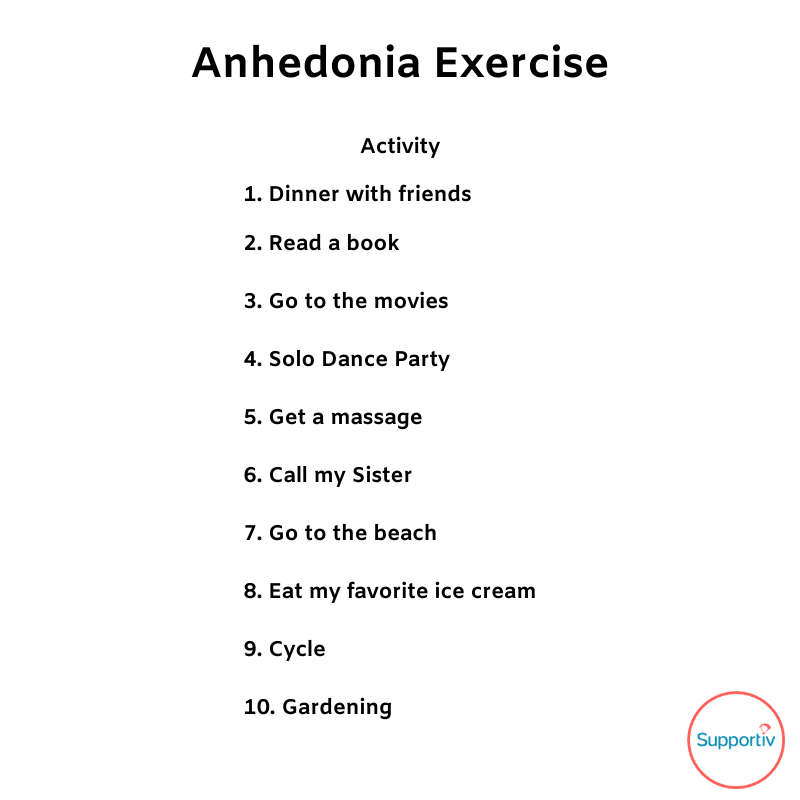
Step 2
Once you’ve got your list ready, think about how much excitement, happiness and pleasure each of these activities bring you and rate each one. On a scale of 1 to 10 (with 1 being “it completely sucks” and 10 being “this rocks my world”), write the level of enjoyment each activity brings you — as if they were all completely effortless. This is how I rated my activities:
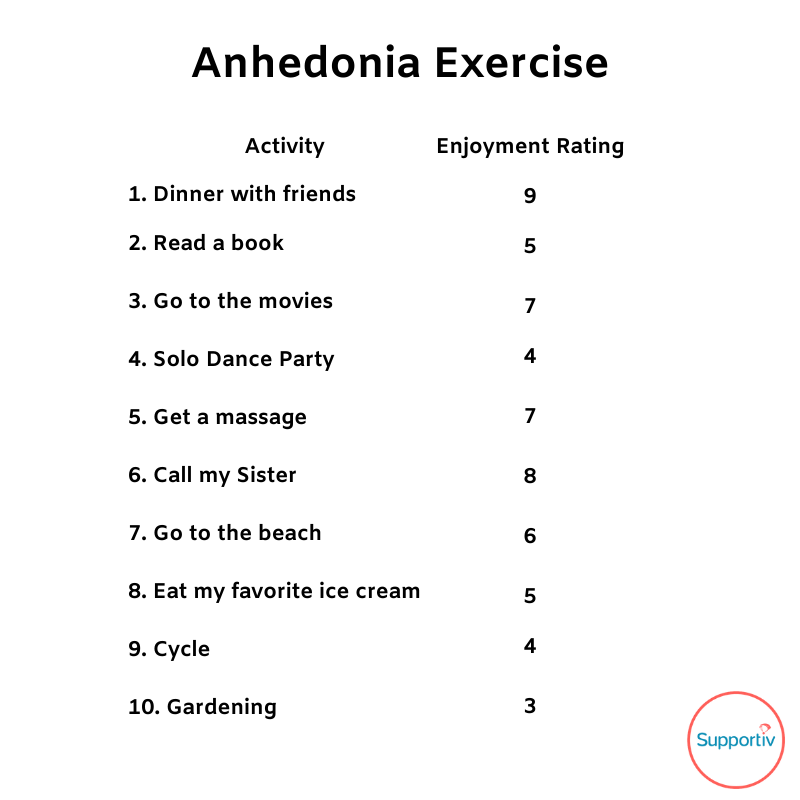
Step 3
Next, think about how difficult the activity is for you to do – like how much effort, time, planning goes into actually doing it. So again, from 1 to 10 (with 1 being pretty easy and 10 being “Hell NO”), rate each activity on your list.
See my list below. In contrast to how much pleasure these activities (used to) bring you, you can also see how difficult they are to do.
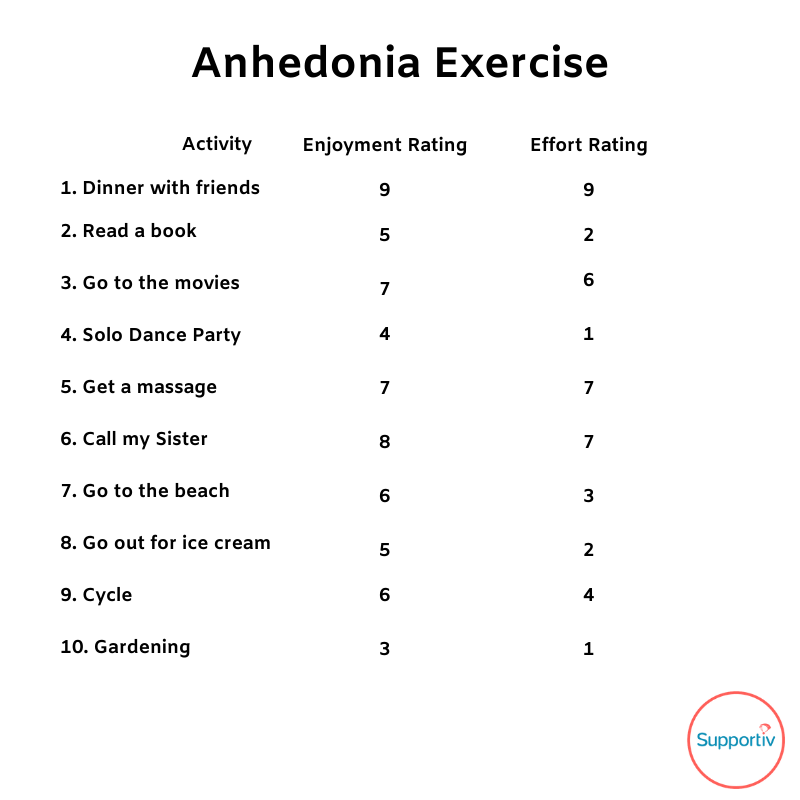
Step 4
Now comes the fun part – okay, maybe more introspection than fun. Last step! In this part of the exercise, you want to find the tradeoff between your enjoyment and the effort required to do each thing.
To do this, subtract (minus) the effort rating from the enjoyment rating. For example, on the activity of reading a book, my enjoyment rating is 5 and my effort rating is 2. Therefore, the value of my activity is 3 (5 – 2 = 3). Do this for each of your activities like below.
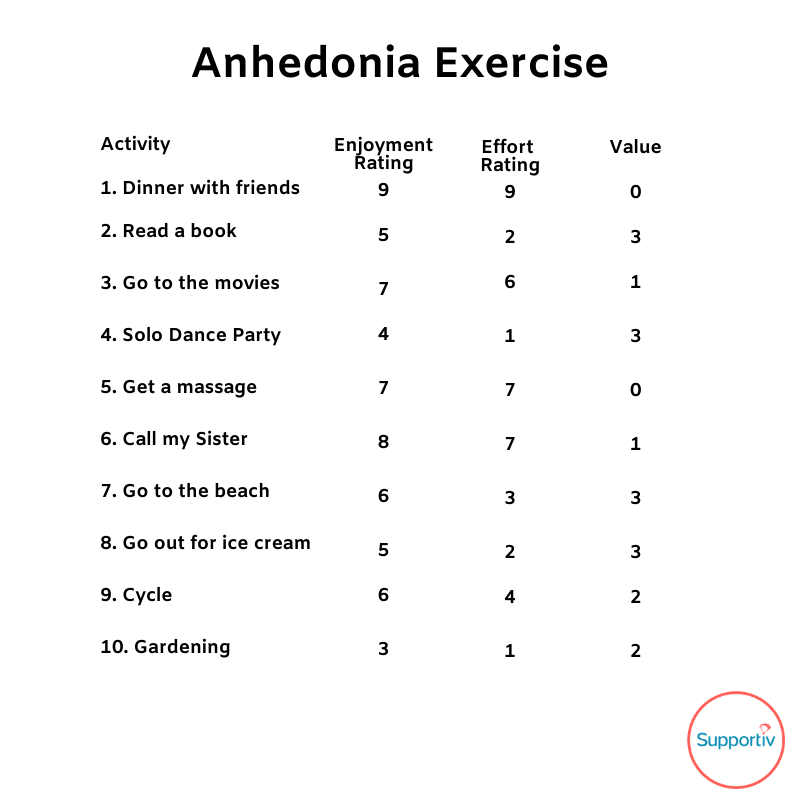
The Result
After you’ve found the tradeoff “value” for each activity, look at the activities with the highest value number. These will likely be the easiest for you to accomplish, while bringing you the most enjoyment.
Now the key is to act on these activities, even if you have to force yourself. Start planning to do your high value activities as soon as possible, because they have the best chance at bringing you some enjoyment.
Doing the easier and more pleasurable ones first may motivate you to keep going. This way, you can build your brain’s reward systems back up, until you start magically wanting to do things off the list!
But just saying you’re going to get it done doesn’t work! Turn your piece of paper around and write down the dates and times for you to try each thing you used to love. Hold yourself to these dates and try your best to just try doing them – even if you bail after 5 or 10 minutes, you tried!
Moral support available right here! Actually trying this stuff can be the hardest part of healing from anhedonia.
The purpose of this exercise is to kick anhedonia to the curb. So even if you don’t start enjoying things at first go – keep trying and be consistent.
Once you’re sort of enjoying the highest value activities, try to work on those lower value ones too. Don’t be too hard on yourself, and have patience. With some effort, you really can recover your ability to care about things!
If you need some moral support or motivation to tackle your anhedonia, we’re here 24/7 to chat.
The post Don’t Care About Anything? Enjoy Life Again, Through COVID-19 appeared first on Supportiv.
]]>